
Many professionals still rely on public playlist data, unaware that private data reveals emerging artists 4 to 6 weeks earlier and boosts decision accuracy by 35%. Traditional metrics reflect trends after the breakout window closes, leaving A&R teams competing for already discovered talent. This guide explains best practices in playlist analysis to gain predictive promotional insights, optimize marketing spend, and identify rising artists before competitors.
Table of Contents
- Understanding The Unique Value Of Private Playlist Data
- Key Metrics In Playlist Analysis: What To Track And Why
- Analyzing Genre Blending And Geographic Micro-Trends
- Common Misconceptions In Playlist Analysis
- Frameworks For Predictive Playlist Analytics In A&R Decision-Making
- Bridging Insights To Practical Artist Promotion Strategies
- Unlock Advanced Playlist Analytics With Music24 Solutions
Key Takeaways
| Point | Details |
|---|---|
| Early Detection Window | Private playlist data leads public charts by 4 to 6 weeks for early artist detection. |
| Predictive Metrics | Playlist addition velocity and curator centrality predict breakout potential accurately. |
| Micro-Trend Targeting | Genre blending and geographic micro-trends inform targeted marketing campaigns. |
| Decision Accuracy | Integrating private data improves A&R decision accuracy by up to 35%. |
| Promotional ROI | Early discovery can increase promotional ROI by 40%. |
Understanding the Unique Value of Private Playlist Data
Public streaming charts and social metrics show you what already happened. By the time an artist hits the top 50 on Spotify or gains viral traction on TikTok, you're competing with dozens of labels for their attention. Private playlist data captures listener discovery 4 to 6 weeks earlier than public streaming charts, giving you a predictive advantage.
Private playlists reveal authentic music discovery patterns invisible in public data. When listeners curate personal collections away from public view, they signal genuine preferences without social pressure or algorithmic influence. These early signals allow A&R teams and managers to act before competitors notice the trend. You gain access to micro-trends and niche listener behavior that public data misses entirely.
The authenticity factor matters for nuanced artist evaluation. Public playlist additions can reflect promotional budgets and playlist placement deals rather than organic listener interest. Private data strips away these distortions and shows you which tracks genuinely resonate. This clarity helps you separate fleeting hype from sustainable talent.
Key advantages of private playlist analysis include:
- Detection of emerging artists before they surface on public charts or viral platforms
- Visibility into niche genres and micro-trends that mainstream metrics overlook
- Authentic engagement signals free from promotional manipulation
- Geographic and demographic insights at granular city and neighborhood levels
- Early identification of genre blending patterns that predict crossover success
Understanding music discovery before public metrics become saturated transforms your competitive positioning. You shift from reactive scouting to predictive discovery, securing talent relationships and promotional strategies while others wait for confirmation.
Key Metrics in Playlist Analysis: What to Track and Why
Quantitative metrics turn playlist data into actionable predictions. Three measurements stand out for forecasting artist breakout potential: playlist addition velocity, skip rates, and curator network centrality. Each metric reveals different dimensions of listener engagement and viral trajectory.
Playlist addition velocity tracks how quickly a track accumulates new playlist adds across private collections. Sudden acceleration in additions often precedes streaming spikes by 2 to 4 weeks. When you spot a track jumping from 50 additions per day to 300, you're witnessing early momentum that public charts won't reflect until much later.
Skip rates reveal engagement quality that raw play counts hide. A track with high playlist additions but a 60% skip rate signals declining interest. Early detection of rising skip rates prevents wasted promotional spend on tracks losing momentum. Conversely, low skip rates below 15% combined with strong addition velocity indicate genuine listener satisfaction and viral potential.
Curator network centrality measures influence within the playlist ecosystem. Curator influence can be quantitatively measured by network centrality metrics, with top 5% of curators responsible for over 60% of viral playlist streams in niche genres. Identifying these influential curators and tracking their additions gives you early warning of breakout tracks.

Focusing on top curators captures disproportionate share of niche viral streams. When a high centrality curator adds a track, their network effect amplifies discovery across connected listeners. This cascading pattern creates the viral loops that drive breakout success. Understanding these metrics enables better predictive decisions across your artist roster.
Essential metrics to monitor include:
- Daily and weekly playlist addition velocity across private collections
- Skip rate trends showing engagement quality over time
- Curator influence scores based on network centrality analysis
- Geographic distribution patterns of playlist additions
- Cross-genre playlist placement indicating blending potential
Pro Tip: Set up automated alerts when addition velocity exceeds 200% week over week for any artist in your watchlist. This threshold catches early momentum before competitors notice, giving you first mover advantage in outreach and promotional planning.
Mastering private playlist analysis for music trends requires consistent tracking of these core metrics. You can spot rising artists using private playlist data weeks before traditional scouting methods surface them.
Analyzing Genre Blending and Geographic Micro-Trends
Genre boundaries blur faster than traditional categories can track. Artists blending genres have 30% higher odds of breakthrough success because they tap multiple listener bases simultaneously. Private playlist data reveals these cross-genre patterns before they reach mainstream recognition.
When a track appears across hip hop, electronic, and indie rock playlists simultaneously, you're witnessing genre fusion that public genre classifications miss. These blending signals indicate an artist creating something fresh that appeals beyond traditional boundaries. Early identification lets you position promotional campaigns across multiple verticals for maximum reach.
Geographic micro-trends reveal unique city level listener preferences and growth pockets. A track gaining traction in Austin private playlists might signal different promotional opportunities than one breaking in Atlanta. Localized playlist behavior informs targeted marketing, tour routing, and regional campaigns with precision impossible using national level data.
Tracking these patterns enables early identification of new audience segments. You might discover an emerging subgenre forming in Pacific Northwest private playlists, giving you months to scout talent and build relationships before the trend surfaces publicly. This geographic specificity transforms how you allocate promotional budgets and plan release strategies.
| Trend Type | Early Indicator | Promotional Application |
|---|---|---|
| Genre Blending | Cross-genre playlist adds | Multi-vertical campaign targeting |
| Geographic Hotspot | City-specific velocity spike | Regional tour routing and local media |
| Demographic Shift | Age/gender playlist pattern | Targeted social advertising |
| Temporal Pattern | Weekend vs weekday adds | Release timing optimization |
Key applications include:
- Identifying cities for tour stop prioritization based on private playlist density
- Tailoring social media campaigns to geographic micro-trends
- Discovering genre fusion opportunities for artist development and A&R
- Optimizing radio promotion budgets toward regions showing organic traction
Leveraging music discovery with geographic insights sharpens every promotional decision. Understanding the role of playlist data in 2025 means embracing these granular behavioral patterns as core competitive advantages.
Common Misconceptions in Playlist Analysis
Many professionals misunderstand playlist data limitations, leading to delayed artist discovery and wasted promotional spend. Correcting these misconceptions improves prediction accuracy and campaign timing.
First misconception: public playlist data provides sufficient early warning. Public playlist data lags private playlist data by 4 to 6 weeks, meaning you're always reacting rather than predicting. By the time an artist hits major public playlists, bidding wars and promotional costs have already escalated. Relying solely on public data delays discovery past the optimal signing and promotional window.
Second misconception: mass market playlist additions always indicate authentic engagement. Playlist placement deals and promotional campaigns can inflate public playlist numbers without genuine listener interest. Mass market playlist additions don't always reflect authentic fan engagement; niche curators drive true buzz through organic discovery and passionate advocacy. A track with 10,000 adds from paid placements may underperform one with 1,000 adds from influential niche curators.
Third misconception: play counts alone measure track success. Ignoring skip rates misses early warning signs of declining track popularity. A song might accumulate impressive play counts while listeners skip after 15 seconds, signaling fundamental engagement problems. Skip rate analysis reveals these issues weeks before streaming numbers decline.
Fourth misconception: all playlist curators hold equal influence. Curator network centrality varies dramatically, with top influencers driving exponentially more discovery than average users. Treating all playlist adds equally misses the weighted impact of high centrality curators who can trigger viral cascades.
Common errors to avoid:
- Waiting for public chart validation before pursuing emerging artists
- Ignoring skip rate trends when evaluating promotional campaign performance
- Treating all playlist additions as equal regardless of curator influence
- Overlooking geographic micro-trends in favor of national level data
- Relying on streaming counts without contextual engagement metrics
Pro Tip: Create a two-tier artist watchlist separating public chart performers from private playlist risers. Review your private playlist tier weekly for addition velocity spikes, and compare against your public tier to identify how early you're catching trends. This discipline builds predictive muscle and proves ROI from early discovery investments.
Avoiding private playlist data misconceptions separates effective A&R teams from those perpetually late to emerging talent. Recognizing playlist data misconceptions in 2025 positions you ahead of competitors still relying on outdated approaches.
Frameworks for Predictive Playlist Analytics in A&R Decision-Making
Structured frameworks transform playlist metrics into confident A&R decisions. Integrating private playlist data with streaming metrics boosts decision accuracy by up to 35%, but only when you combine signals systematically.
Effective frameworks combine three core elements: addition velocity tracking, curator influence scoring, and micro-trend analysis. Addition velocity provides momentum indicators, curator scoring weights signal quality, and micro-trend analysis reveals genre and geographic context. Together these elements create a multidimensional view of breakout potential.
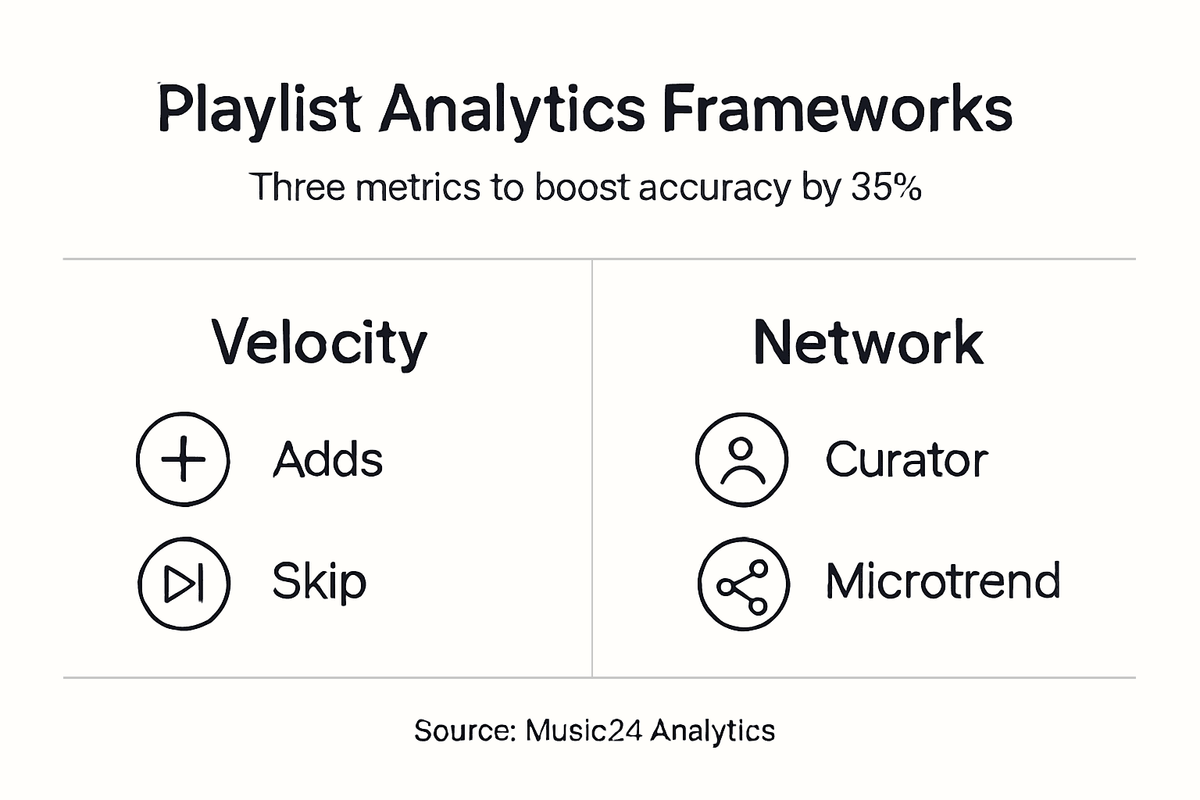
Data-driven approaches integrating private playlist insights with traditional streaming metrics improve A&R decision-making accuracy by up to 35%. This improvement stems from catching artists earlier and filtering false positives that traditional metrics miss. You reduce signing mistakes while accelerating discovery of genuine talent.
Comparison of traditional versus predictive frameworks highlights the advantages:
| Framework Element | Traditional Approach | Predictive Approach | Improvement |
|---|---|---|---|
| Artist Discovery Timing | Post public chart appearance | 4 to 6 weeks pre-chart | 35% earlier detection |
| Data Sources | Public streams and social | Private playlists plus public | 40% more signals |
| Curator Weighting | Equal treatment | Centrality-based influence | 60% better viral prediction |
| Geographic Insights | National aggregates | City-level micro-trends | 50% targeting precision |
Implementing these frameworks enables tailored promotional campaigns based on quantified insights rather than intuition. You can model expected streaming growth based on current addition velocity, estimate viral probability from curator influence scores, and project geographic expansion from micro-trend patterns.
Key framework components include:
- Automated addition velocity alerts triggering at 200% week over week growth
- Curator influence database ranking private playlist creators by centrality
- Geographic heat mapping showing city level playlist activity
- Genre blending indices measuring cross-category appeal
- Skip rate monitoring flagging engagement quality issues
Understanding predictive playlist analytics benefits requires systematic application across your artist pipeline. The artist discovery process with private playlist data becomes repeatable and scalable when frameworks structure your analysis. A clear private playlist analytics workflow ensures consistent application across your team.
Bridging Insights to Practical Artist Promotion Strategies
Playlist analysis insights only create value when translated into promotional action. Early artist discovery leads to up to 40% higher promotional ROI by securing relationships before competitive bidding and optimizing spend timing.
Adjusting campaigns based on skip rate data avoids wasted spend on declining tracks. When skip rates rise above 40%, pause promotional investment and reassess the track's viability. Conversely, tracks maintaining skip rates below 20% while showing strong addition velocity deserve accelerated promotional budgets to capitalize on momentum.
Leveraging geographic micro-trends targets promotions where they resonate most. If private playlist data shows a track gaining traction in Nashville and Austin but not Los Angeles or New York, concentrate initial radio promotion and tour stops in those Southern markets. This precision prevents diluted spend across markets showing weak organic interest.
Optimized strategies increase chances of breakout success and market impact. Timing album releases to coincide with addition velocity peaks, coordinating tour announcements with geographic hotspot emergence, and tailoring social campaigns to demographic playlist patterns all improve conversion rates and fan engagement.
Practical applications include:
- Allocating 60% of promotional budget to geographic hotspots identified in playlist data
- Pausing campaigns when skip rates exceed 40% for three consecutive days
- Accelerating social advertising spend when addition velocity exceeds 250% week over week
- Timing single releases to match playlist curator discovery cycles
- Structuring tour routing around cities showing strongest private playlist density
Applying music marketing analytics for artist discovery creates measurable improvements in campaign efficiency and artist development outcomes. You transform playlist insights from interesting data points into revenue driving promotional strategies.
Unlock Advanced Playlist Analytics with Music24 Solutions
Music24 offers cutting-edge analytics integrating private playlist data for early artist discovery. Our platform tracks addition velocity, curator influence, and geographic micro-trends in real time, giving you the 4 to 6 week predictive advantage discussed throughout this guide.
Our music marketing analytics platform provides user-friendly dashboards that surface breakout artists before they hit public charts. You can monitor key metrics like skip rates and curator centrality without building complex data infrastructure. Leverage geographic and genre micro-trends to optimize your promotions and campaign ROI with tools designed specifically for A&R professionals and artist managers.
Explore our music analytics tools and compare our capabilities against competitors through our music influencer analytics platforms review. Transform playlist insights into competitive advantages today.
FAQ
How soon can private playlist data reveal emerging artists compared to public data?
Private playlist data can reveal emerging artists 4 to 6 weeks before they appear on public charts. This lead time allows for earlier A&R action and promotional planning, securing talent relationships before competitive bidding escalates.
What are the most predictive metrics in playlist analysis for breakout potential?
Playlist addition velocity, skip rates, and curator network centrality are key predictive metrics. Together they indicate early listener engagement and viral potential, with curator influence particularly powerful for identifying tracks likely to cascade through niche communities.
How can geographic micro-trends inform music promotion strategies?
Geographic micro-trends highlight unique listener preferences in specific cities and regions. Marketers can tailor campaigns and optimize tour stops to those locations for better ROI, concentrating spend where organic traction already exists.
Why shouldn't I rely solely on public playlist data for artist discovery?
Public playlist data lags behind by 4 to 6 weeks and misses niche early trends. Private playlist data reveals authentic discovery patterns critical for early breakout identification, giving you predictive rather than reactive intelligence.
Recommended
- Playlist Analysis Strategies: Unlocking Early Artist Trends - Blog - Music24.com
- Playlist Data Interpretation Steps for Early Trend Detection - Blog - Music24.com
- 7 Playlist Analytics Examples to Boost Your Strategy - Blog - Music24.com
- Playlist Analysis Explained: Uncovering Music Discovery Trends - Blog - Music24.com

