
Every A&R executive knows that detecting the next global breakout depends on more than chart metrics. Playlist analysis uncovers complex listener interactions and cultural patterns inside digital music consumption. As user-generated, collaborative, and private playlists transform how audiences discover new sounds, analyzing these evolving playlists helps identify emerging artists earlier and fine-tune marketing decisions using exclusive behavioral insights.
Table of Contents
- Defining Playlist Analysis And Its Role
- Types Of Playlists And Data Insights
- How Private Playlist Analytics Work
- Detecting Trends, Influencer Impact, And Breakouts
- Risks, Limitations, And Ethical Responsibilities
Key Takeaways
| Point | Details |
|---|---|
| Playlist Analysis Uncovers Trends | This methodology reveals complex listener interactions, enabling early detection of emerging artists and trends. |
| Playlists as Cultural Artifacts | They reflect sophisticated listener behaviors and provide insights into musical preferences and audience dynamics. |
| Ethical Considerations in Analytics | Professionals must address algorithmic bias and data privacy to maintain fairness in music discovery. |
| Actionable Insights for A&R Executives | Focus on playlist evolution and contextual cues to enhance artist targeting and audience engagement strategies. |
Defining Playlist Analysis and Its Role
Playlist analysis represents a sophisticated data exploration methodology that uncovers intricate patterns within music consumption behaviors. At its core, this approach goes far beyond simple track counting, revealing complex listener interactions that illuminate emerging musical trends and audience preferences.
The discipline involves multiple strategic dimensions:
- Tracking listener behavior across digital platforms
- Identifying micro-genre crossover trends
- Understanding contextual music selection patterns
- Mapping listener demographic music preferences
For A&R executives, playlist analysis provides a critical early warning system for artist potential. By examining user-generated playlists, professionals can detect emerging artists before traditional metrics catch up, essentially creating a predictive intelligence platform for music discovery.
Contextual Discovery becomes the primary value proposition. Playlist analysis transforms raw listening data into actionable insights, revealing not just what people listen to, but how and why they curate specific musical experiences.
The methodology synthesizes multiple data points, including:
- Track sequence and placement
- Listener demographic information
- Playlist creation context
- Cross-genre mixing patterns
Playlists are more than music collections - they are cultural artifacts that reflect sophisticated listener behaviors and emerging musical preferences.
Pro tip: Develop a nuanced approach to playlist analysis by tracking not just popular tracks, but understanding the subtle contextual cues that drive listener selection.
Types of Playlists and Data Insights
Playlist analysis reveals a complex landscape of musical curation, where different playlist types significantly impact listener experiences. Understanding these variations is critical for A&R professionals seeking to decode emerging musical trends and listener preferences.
The primary playlist categories include:
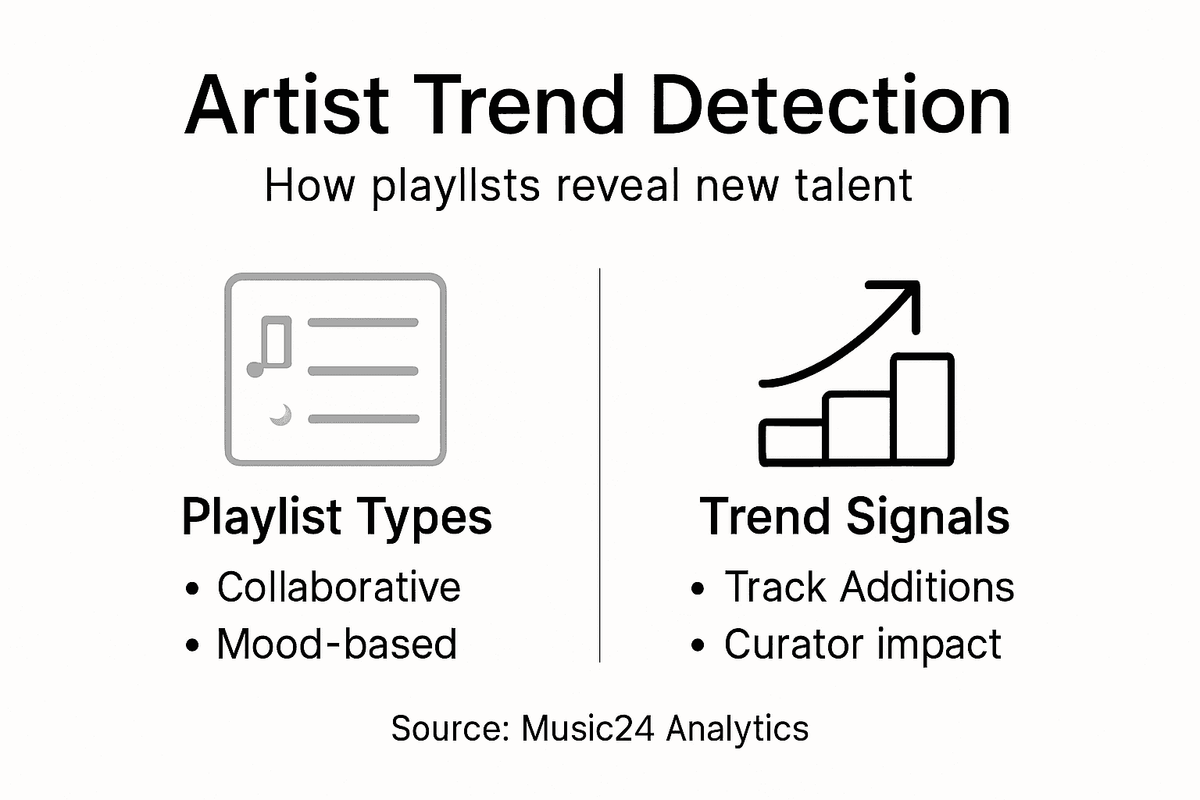
- User-Generated Playlists: Manually curated collections reflecting personal taste
- Algorithmic Playlists: Automatically generated based on listening history
- Collaborative Playlists: Created and edited by multiple users
- Mood/Context Playlists: Designed around specific emotional states or activities
Each playlist type offers unique insights into listener behavior. Collaborative playlists, for instance, provide a rich tapestry of collective musical preferences, revealing how different audiences intersect and influence each other's musical choices.

Here is a comparison of playlist types and the unique insights they provide for music analysis:
| Playlist Type | Listener Motivation | Data Insight Focus | Business Impact |
|---|---|---|---|
| User-Generated | Personal taste, identity | Taste clusters, discovery trends | Artist targeting, market segmentation |
| Algorithmic | Efficiency, familiarity | Predictive listening patterns | Automated recommendations, retention |
| Collaborative | Group consensus, sharing | Social influence mapping | Viral marketing, cross-demographics |
| Mood/Context | Emotion, activity-driven | Contextual consumption analysis | Event or theme-based campaigns |
The depth of playlist analysis extends beyond simple track listings. Professionals examine multiple dimensions:
- Track sequence and transition patterns
- Genre blending characteristics
- Temporal listening trends
- Demographic-specific musical preferences
Playlists are not merely collections of songs, but sophisticated cultural narratives that map listener psychology and musical discovery.
Pro tip: Focus on tracking playlist evolution over time, not just static snapshot data, to understand the dynamic nature of musical preferences.
How Private Playlist Analytics Work
Private playlist analytics represent a sophisticated approach to understanding musical consumption, leveraging intricate data extraction techniques that balance user privacy with deep behavioral insights. These advanced methodologies enable A&R professionals to decode complex listener interactions without compromising individual user data.
The core components of private playlist analytics include:
- Metadata Analysis: Extracting structural information about playlist composition
- Behavioral Tracking: Monitoring listening patterns and interaction signals
- Anonymized Aggregation: Collecting insights without identifying individual users
- Contextual Mapping: Understanding playlist creation motivations
Behavioral Signals provide critical intelligence about listener preferences. These signals encompass nuanced interactions such as track skips, repeat listens, playlist longevity, and cross-genre transitions that reveal deeper musical engagement patterns.
The analytical process involves multiple sophisticated dimensions:
- Anonymized data collection
- Pattern recognition algorithms
- Trend identification mechanisms
- Privacy-preserving insight generation
Private playlist analytics transform raw listening data into strategic intelligence, revealing the hidden narratives behind musical preferences.
Pro tip: Develop multi-dimensional analysis frameworks that look beyond surface-level metrics to understand the intricate psychological drivers of playlist creation.
Detecting Trends, Influencer Impact, and Breakouts
Detecting emerging musical trends requires a sophisticated approach that goes beyond traditional recommendation algorithms. A&R professionals must navigate complex social and technological landscapes to identify potential breakout artists before they become mainstream.
Key strategies for trend detection include:
- Influencer Network Mapping: Tracking playlist curators with significant audience reach
- Viral Signal Tracking: Monitoring rapid playlist additions and cross-platform mentions
- Micro-Genre Emergence: Identifying nascent musical subgenres and style transitions
- Collaborative Trend Analysis: Understanding collective musical taste movements
Influencer Impact represents a critical dimension of trend detection. Certain playlist curators can dramatically accelerate an artist's visibility, creating cascading discovery effects that transform underground musicians into mainstream sensations.
The most effective trend detection mechanisms involve multiple analytical dimensions:
This table summarizes essential analytical dimensions and their role in advanced playlist trend detection:
| Dimension | Description | Business Value |
|---|---|---|
| Social Media Sentiment | Tracks listener reactions online | Early trend identification |
| Playlist Propagation Velocity | Measures how fast playlists spread | Identifies potential breakout artists |
| Cross-Platform Engagement | Analyzes activity across apps | Informs promotion strategy |
| Quantitative Data Analysis | Examines usage metrics | Predicts high-performing tracks |
- Quantitative listening data analysis
- Social media sentiment tracking
- Cross-platform engagement metrics
- Playlist propagation velocity
Trend detection is less about predicting the future and more about understanding the complex social dynamics of musical discovery.
Pro tip: Develop a multi-source intelligence framework that combines algorithmic insights with human curation to capture the nuanced signals of emerging musical trends.
Risks, Limitations, and Ethical Responsibilities
Playlist analysis confronts significant ethical challenges, with critical concerns surrounding algorithmic transparency and fairness. A&R professionals must navigate a complex landscape that balances data insights with fundamental ethical considerations.
Key ethical risks in playlist analytics include:
- Algorithmic Bias: Unintentional discrimination against certain artists or genres
- Data Privacy: Protecting individual listener information
- Representation Challenges: Potential reinforcement of existing music industry power structures
- Cultural Homogenization: Risk of narrowing musical diversity
Transparency Mechanisms represent a critical counterpoint to potential algorithmic manipulation. Responsible playlist analysis requires proactive approaches that prioritize artist representation, listener autonomy, and systemic fairness.
The primary ethical limitations manifest across several critical dimensions:
- Potential suppression of emerging artists
- Unintended demographic exclusions
- Opacity in recommendation algorithms
- Potential economic marginalization
Ethical playlist analysis is not just about technological capability, but about maintaining the fundamental integrity of musical discovery and artistic expression.
Pro tip: Implement regular algorithmic audits and diverse representation checks to ensure your playlist analysis remains fair, transparent, and culturally inclusive.
Unlock Early Artist Trends with Cutting-Edge Playlist Analytics
The article highlights the challenge of detecting emerging musical trends and artist breakouts long before they appear on public charts. Traditional methods struggle with algorithmic biases, limited transparency, and lack of access to private listener behavior. You need deeper insights into micro-genre crossovers, influencer impacts, and the nuanced patterns in private playlists to stay ahead. Music24.com offers exactly this by analyzing millions of anonymized private playlists to uncover authentic music discovery patterns that others cannot see. Our platform lets A&R teams, managers, and marketers detect rising artists and trends early using powerful predictive analytics.
Discover how Music24 transforms complex playlist data into actionable intelligence through advanced behavioral tracking and social influence mapping. We provide detailed reports on genre blending, geographic micro-trends, and playlist creator influence. This means you gain a competitive edge by understanding not just what is popular now but what will be popular next. Stop relying on surface-level public metrics and embrace a more transparent and ethical playlist analysis approach.
Take the first step in revolutionizing your music discovery process with Music24.com now.
Ready to identify breakout artists before anyone else Learn more about our platform and sign up today to unlock early music trends with private playlist data analysis at Music24.com and experience a new era of music intelligence.
Frequently Asked Questions
What is playlist analysis and why is it important for music professionals?
Playlist analysis is a data exploration methodology that reveals intricate patterns in music consumption behavior. It helps music professionals, particularly A&R executives, identify emerging artists before they become mainstream, providing critical insights into listener interactions and preferences.
How do private playlist analytics maintain user privacy while providing insights?
Private playlist analytics utilize advanced data extraction methods that focus on anonymized data collection and behavioral tracking without identifying individual users. This approach allows for gathering deep insights about listening patterns while ensuring user privacy is protected.
What are the different types of playlists and their impacts on listener behavior?
There are several types of playlists: user-generated, algorithmic, collaborative, and mood/context playlists. Each type reflects different listener motivations and provides unique insights into audience preferences, influencing how music is marketed and promoted.
How can trend detection in playlist analysis be improved?
Trend detection can be enhanced by utilizing multi-source intelligence frameworks that combine algorithmic insights with human curation, tracking social media sentiment, monitoring playlist propagation velocity, and analyzing engagement across different platforms.
Recommended
- Playlist Trend Mapping: Early Breakout Artist Insights - Blog - Music24.com
- 7 Data-Driven Artist Discovery Tips for A&R Success - Blog - Music24.com
- Why Analyze Playlist Trends for Early Artist Discovery - Blog - Music24.com
- Music Trend Analysis Step by Step to Spot Breakout Artists - Blog - Music24.com

