
Bold claims can hide real opportunity. Genuine music discovery no longer depends solely on Billboard charts or Spotify algorithmic placements. For A&R executives and artist managers, understanding the value of private playlist analysis means uncovering the unfiltered listening preferences that reveal early signals and true fan behavior. By focusing on authentic user preferences instead of public metrics, you gain actionable insight into emerging artists before mainstream recognition takes hold.
Table of Contents
- Defining Private Playlist Analysis and Its Value
- How Playlist Data Reveals Hidden Trends
- Identifying Influential Curators and Emerging Artists
- Practical Uses for A&R and Labels
- Ethical and Legal Considerations in Data Use
Key Takeaways
| Point | Details |
|---|---|
| Emerging Trends | Private playlists reveal trends before they appear in public charts, enabling proactive decisions on artist signings and marketing. |
| Authentic Data | Analyzing private playlists offers insights into genuine listener preferences, helping to identify potential breakout artists early. |
| Curator Influence | Identifying influential curators allows labels to track significant shifts in taste and align their strategies with authentic audience behavior. |
| Ethical Considerations | Responsible data use, including anonymization and bias audits, is crucial to maintain trust and comply with regulatory standards in the industry. |
Defining Private Playlist Analysis and Its Value
Private playlist analysis examines the music collections users create for themselves—not the public-facing playlists they share. These personal collections reveal authentic listening behavior, uncensored preferences, and emerging taste patterns before they surface on Billboard or Spotify's official charts.
Unlike public streaming data, private playlists capture unfiltered musical choices. A curator might add an experimental indie track months before it trends. A listener might blend genres in ways that predict broader market shifts. This is where your competitive edge lives.
Why Private Playlists Matter More Than Public Data
Public metrics lie. Charted songs reflect algorithmic promotion, playlist placement, and marketing spend—not necessarily what listeners genuinely want. Private playlists? They show what people actually listen to when no one's watching.
Research on music preference patterns demonstrates that playlists capture authentic user preferences which reveal deeper insights about listener behavior and music taste. This data unlocks patterns invisible in public streaming.
Here's what separates private playlist analysis from conventional A&R work:
Here's a quick comparison between private playlist analysis and public streaming data focus:
| Aspect | Private Playlist Analysis | Public Streaming Data |
|---|---|---|
| Audience Insight | Reveals authentic preferences | Shows algorithm-driven choices |
| Trend Detection | Identifies early micro-trends | Tracks post-promotion trends |
| Curator Impact | Maps tastemaker influence | Focuses on mass listener data |
| Competitive Advantage | Provides early market signals | Signals arrive after broad exposure |
- Early detection: Spot emerging artists 3-6 months before mainstream acknowledgment
- Authentic signals: Track genuine fan behavior, not algorithmic amplification
- Genre trends: Identify unexpected genre blends and micro-trends by geography
- Curator influence: Find tastemakers shaping listener preferences in real-time
- Personality alignment: Connect artist positioning with listener demographics and traits
The Data Your Competitors Miss
While other labels watch the same public charts, private playlists reveal micro-trends before they scale. A manager discovers an emerging UK grime artist gaining traction in Norwegian indie listener collections. A label spots a Latin trap producer resonating with Southeast Asian audiences months ahead of streaming milestones.
Private playlist data reveals what listeners actually choose when algorithms aren't influencing their selection—this is your signal before the noise amplifies.
These signals compound. Ten thousand private playlists featuring an artist across multiple countries, multiple age groups, and across unexpected genre mixes? That's a breakout in formation.
Actionable Value for A&R Teams
Your role depends on identifying talent before it becomes obvious. Private playlist analysis shifts that from intuition to evidence.
You can now:
- Track emerging artists across geographic regions before regional charts reflect movement
- Validate artist viability through authentic listener behavior patterns
- Identify breakthrough potential by analyzing curator influence and listener crossover
- Time your artist signings and marketing pushes with early momentum indicators
- Develop targeted strategies based on where listeners actually place the music
This transforms A&R from reactive scouting to predictive identification.
Pro tip: Start by analyzing private playlists of listeners in your target demographic, not just your home market—emerging artists often gain traction in unexpected regions first.
How Playlist Data Reveals Hidden Trends
Playlist data acts as a behavioral mirror. It shows which songs listeners group together, how they organize music by mood or moment, and which artists they pair in personal collections. These patterns reveal emerging trends long before streaming charts acknowledge them.
When thousands of independent listeners add the same obscure artist to private playlists—often across different genres and geographies—that signals authentic discovery. The trend isn't manufactured by algorithms or marketing budgets. It's genuine listener behavior.

Decoding What Playlists Actually Reveal
Every private playlist tells a story about taste, timing, and influence. Longer, stable playlists with fewer edits reveal curators with intentional vision. Playlists that rapidly evolve show listeners responding to new discoveries in real-time.
Research on playlist coherence patterns demonstrates that structure and curation history directly impact playlist consistency. This reveals underlying listener preferences and behavioral patterns otherwise invisible to A&R teams relying solely on chart positions.
Here's what hidden playlist data shows you:
- Genre fusion points: Where unexpected musical styles intersect in personal collections
- Geographic micro-trends: Artists gaining traction in specific regions before national recognition
- Timing signals: When listeners add emerging artists, indicating adoption cycles
- Curator influence: Which tastemakers shape listener choices within their networks
- Cross-genre appeal: How emerging artists resonate across multiple listener demographics
The Trend Detection Timeline
Traditional A&R waits for chart confirmation. By then, competitors have already signed the artist. Private playlist analysis compresses your timeline.
An emerging drill artist gains momentum in London grime circles, then appears in Norwegian indie listener playlists, then Brazilian hip-hop collections. Each appearance is independent validation. Fifteen months later, the artist charts globally. You identified the trend eleven months before mainstream recognition.
Playlist trends reveal listener behavior before algorithms amplify it—this is your window to move first.
The data compounds across regions, genres, and listener types. What starts as a whisper in private playlists becomes undeniable signal.
Translating Data Into Action
This isn't theoretical. Private playlist signals guide concrete decisions:
- Sign emerging artists before competitive bidding intensifies
- Develop artist positioning aligned with where listeners actually place the music
- Time release strategies around authentic momentum, not arbitrary dates
- Identify collaboration opportunities by analyzing artist adjacencies in private playlists
- Validate A&R instinct with behavioral data from thousands of independent listeners
You move from "I think this artist will break" to "Fifty thousand listeners across twelve countries already placed them here."
Pro tip: Track when emerging artists first appear in private playlists across multiple regions, then monitor frequency growth over 8-12 weeks—consistent growth across geographies signals breakout potential before any chart movement.
Identifying Influential Curators and Emerging Artists
Not all listeners carry equal weight. Some people shape taste for thousands. When they add an artist to a private playlist, ripples follow. Identifying these influential curators and the emerging artists gaining traction in their collections is where competitive advantage lives.

Private playlist data reveals curator networks and influence patterns invisible in public metrics. A curator with genuine influence doesn't need massive follower counts. Their taste guides smaller circles with outsized impact.
Who Are Influential Curators?
Influential curators aren't necessarily famous. They're listeners whose musical taste influences others within their networks. They discover first, curate intentionally, and others follow their lead.
These curators typically share specific characteristics:
- Early adopters: Add emerging artists months before mainstream recognition
- Consistent vision: Maintain coherent curation across multiple playlists
- Cross-network reach: Influence listeners across geographic regions and demographics
- Genre boundary-pushers: Blend unexpected musical styles in compelling ways
- Stable followings: Have listeners who consistently reference their playlist choices
Spotting Emerging Artists Through Curator Behavior
Emerging artists appear first in curator playlists. When the same unknown artist shows up across multiple curator collections within a defined geography or genre, that's your signal.
The pattern looks like this: A curator in Stockholm adds an emerging Jakarta hip-hop producer. Two weeks later, curators in Bangkok, Manila, and Singapore add the same artist. Three months after, the artist charts in Southeast Asia. You caught the trend before any chart movement.
Curators signal emerging talent before algorithms amplify it—track curator behavior to identify breakout artists in formation.
This requires looking beyond individual playlists. You're analyzing curator networks, adoption timing, and geographic spread simultaneously.
Your Identification Framework
Use this structure to identify both curators and emerging artists worth tracking:
- Map curators whose taste preferences align with your label's artist roster
- Monitor when these curators first add unfamiliar artists to their collections
- Track if other influential curators add the same artist independently
- Analyze geographic spread—is adoption limited to one region or expanding?
- Assess artist adjacency—which established artists share playlists with the emerging talent?
- Validate with engagement patterns—are listeners repeatedly returning to these artists?
This transforms A&R discovery from gut feeling to data-driven curator mapping.
Why Curators Matter More Than Follower Count
A curator with two thousand followers carries more weight than an influencer with two million if those two thousand listeners consistently act on the curator's taste. Impact concentrates in trusted networks, not broadcast scale.
Influential curators in emerging artist discovery represent authentic validators. When they add an artist, they're making a statement about quality. Other listeners notice.
Your job is identifying which curators matter in your genre, tracking their behavior, and moving fast when they signal emerging talent.
Pro tip: Build relationships with curators directly—when you identify influential tastemakers adding emerging artists you're considering signing, reach out with artist context and collaborate on playlist placement for mutual credibility.
Practical Uses for A&R and Labels
Private playlist analysis moves beyond theory into concrete business decisions. Labels and A&R teams use this data to identify artists, validate investment, time releases, and build targeted strategies. The data answers questions that gut feeling cannot.
When you have evidence that thousands of listeners across multiple regions are already placing an artist in their personal collections, you make different decisions. You move faster. You negotiate differently. You market more strategically.
Artist Identification and Validation
Finding emerging talent is the core function. Private playlist data shows you which artists are gaining authentic traction before competitors notice.
Traditional A&R scouts playlists manually. You listen to thousands of artists hoping to catch the next big name. Private playlist analysis inverts this workflow. The data tells you which artists listeners are already discovering organically.
You validate investment decisions with behavioral evidence. An artist showing consistent growth across twenty thousand private playlists in three months? That's validation that justifies contract negotiations.
Here's how this translates to action:
- Pre-signing validation: Confirm an artist's authentic appeal before significant investment
- Geographic targeting: Identify which regions show strongest adoption signals
- Competitive positioning: Understand where an artist fits relative to established acts
- Trend alignment: Verify the artist resonates with emerging listener preferences
- Risk assessment: Validate that growth signals are sustained, not temporary spikes
Release Strategy and Timing
Album release dates aren't arbitrary. Private playlist data shows optimal timing windows based on listener adoption curves and seasonal patterns.
When playlist-driven recommendation systems shape music consumption, understanding playlist behavior becomes critical for A&R strategy. You can time releases to align with natural momentum peaks.
An emerging artist gaining traction across Southeast Asian playlists? Release regionally before global expansion. An artist building cross-genre appeal? Release during a natural adoption surge rather than fighting algorithm indifference.
Marketing and Promotion Efficiency
Marketing budgets concentrate where evidence exists. Private playlist data reveals which curators and listener segments matter most.
Instead of broad playlist pitching, you target specific curators whose followers align with your artist's sound. You develop regional strategies based on where adoption signals are strongest. You collaborate with influencers who have already validated similar artists.
This reduces waste and increases conversion rates significantly.
Catalog Development
Labels use private playlist data to identify catalog gaps and artist roster opportunities. If certain genres or subgenres show explosive private playlist growth but limited artist representation, that's your development signal.
You spot where listener demand exists before public metrics reflect it.
Private playlist data guides A&R strategy from artist selection through release timing and promotion—this is operational intelligence, not just analytics.
Pro tip: Cross-reference emerging artists gaining private playlist traction with your label's existing roster—identify collaboration opportunities and complementary artist pairings before competitors recognize the connection.
Ethical and Legal Considerations in Data Use
Data power comes with responsibility. Private playlist analysis reveals listener behavior at scale, which creates obligations around privacy, fairness, and transparency. Ignoring these considerations exposes your label to legal risk and damages industry credibility.
The music industry increasingly faces scrutiny over how data influences artist discovery and promotion. Understanding where ethical boundaries exist protects your operations and builds trust with artists, listeners, and regulatory bodies.
Privacy and Data Anonymization
Private playlist data must remain private. Anonymization isn't optional compliance—it's foundational to responsible analysis.
When platforms aggregate playlist data, they strip identifying information. You analyze patterns, not individuals. A label cannot determine which specific listener added an artist to their collection. You see aggregate behavior across thousands of listeners.
This distinction matters legally and ethically. Music data privacy fundamentals protect listener rights while enabling legitimate business intelligence. Proper anonymization allows you to extract insights without violating user privacy.
Key privacy protections include:
Below is a summary of ethical requirements for private playlist data usage:
| Ethical Requirement | Description | Why It Matters |
|---|---|---|
| Anonymization | Remove all personal identifiers | Ensures listener privacy |
| Aggregate Reporting | Show only collective patterns | Prevents exposure of individual data |
| Bias Audits | Check for demographic bias | Promotes fair artist discovery |
| Transparency | Inform users of data use | Builds industry trust |
- User anonymization: No ability to identify individual listeners or their personal data
- Aggregate analysis only: Insights derived from collective patterns, not individual behavior
- Data minimization: Collecting only information necessary for analysis
- Retention limits: Removing data after analysis windows close
- Access controls: Restricting who within your organization can view playlist data
Algorithmic Fairness and Bias
Playlist data reflects existing biases. If emerging artists from minority genres show lower playlist adoption simply due to existing listener demographics, your analysis must account for this structural inequality.
Algorithmic bias in music recommendation systems can reinforce industry inequities rather than correct them. Labels have responsibility to avoid using data in ways that perpetuate historical disadvantages.
This means:
- Auditing your analysis for demographic bias patterns
- Intentionally identifying underrepresented genres and artists
- Avoiding over-reliance on playlist data for certain artist categories
- Balancing data signals with deliberate diversity initiatives
- Monitoring whether your decisions reinforce or reduce existing industry imbalances
Transparency and Consent
Users contributing to private playlists deserve to know their data supports music discovery analytics. Transparency builds industry trust and supports regulatory compliance.
Streaming platforms must communicate how listener data supports industry functions. Artists deserve understanding of how their visibility connects to playlist analytics. Transparency doesn't require revealing proprietary methods—it requires honesty about data use.
Ethical data use protects both listeners and the industry—compliance and responsibility reinforce each other.
Copyright and Licensing
Playlist data analysis doesn't grant rights to the music itself. Analyzing which artists appear in playlists is separate from licensing rights for promotion or distribution.
Your label must maintain proper licensing agreements when using insights to promote artists or develop marketing strategies. Private playlist analysis informs decisions; it doesn't override existing copyright frameworks.
Pro tip: Document your data anonymization process and bias audit procedures—regulatory oversight of music data use is increasing, and clear documentation protects your label during compliance reviews.
Gain a Competitive Edge with Private Playlist Insights
The challenge in today's music industry is clear Artists and A&R teams struggle to identify breakthrough talent before they appear on mainstream public charts. The pain lies in relying on surface-level streaming data influenced by algorithms while missing the authentic listener behavior hidden in private playlists. Concepts like early detection, curator influence, and geographic micro-trends offer powerful tools but require specialized analytics to unlock their value.
At Music24.com, we solve this problem by offering a dedicated platform that analyzes millions of anonymized private playlists revealing genuine music discovery patterns unavailable through conventional means. Our platform enables you to spot emerging artists months ahead, understand curator networks shaping trends, and tailor your strategies based on real listener engagement rather than paid promotion or fleeting social metrics. Discover how you can transform your A&R and marketing decisions with actionable insights from private playlist data.
Ready to move beyond guesswork and act on predictive analytics that put you first in the market Explore Music24.com today and harness the power of authentic music discovery with our cutting-edge tools.
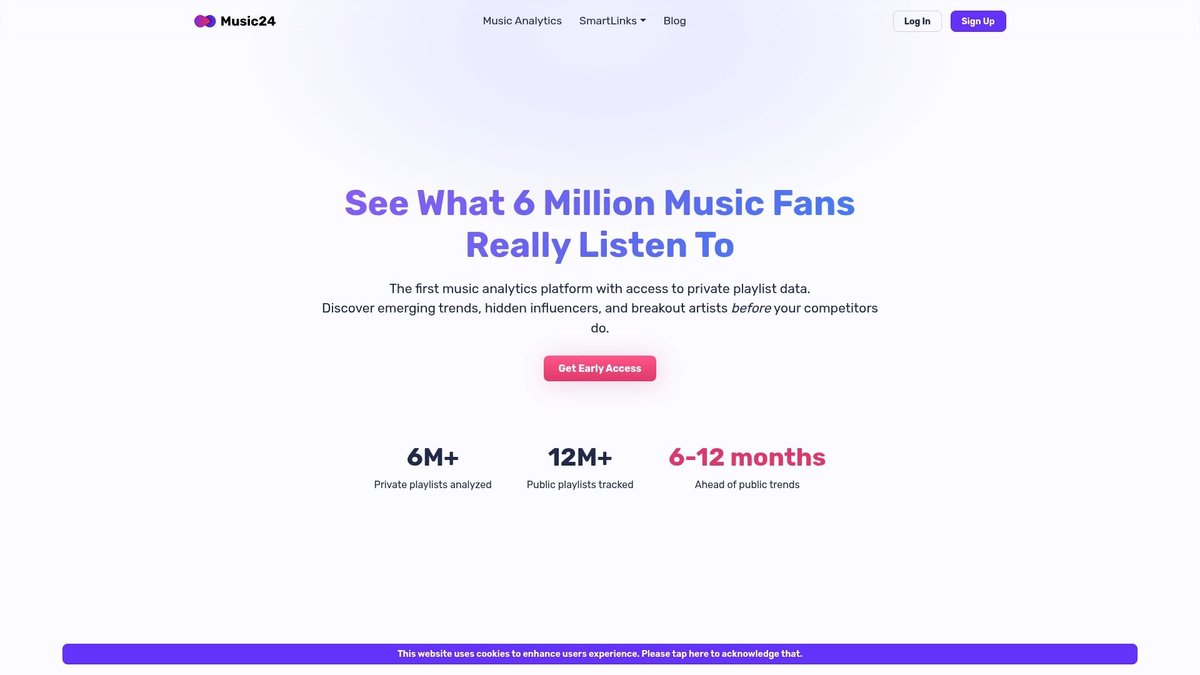
Unlock early artist trends and curator signals with Music24.com Take control of your music discovery strategy and sign up now to gain the advantage your competition cannot match.
Frequently Asked Questions
What is private playlist analysis?
Private playlist analysis involves examining the music collections that users create for themselves, revealing their true listening behaviors and preferences that aren't influenced by algorithms or marketing promotions.
Why are private playlists important for music discovery?
Private playlists provide insights into genuine listener behavior, allowing you to identify emerging trends, authentic preferences, and potential breakout artists before they gain mainstream recognition.
How can A&R teams benefit from analyzing private playlists?
A&R teams can use private playlist analysis to accurately track emerging artists, validate their appeal through listener behaviors, and time marketing efforts around authentic momentum rather than relying solely on chart data.
What ethical considerations should be taken into account when using private playlist data?
When using private playlist data, it's essential to ensure user privacy through anonymization, avoid demographic biases, maintain transparency about data usage, and uphold copyright and licensing agreements.
Recommended
- Private Playlist Insights: Accelerating Music Discovery - Blog - Music24.com
- Private Playlist Analysis Guide: Complete Overview - Blog - Music24.com
- Private Playlist Analytics: Transforming A&R Discovery - Blog - Music24.com
- Private Playlist Monitoring Workflow: Unlocking Early Music Trends - Blog - Music24.com

