
Bold moves in music happen when data goes deeper than surface-level trends. For American music executives and A&R teams, private playlist analytics are reshaping artist discovery and marketing precision. More than 80 percent of streaming decisions begin with personal curation, giving companies access to authentic listener patterns that drive real growth. This approach uncovers untapped talent and helps design smarter, data-informed campaigns that stand out in a crowded marketplace.
Table of Contents
- Defining Music Marketing Analytics Today
- Types of Data: Public vs. Private Playlists
- Key Processes and Features for A&R Teams
- Real-World Applications in Artist Discovery
- Limitations, Misconceptions, and Common Pitfalls
Key Takeaways
| Point | Details |
|---|---|
| Importance of Music Marketing Analytics | Music marketing analytics enables data-driven decision-making, allowing music professionals to leverage complex datasets to understand audience behavior and market trends. |
| Public vs. Private Data | Understanding the differences between public and private playlists is critical; public data provides surface-level insights, while private data reveals deeper listener preferences and trends. |
| Role of A&R Teams | Modern A&R teams utilize analytics for talent discovery, combining data insights with artistic evaluation to identify promising artists and trends. |
| Data Limitations | While analytics offer valuable insights, professionals must critically assess data limitations and avoid over-reliance on quantitative metrics, ensuring creativity remains a key component of the decision-making process. |
Defining Music Marketing Analytics Today
Music marketing analytics represents a sophisticated digital strategy that transforms raw data into actionable insights for music industry professionals. By leveraging complex datasets and advanced computational techniques, music enterprises are shifting from intuition-based approaches to technology-driven decision making.
At its core, music marketing analytics involves collecting and analyzing multidimensional datasets spanning streaming performance, audience behavior, engagement metrics, and listener preferences. These comprehensive data processing techniques enable music companies to decode intricate patterns of music consumption, predict emerging trends, and develop targeted marketing strategies.
The primary components of music marketing analytics include:
- Streaming performance tracking
- Audience demographic analysis
- Listener behavior mapping
- Engagement metric evaluation
- Predictive trend forecasting
Modern music marketing analytics goes beyond traditional metrics by integrating advanced machine learning algorithms that can identify subtle shifts in listener preferences, detect emerging artist potential, and provide strategic recommendations for music promotion and audience development.
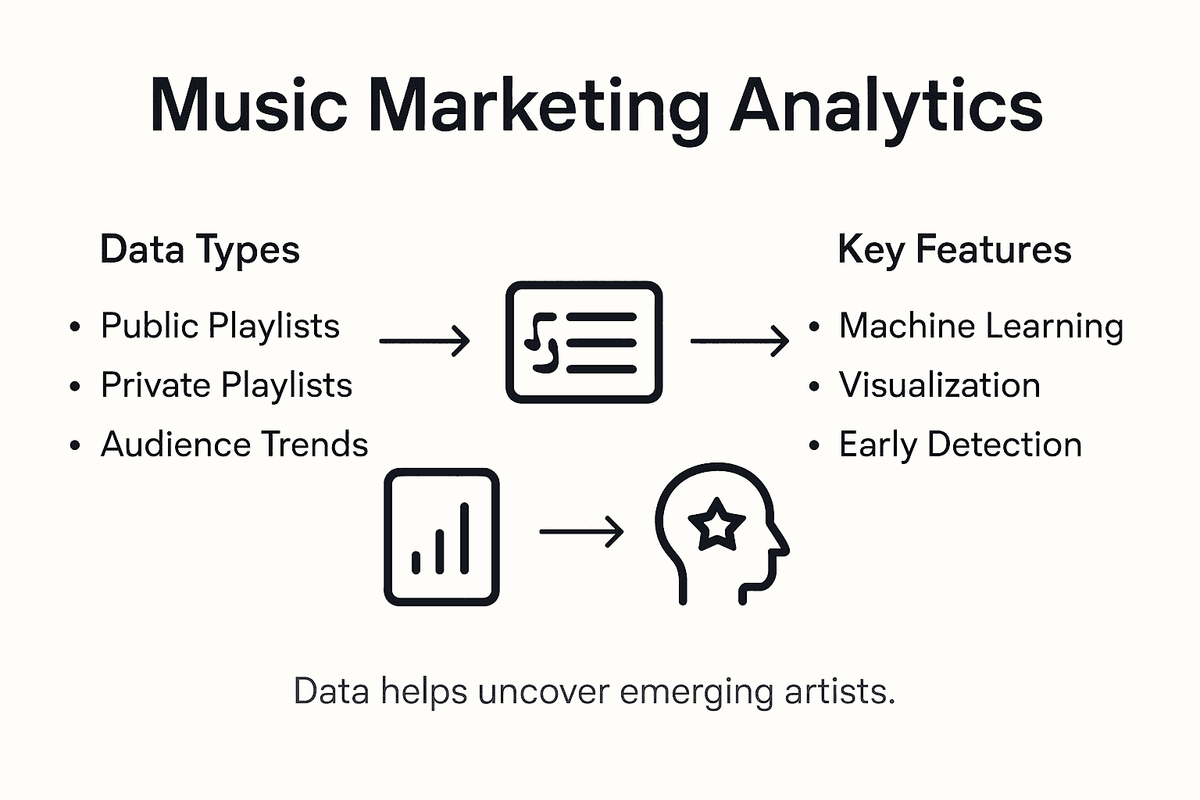
Pro tip: Invest in robust data visualization tools that can help translate complex analytics into easy-to-understand visual representations for quick strategic decision making.
Types of Data: Public vs. Private Playlists
Music data analytics fundamentally relies on two distinct categories of information: public and private datasets. Music industry data encompasses diverse metadata types classified broadly into public and restricted information categories, each serving unique strategic purposes for music professionals.

Public playlists represent openly accessible data collections typically found on streaming platforms like Spotify or Apple Music. These playlists are curated and shared publicly, offering transparent insights into listener preferences, trending tracks, and genre-specific recommendations. They provide valuable but surface-level information that most music industry professionals can easily access.
By contrast, private playlists represent a more nuanced and potentially groundbreaking data source. Private playlist tracking enables music enterprises to uncover deeper listener behavior patterns that are not immediately visible through public channels. These personal, often hidden collections reveal more authentic listener preferences, underground music trends, and emerging artist discoveries before they become mainstream.
Key differences between public and private playlist data include:
Here's a quick comparison of how public and private playlist data can impact music marketing strategies:
| Aspect | Public Playlist Data | Private Playlist Data |
|---|---|---|
| Accessibility | Open to all users | Limited to playlist owner or algorithm |
| Strategic Value | Helps assess mainstream trends | Predicts niche or emerging movements |
| Use in Artist Discovery | Identifies popular artists | Reveals undiscovered talent |
| Personalization Level | General listener groups | Highly individual preferences |
- Visibility: Public playlists are visible to everyone; private playlists remain hidden
- Authenticity: Private playlists reflect more genuine listener preferences
- Trend Detection: Private playlists can signal emerging music trends earlier
- Depth of Insight: Private playlists offer more granular, personalized data
Pro tip: Develop sophisticated data collection methodologies that respect user privacy while extracting meaningful insights from anonymized private playlist information.
Key Processes and Features for A&R Teams
Artist and Repertoire (A&R) teams have dramatically transformed in the digital era, evolving from traditional talent scouting to sophisticated data-driven discovery platforms. Modern A&R roles now combine talent identification with advanced analytics, analyzing streaming data, social media metrics, playlist placements, and market trends to discover and evaluate potential artists.
The core processes for contemporary A&R teams involve multiple interconnected strategies that leverage technology and data insights. These include comprehensive talent mapping, predictive trend analysis, audience sentiment tracking, and strategic artist development. By integrating machine learning algorithms and advanced analytics, A&R professionals can now predict an artist's potential market impact with unprecedented accuracy.
Key features that distinguish modern A&R teams include:
Below is a summary of key digital processes that modern A&R teams use to discover new talent:
| Process | Technology Applied | Business Benefit |
|---|---|---|
| Real-time trend analysis | Machine learning algorithms | Early talent identification |
| Social data mapping | Big data integration | Targeted artist development |
| Engagement monitoring | Automated analytics tools | Enhanced market prediction |
| Portfolio management | Cloud platforms | Streamlined evaluation workflow |
- Advanced data aggregation technologies
- Predictive performance modeling
- Cross-platform audience engagement tracking
- Real-time trend detection algorithms
- Comprehensive artist portfolio management
- Automated talent discovery workflows
Emerging artist detection strategies now require a holistic approach that combines quantitative metrics with qualitative assessment. Successful A&R teams understand that raw data must be contextualized with creative intuition, ensuring that numerical insights do not overshadow artistic potential.
Pro tip: Develop a balanced scorecard approach that weights both data-driven metrics and creative potential when evaluating emerging musical talent.
Real-World Applications in Artist Discovery
Music industry professionals are increasingly leveraging advanced data analytics to transform artist discovery from an intuitive process to a precise, strategic approach. Big data analytics is revolutionizing talent identification by meticulously analyzing streaming patterns, social media engagement, and sales data to predict potential breakout artists.
Contemporary music analytics platforms enable unprecedented insights by integrating complex data streams from multiple sources. These sophisticated systems can track an artist's trajectory by monitoring micro-trends in playlist additions, engagement rates, geographic listener distribution, and cross-platform performance metrics. By synthesizing these diverse data points, music industry professionals can now identify emerging talent with remarkable accuracy.
The practical applications of music marketing analytics in artist discovery are expansive:
- Predictive talent scoring
- Geographic market potential assessment
- Audience demographic mapping
- Genre crossover potential analysis
- Early virality detection
- Targeted marketing strategy development
Music discovery strategies now require a nuanced approach that balances quantitative metrics with qualitative artistic assessment. The most successful music industry professionals understand that data serves as a powerful tool for discovery, not a definitive selector of artistic potential.
Pro tip: Develop a multidimensional scoring system that weights algorithmic insights against creative originality when evaluating emerging musical talent.
Limitations, Misconceptions, and Common Pitfalls
Music marketing analytics offers powerful insights, but professionals must navigate its inherent limitations with critical awareness. Many music industry professionals fall into common marketing traps by launching campaigns without clear planning or structured strategies, which can significantly undermine their analytical efforts.
Numerous misconceptions plague music marketing analytics, creating unrealistic expectations and potentially misguiding strategic decisions. Artists and marketers often believe that good music alone guarantees success, or that social media presence is sufficient for comprehensive marketing. These dangerous assumptions can lead to ineffective resource allocation and missed opportunities.
Key limitations and misconceptions in music marketing analytics include:
- Over-reliance on quantitative metrics
- Neglecting qualitative artistic assessment
- Assuming data tells the complete story
- Misinterpreting correlation as causation
- Ignoring regional and cultural nuances
- Treating algorithms as infallible predictors
Successful music marketing professionals understand that data is a tool, not a definitive oracle. Effective strategy requires balancing technological insights with human creativity, intuition, and deep musical understanding.
Pro tip: Always maintain a critical perspective on analytics, treating data as guidance rather than gospel, and preserve space for artistic intuition and human judgment.
Unlock Early Artist Discovery with Advanced Music Marketing Analytics
The article highlights the challenge of relying solely on public playlist data which often misses hidden listener preferences and emerging trends. Music professionals seek authentic insights from private playlists to identify breakout artists before they become mainstream. They face pain points such as the need for predictive analytics, understanding geographic micro-trends, and gaining a competitive edge beyond superficial social media metrics.
At Music24.com, we address these challenges by offering exclusive access to anonymized private playlists, enabling you to detect real music discovery patterns that public data cannot reveal. Our platform empowers A&R teams, artist managers, and marketers with deep analytics on genre blending, influential curators, and early artist signals. This means you can move from intuition to strategic data-driven decisions and unlock new opportunities in artist development and marketing.
Discover why leading music professionals trust Music24.com to transform their artist discovery and marketing processes.
Explore our innovative approach today and gain the advantage in uncovering tomorrow's biggest stars.
[Image:cta_image]
Ready to revolutionize your music marketing strategy and spot emerging talent early Visit Music24.com now to start leveraging the power of private playlist analytics.
Frequently Asked Questions
What is music marketing analytics?
Music marketing analytics involves collecting and analyzing data related to streaming performance, audience behavior, engagement metrics, and listener preferences to develop effective marketing strategies in the music industry.
How do public playlists differ from private playlists in music analytics?
Public playlists are openly accessible and provide surface-level insights into listener trends, while private playlists offer deeper insights into authentic listener preferences and emerging music trends that are not visible through public channels.
What key processes do A&R teams use to discover new talent in the digital era?
Modern A&R teams use processes like real-time trend analysis, social data mapping, engagement monitoring, and portfolio management, all supported by advanced analytics and machine learning to identify and evaluate potential artists.
What are common pitfalls in music marketing analytics?
Common pitfalls include over-reliance on quantitative metrics, neglecting qualitative assessments, misinterpreting data correlation, and assuming that good music alone guarantees success, which can lead to ineffective marketing strategies.

