
Finding the next breakout star often feels like searching for a spark before it lights up the sky. For A&R teams at global record labels, relying on public metrics can mean chasing trends instead of starting them. Exploring private playlist analytics provides a window into authentic listener discovery, giving your label the chance to spot emerging talent ahead of mainstream charts and transform how you approach artist scouting.
Table of Contents
- Step 1: Set Up Music24 for Private Playlist Analytics
- Step 2: Define Target Criteria for Breakout Artists
- Step 3: Analyze Discovery Patterns in Private Playlists
- Step 4: Identify Influential Playlist Curators and Micro-Trends
- Step 5: Validate Emerging Artists With Predictive Metrics
- Step 6: Implement Insights Into A&R Strategies
Quick Summary
| Key Point | Explanation |
|---|---|
| 1. Set Up Music24 Effectively | Create an account and configure preferences to gain insights into private playlist data tailored to your label's needs. |
| 2. Define Clear Breakout Criteria | Establish specific metrics to efficiently identify which emerging artists hold real potential for success. |
| 3. Analyze Discovery Patterns | Use data to track consistent placements in private playlists, indicating authentic audience interest and organic growth. |
| 4. Monitor Influential Curators | Identify curators with significant influence to anticipate artist success early and adapt your strategy accordingly. |
| 5. Validate Artists with Predictive Metrics | Use retention rates and demographic data to ensure the artists you pursue show real long-term engagement potential. |
Step 1: Set Up Music24 for Private Playlist Analytics
Setting up Music24 gives you immediate access to private playlist data that public metrics simply cannot capture. You'll unlock insights into how real listeners are discovering music before those trends appear on charts. This foundation positions your A&R team to identify emerging artists with a significant competitive advantage.
Start by creating your Music24 account with your label credentials. The registration process takes about five minutes. You'll connect your existing music industry email, verify your account through a confirmation link, and establish your initial login credentials. This verification step ensures that only authorized A&R professionals access the platform's proprietary data.
Once logged in, navigate to the Dashboard settings panel. Here you'll configure your geographic regions and preferred genres that align with your label's artist roster. When analyzing listener behavior with private playlist data, your setup choices directly impact which emerging artists appear in your discovery results. Select multiple regions if your label operates internationally. Add genre preferences based on where you actively scout talent, whether that's indie rock, hip hop, electronic, or any combination that matches your A&R strategy.
Next, link your streaming accounts and music distribution data if applicable. Music24 can cross-reference private playlist placements with your internal artist catalog. This integration allows the platform to show you exactly how your current roster performs within private collections compared to public metrics. The sync typically completes within 30 minutes.
Finally, set up your notification preferences. You can configure alerts for specific artists, emerging trends in your target regions, or playlist creator activity. Most A&R teams configure these to trigger daily digest emails rather than real-time notifications, keeping your inbox manageable while staying informed about significant discovery patterns.
Pro tip: Start by monitoring a small set of established artists you already represent to understand how private playlist data differs from your familiar streaming numbers, then expand to broader discovery searches once you've calibrated your expectations around the metrics.
Step 2: Define Target Criteria for Breakout Artists
Defining your target criteria transforms private playlist data from interesting information into actionable intelligence. You need specific markers that tell you when an artist has genuine breakout potential rather than just momentary playlist placements. This step determines which emerging talents your A&R team actively pursues.
Start by examining the playlist creators discovering your target artists. Look at their follower counts, the diversity of their playlist subscribers, and how consistently they add new music. Artists appearing in playlists managed by curators with substantial engaged audiences show stronger breakout indicators than those in smaller, inactive collections. Private playlist data reveals curator influence patterns that streaming platforms never expose publicly.
Next, establish geographic growth thresholds specific to your label's expansion strategy. An artist gaining traction across five European markets matters more than concentrated activity in a single country. Use Music24 to track how artists expand geographically through private playlists before they hit mainstream charts. Data-driven artist discovery strategies help you prioritize regions where your label has distribution advantages.
Define listener demographic patterns within private playlists where these artists appear. Are they attracting younger listeners, established music fans, or unexpected cross-genre audiences? Artists with listener diversity across age groups and music preferences show stronger staying power than those with narrow demographic appeal. This intelligence directly informs your marketing budget allocation and artist development timeline.
Set clear velocity metrics for your breakout criteria. Decide whether an artist needs 50 new playlist placements monthly, or 200, to trigger your team's deeper investigation. Establish whether they need presence in high-quality editorial playlists or whether grassroots curator adoption matters more for your label's strategy. These numbers become your decision framework.
Finally, review your criteria quarterly as market trends shift. What defined a breakout artist in January may feel outdated by July. Updating your thresholds keeps your discovery process competitive without requiring complete rebuilds.
Pro tip: Create separate criteria profiles for different genres within your roster, since emerging hip hop artists show completely different private playlist patterns than indie rock or electronic producers.
Step 3: Analyze Discovery Patterns in Private Playlists
Analyzing discovery patterns reveals the hidden pathways artists travel before they become mainstream sensations. Private playlists show you exactly how real listeners are organizing and sharing music, uncovering trends that public charts will only reflect months later. This analysis transforms raw data into strategic insights for your A&R decisions.

Begin by filtering your search to playlists within your target genre and geographic regions. Look for artists that consistently appear in multiple independent curator collections rather than just a single popular playlist. When an artist gains placement across diverse private collections managed by different curators, you're seeing authentic discovery momentum. This pattern indicates listener demand beyond algorithmic recommendation.
Examine the velocity of playlist additions over time. An artist added to 15 new private playlists weekly shows stronger growth trajectory than one appearing occasionally. Use Music24's timeline view to see whether placements cluster around specific dates or spread naturally across weeks. Sudden clustering might indicate promotional activity, while gradual expansion suggests organic discovery. Understanding private playlist analysis helps you distinguish between manufactured hype and genuine listener interest.
Next, cross-reference these patterns against listener demographic shifts. If an artist starts gaining traction in playlists curated by music industry professionals before appearing in casual listener collections, that signals strong artist potential. Conversely, grassroots adoption from everyday listeners often predicts longer commercial viability. Track whether the artist is moving up or down the playlist creator pecking order.
Compare discovery patterns across competing artists in your target demographic. Which artists are appearing in the same high-quality private playlists? Which curators are championing artists similar to your roster? These overlaps show you where listener attention is concentrating and which emerging artists face the strongest competition for playlist real estate.
Document your findings in a searchable database. Track which private playlists serve as early indicators for breakout success, which curators accurately predict trends, and which geographic markets lead others. These patterns become your discovery playbook.
Pro tip: Focus on private playlist patterns from curators with 10,000 to 500,000 followers, as this range typically shows sophisticated taste makers with genuine influence but before mainstream saturation occurs.
Step 4: Identify Influential Playlist Curators and Micro-Trends
Identifying influential curators transforms your discovery strategy from reactive to predictive. These tastemakers often champion artists months before mainstream recognition arrives. Understanding their patterns and preferences gives your A&R team a competitive edge that transcends standard market analytics.
Start by examining which curators consistently appear across high-performing private playlists in your target genres. Look for curators whose follower counts grew 50 percent or more over the past six months. Rapid growth signals that listeners trust their curatorial judgment and actively follow their playlists. These curators wield genuine influence over listener behavior and discovery patterns.
Next, track the artists these influential curators add to their playlists over rolling two-week periods. When you notice the same emerging artist appearing in multiple curator collections simultaneously, you are witnessing early signal of a potential breakout. Influential curator examples show how tastemakers operate at different tiers of the music discovery ecosystem. Document which curators champion artists that later achieve mainstream success.
Identify micro-trends by looking at genre combinations and listener demographics within private playlists. Are curators blending electronic production with reggae influences? Are they creating playlists specifically for early morning workouts that feature indie pop? These micro-trends represent emerging listener preferences that major streaming platforms have not yet amplified. Acting on these patterns positions your label ahead of algorithmic recommendations.
Create a watch list of your top 20 to 30 curators across different follower ranges and geographic markets. Monitor their playlist additions weekly. Notice which new artists they discover and track how many playlists those artists accumulate afterward. Over time, you will develop a reliable pattern of which curators serve as reliable early indicators.
Build relationships with these influential curators when appropriate. Understanding their musical taste and submission preferences helps you pitch emerging artists from your roster more effectively.
Pro tip: Track not just which artists curators add, but also which artists they remove from playlists, as removal often signals early doubts about long-term commercial viability.
Step 5: Validate Emerging Artists With Predictive Metrics
Validating emerging artists separates genuine breakout potential from temporary playlist placements. Predictive metrics reveal which artists possess the momentum and listener engagement necessary for long-term commercial success. This validation step protects your label from overhyping artists who lack staying power.
Begin by analyzing playlist retention rates for artists you are considering. Track how long they remain in curator collections after being added. Artists who stay in private playlists for eight weeks or longer demonstrate genuine listener appeal. Those removed within two weeks suggest curators lost confidence or that the artist was a novelty addition. Retention data reveals authentic audience connection versus algorithmic flukes.
Examine the breadth of playlist placement across listener demographics. An emerging artist appearing in playlists curated by music producers, established listeners, and casual fans simultaneously signals cross-demographic appeal. When emerging artist spotting tips emphasize demographic diversity, they highlight how successful artists break through niche boundaries. Artists confined to narrow listener segments often struggle to achieve sustained growth.
Monitor playlist momentum velocity month over month. Calculate whether an artist is accelerating playlist additions, maintaining consistent placement, or declining. Artists gaining 100 new playlists monthly with month-over-month growth of 15 to 25 percent show predictive strength. Those experiencing declining addition rates despite earlier buzz face headwinds that precede commercial struggles.
Cross-reference private playlist performance against available public metrics like streaming growth or social media engagement. When private playlist data precedes public growth by two to three months, you have identified a reliable leading indicator. Document these timing patterns for your specific label and genres.
Compile validation scores combining retention rates, demographic spread, curator tier diversity, and momentum velocity. Artists scoring above your threshold move forward to artist development discussions. Those below warrant continued monitoring before significant investment.
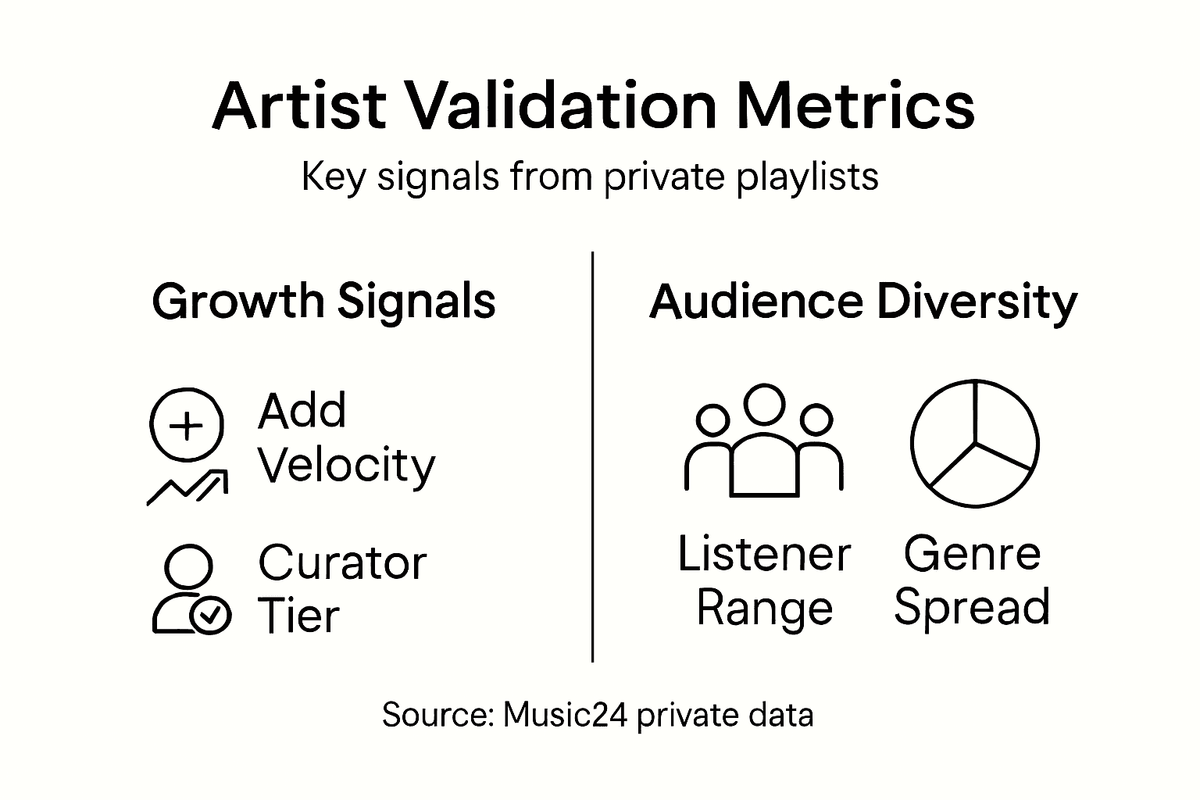
Here is a summary of key private playlist analytics metrics and their strategic implications:
| Metric | What It Measures | Strategic A&R Implication |
|---|---|---|
| Playlist Retention Rate | How long an artist stays in playlists | Indicates real listener connection |
| Playlist Addition Velocity | Rate of new playlist placements | Signals momentum and emerging demand |
| Curator Tier Diversity | Range of curator influence levels | Predicts likelihood of mainstream lift |
| Demographic Spread | Listener age, region, and taste diversity | Reveals cross-market breakout potential |
| Geographic Growth | Expansion across new regions | Informs targeted signing priorities |
Pro tip: Weight curator tier heavily in your validation model since playlist additions from established tastemakers predict long-term success far better than volume from casual listener collections.
This table compares public chart metrics and private playlist analytics for A&R use:
| Data Type | Visibility | Predictive Value | Use Case for A&R |
|---|---|---|---|
| Public Chart Metrics | Widely accessible | Low for early artist detection | Benchmark established acts |
| Private Playlist Data | Restricted access | High for early trend spotting | Discover unsigned breakthroughs |
Step 6: Implement Insights Into A&R Strategies
Implementing private playlist insights into your A&R strategy transforms data analysis into competitive advantage. Your team now possesses early signals about emerging artists that competitors using only public metrics cannot access. This final step converts discovery work into actionable decisions that shape your label's roster development.
Start by integrating validated emerging artists into your formal A&R pipeline. Create a tiered system where artists meeting your predictive metrics move into active development conversations. Assign specific A&R representatives to build relationships with these artists and their management teams. The earlier you engage, the more influence you gain over their career trajectory and label decisions.
Adjust your scouting budget allocation based on private playlist patterns across geographic regions. If your analysis reveals emerging talent clusters in Scandinavia or Southeast Asia, redirect resources accordingly. Data-driven artist discovery tips emphasize how successful labels shift spending toward regions showing strongest private playlist momentum. This geographic intelligence prevents wasted effort chasing saturated markets.
Refine your artist development timelines based on playlist velocity patterns you have observed. Artists showing rapid playlist acceleration may benefit from accelerated release schedules and marketing investment. Those with slower but steady growth require patient development strategies. Matching your timeline to their discovery trajectory maximizes commercial impact.
Share your private playlist insights with your marketing and publicity teams. They can craft targeted campaigns that align with the specific listener demographics and curator networks supporting each artist. Marketing becomes precision-guided rather than broad-based when informed by private playlist data.
Establish monthly review cycles examining which of your validated artists are progressing as predicted. Track accuracy of your predictive model. Which metrics proved most reliable? Which curator types best predict success? Refining these patterns quarterly keeps your discovery advantage sharp.
Finally, document case studies of successful artist signings traced back to private playlist signals. This institutional knowledge becomes your competitive moat.
Pro tip: Set a formal review schedule where your entire A&R team audits private playlist signals monthly, ensuring the process becomes embedded culture rather than a sporadic analysis activity.
Unlock Breakthrough Artist Discovery With Private Playlist Analytics
The challenge facing A&R teams today is clear: traditional public music metrics leave you chasing trends too late. This article highlights how private playlist data reveals authentic listener behavior and emerging artist momentum long before public charts catch on. If you want to detect genuine breakout potential, identify influential curators, and capture geographic micro-trends that shape tomorrow’s hits, relying solely on social or streaming data puts you at a disadvantage.
Music24.com transforms this challenge into your greatest opportunity. Our specialized platform provides exclusive access to millions of anonymized private playlists so you can analyze playlist retention rates, curator influence, and demographic spread with precision. Harness predictive metrics to validate artists faster and prioritize your A&R efforts where it matters most. By integrating these proprietary insights into your talent scouting, you gain a competitive edge that is impossible to replicate with public data alone.
Take control of the artist discovery process now. Visit Music24.com to explore how private playlist analytics can power your next signing success.
Discover the future of music scouting at Music24.com and start identifying breakout talent before anyone else. Elevate your A&R strategy with data-driven confidence and see the difference that private playlist intelligence makes today.
Frequently Asked Questions
How do I set up Music24 for private playlist analytics?
To set up Music24, create an account using your label credentials. This process typically takes about five minutes and involves linking your music industry email and verifying your account through a confirmation link.
What criteria should I define for identifying breakout artists using private playlist data?
Define specific markers such as listener demographics, geographic growth patterns, and playlist creator influence to identify breakout artists. Assess these criteria quarterly to stay aligned with shifting market trends.
How can I analyze discovery patterns in private playlists?
Begin by filtering playlists within your target genre and geographic regions to identify artists consistently appearing across various independent curators. Look for signs of authentic discovery momentum, such as frequent placements across diverse playlists, rather than reliance on a single popular playlist.
What metrics should I use to validate emerging artists?
Use metrics like playlist retention rates, demographic diversity, and momentum velocity to validate emerging artists. For example, track how long an artist remains in playlists; a retention of over eight weeks indicates genuine listener engagement.
How often should I review my private playlist data for artist discovery?
Establish a monthly review cycle to analyze validated artists' progress based on predictive metrics. Consistent monitoring helps you refine your discovery process and adapt your strategies to the evolving music landscape.
What are the benefits of using private playlist data over public metrics?
Private playlist data provides early insights into artist trends and listener behavior that public metrics do not reveal. This information allows you to make informed A&R decisions and discover emerging talent before they achieve mainstream popularity.

