
Private playlist analytics are reshaping how A&R teams uncover fresh talent before anyone else. More than 60 percent of American music industry leaders now rely on private playlist data to spot emerging trends faster than traditional streaming charts. Given the fierce competition among major labels, this approach brings sharper insight into authentic music discovery and genre innovation. This article reveals practical strategies for building analytics dashboards, decoding discovery signals, and predicting rising artist momentum using advanced features in Music24.
Table of Contents
- Step 1: Set Up Private Playlist Analytics on Music24
- Step 2: Identify Authentic Discovery Patterns in Data
- Step 3: Analyze Genre Blending and Geographic Micro-Trends
- Step 4: Evaluate Influential Curators Driving Artist Growth
- Step 5: Verify Emerging Artist Potential with Predictive Metrics
Quick Summary
| Key Point | Explanation |
|---|---|
| 1. Set Up Analytics Dashboard | Log into Music24 to customize analytics for tracking listener trends and artist potential in private playlists. |
| 2. Identify Authentic Patterns | Analyze listener behaviors that reflect true musical exploration beyond just popular streaming metrics. |
| 3. Map Genre Blending Trends | Use advanced analytics to understand how genre mixing varies across regions, revealing potential breakthrough artists. |
| 4. Evaluate Curator Influence | Track influential curators to see their impact on emerging artist visibility and growth in the music industry. |
| 5. Apply Predictive Metrics | Use predictive tools to verify artist potential by examining multiple performance indicators beyond traditional metrics. |
Step 1: Set Up Private Playlist Analytics on Music24
Setting up private playlist analytics requires strategic navigation through Music24's platform to unlock powerful artist discovery insights. Your goal is to configure a comprehensive analytics dashboard that reveals hidden trends in listener behavior and emerging artist potential.
Begin by logging into your Music24 account and accessing the private playlist data explorer. Navigate to the main analytics dashboard where you can customize your tracking parameters. Select the specific music genres you want to analyze and set geographic regions of interest. Music24's platform allows granular filtering to help A&R professionals pinpoint precise listener segments and emerging artist movements.
The platform provides multiple visualization options for tracking playlist trends. Choose between heat maps, trend graphs, and detailed demographic breakdowns to understand how private playlists reflect authentic music discovery patterns. Pay special attention to playlist creation dates, frequency of artist inclusion, and cross genre blending indicators that signal potential breakthrough performers.
Pro tip: Configure automatic email alerts for significant playlist trend changes to stay ahead of music discovery curves.
Here is a summary of key data types and the insights they enable in Music24 analytics:
| Data Type | Primary Insight | Business Impact |
|---|---|---|
| Playlist Creation Date | Identifies emerging trends timing | Enables early artist scouting |
| Genre Selection | Reveals core musical interests | Guides targeted artist promotion |
| Geographic Region | Tracks regional trend emergence | Supports local marketing strategies |
| Playlist Frequency | Shows listener engagement patterns | Optimizes release strategies |
| Cross-Genre Inclusion | Highlights blending and innovation | Informs genre fusion opportunities |
Step 2: Identify Authentic Discovery Patterns in Data
Authentic music discovery patterns emerge through sophisticated analysis of listener behavior and playlist composition. A&R professionals must decode subtle signals that indicate genuine musical exploration beyond surface level streaming metrics.
Carefully examine playlist data using music discovery insights that reveal listener exploration tendencies. Focus on tracking user behaviors that demonstrate true musical curiosity rather than passive consumption. Key indicators include frequency of genre switching, inclusion of lesser known tracks, and consistent engagement with emerging artists across multiple playlist iterations.
Identify authentic discovery patterns by analyzing multiple dimensions of playlist data. Look for listeners who demonstrate consistent exploratory behavior such as introducing new artists regularly, maintaining diverse genre representations, and showing sustained interest in tracks outside mainstream popularity charts. These nuanced metrics provide deeper insights into genuine music consumption trends that traditional streaming analytics often miss.

Pro tip: Cross reference playlist data with geographic and demographic filters to uncover hyper specific music discovery microtrends.
Step 3: Analyze Genre Blending and Geographic Micro-Trends
Understanding genre blending and geographic micro-trends requires sophisticated analytical techniques that go beyond traditional music consumption metrics. A&R professionals must develop nuanced approaches to decode emerging musical landscapes and regional listener preferences.
Carefully map out playlist genre coherence patterns that reveal how musical tastes evolve across different geographic regions. Examine how playlists demonstrate fluid genre transitions, paying close attention to track selection complexity, collaborative curation strategies, and the emergence of unique cross genre combinations. Identify regional variations that signal potential breakthrough artists or emerging musical movements before they become mainstream.
Analyze micro-trend data by constructing detailed geographic heat maps that showcase musical preference shifts. Look for signals like repeated artist appearances across seemingly unrelated playlists, unexpected genre intersections, and listener behaviors that challenge traditional music categorization. These subtle indicators can help predict emerging artist potential and uncover hidden musical innovation happening at local and regional levels.
Pro tip: Create geographic overlay visualizations that highlight genre blending patterns across different demographic segments for more precise trend detection.
Step 4: Evaluate Influential Curators Driving Artist Growth
Identifying influential curators requires a sophisticated approach that goes beyond surface level playlist analytics. A&R professionals must develop strategic methods to understand how key music curators drive emerging artist visibility and momentum.
Examine curator collaboration and mentorship patterns that reveal their genuine impact on artist growth. Track curators who consistently introduce innovative artists across multiple platforms, paying attention to their thematic selections, community engagement strategies, and ability to elevate lesser known musical talents. Look for curators who demonstrate a track record of identifying artists before they gain mainstream recognition.
Construct a comprehensive curator influence matrix by analyzing their historical playlist selections, artist promotion frequency, and cross platform impact. Evaluate metrics like the number of emerging artists they have previously supported who later achieved significant success, their genre diversity, and their ability to create meaningful musical narratives that go beyond algorithmic recommendations.
Pro tip: Develop a scoring system that quantifies curator influence by tracking their historical artist discovery success rates and genre innovation potential.
Step 5: Verify Emerging Artist Potential with Predictive Metrics
Verifying emerging artist potential requires a comprehensive approach that transcends traditional streaming metrics. A&R professionals must develop sophisticated analytical strategies to identify true musical innovation and growth potential before mainstream recognition.
Utilize predictive artist discovery tools that analyze performance signals across multiple platforms. These advanced analytics provide daily scoring mechanisms that integrate data points from streaming services, social media engagement, playlist inclusions, and listener interaction patterns. Focus on metrics that demonstrate consistent audience growth, engagement depth, and cross platform momentum.
Construct a holistic evaluation framework by comparing multiple performance indicators beyond traditional streaming numbers. Examine factors such as listener retention rates, playlist addition frequency, social media sentiment, geographic spread of audience, and the velocity of audience expansion. Pay special attention to artists showing exponential rather than linear growth patterns, as these often signal genuine breakthrough potential.
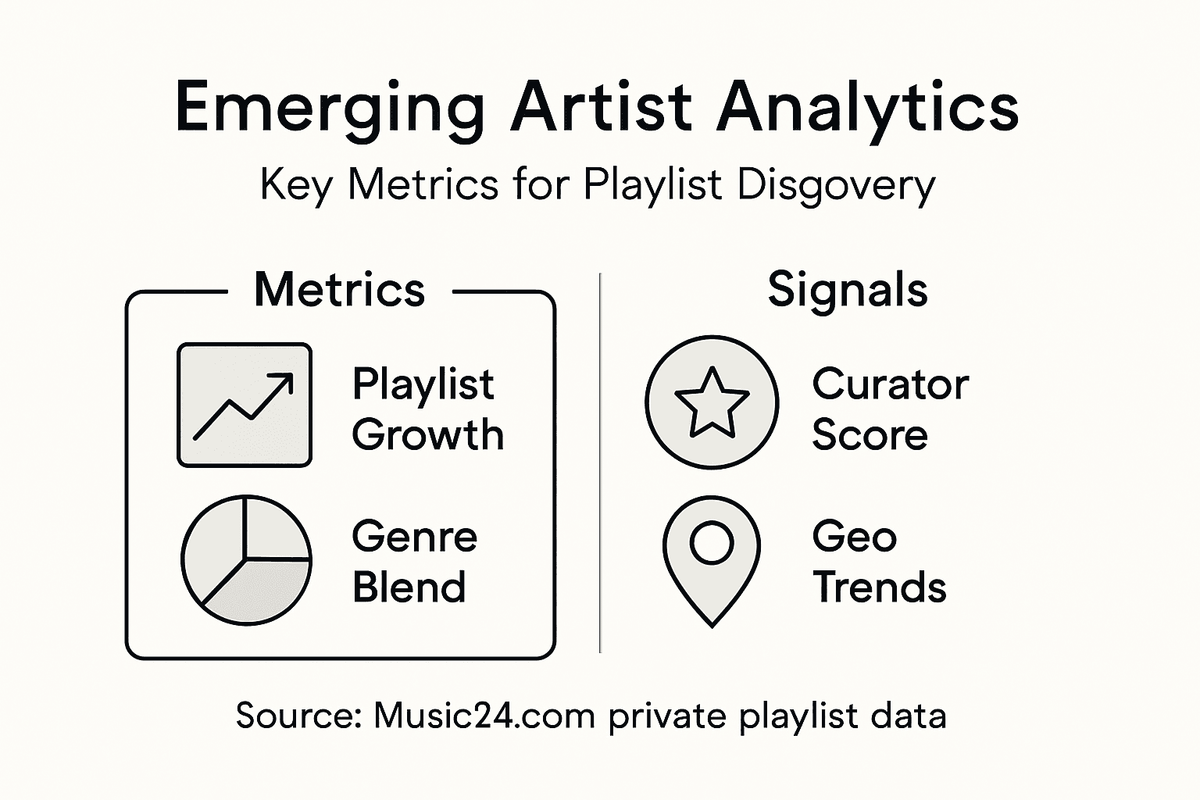
Pro tip: Develop a custom weighted scoring system that balances quantitative metrics with qualitative indicators of artistic potential and audience connection.
The following table compares methods for spotting breakthrough artist potential in playlist analytics:
| Method | Strength | Limitation |
|---|---|---|
| Trend Graphs | Visualizes audience momentum | May miss nuanced interactions |
| Demographic Filtering | Identifies specific user groups | Requires accurate user metadata |
| Genre Blending Analysis | Detects innovation across styles | Complex to interpret at scale |
| Curator Influence Scoring | Reveals tastemaker impact | Data may be fragmented cross-platform |
| Predictive Discovery Tools | Forecasts future success | Needs continual data updates |
Unlock Breakthrough Artist Discovery with Music24
Discovering emerging artists through private playlist analytics comes with challenges like identifying authentic music discovery patterns and understanding complex genre blending and geographic micro-trends. The article highlights the need to go beyond traditional streaming metrics by analyzing playlist frequency, curator influence, and predictive data to spot genuine breakout potential early.
Music24.com is built precisely for these challenges. Our specialized platform leverages anonymized private playlist data to reveal hidden listener behaviors and influential curators ahead of public charts or social signals. By focusing on nuanced metrics like cross-genre inclusion and geographic heat maps, Music24 empowers A&R teams, artist managers, and marketers to make confident, data-driven decisions in talent scouting and marketing strategy development. Experience true innovation with tools designed to decode the subtle signals of music discovery that others miss.
Start transforming your artist discovery approach today with Music24 private playlist analytics.
Looking to gain a competitive edge in emerging artist spotting?

Explore how Music24’s predictive analytics and curator influence scoring can revolutionize your scouting process. Visit Music24 now and be the first to unearth tomorrow’s biggest stars before anyone else. Don't wait for public metrics to catch up—lead the field with insights you can only get from private playlist data. Learn more at Music24.
Frequently Asked Questions
How can I set up private playlist analytics on Music24?
Setting up private playlist analytics involves logging into your Music24 account and accessing the private playlist data explorer. From there, navigate to the main analytics dashboard to customize your tracking parameters, including selecting music genres and geographic regions to analyze.
What data types should I focus on for spotting emerging artists?
Key data types to focus on include playlist creation dates, genre selections, geographic regions, playlist frequency, and cross-genre inclusion. Prioritize these metrics to identify trends and listener behaviors that signal potential breakthrough artists.
How do I identify authentic music discovery patterns in my data?
To identify authentic music discovery patterns, analyze user behaviors such as frequency of genre switching, inclusion of lesser-known tracks, and consistent engagement with new artists. Cross-reference this data with geographic and demographic filters to uncover detailed insights into listener exploration tendencies.
What methods can I use to analyze genre blending in playlists?
You can analyze genre blending by mapping out playlist genre coherence patterns and tracking how different genres transition within playlists. Pay attention to cross-genre combinations and regional variations to spot innovative music trends that may indicate emerging artists.
How can I evaluate the influence of curators on artist growth?
Evaluate the influence of curators by examining their historical playlist selections and how often they promote emerging artists. Construct a curator influence matrix to gauge their success rate in artist discovery and ability to support lesser-known talents.
What predictive metrics should I use to verify emerging artist potential?
Use predictive metrics that incorporate performance signals from multiple platforms, such as audience growth, playlist addition frequency, and social media engagement. Focus on identifying artists with exponential growth patterns, as these often signify genuine breakthrough potential.
Recommended
- Step by Step Emerging Artist Discovery for A&Rs - Blog - Music24.com
- Why Track Private Playlists for Early Artist Discovery - Blog - Music24.com
- 7 Essential Emerging Artist Detection Tips for A&R Success - Blog - Music24.com
- How to Spot Rising Artists Using Private Playlist Data - Blog - Music24.com

