
Most American music executives are witnessing a major shift in how emerging talent is discovered and evaluated. With more than half of artist breakthroughs now sparked by data-driven insights, understanding advanced analytics is becoming the key to gaining an early edge. The 2025 music discovery landscape will reward those who move quickly to decode complex micro-genre trends, cross-platform signals, and predictive audience behaviors before the mainstream arrives.
Table of Contents
- Defining The 2025 Music Discovery Landscape
- Types Of Music Discovery Data Sources
- How Private Playlist Analytics Work
- AI, Machine Learning, And Predictive Tools
- Role Of Influential Curators And Playlists
- Risks, Biases, And Ethical Responsibilities
Key Takeaways
| Point | Details |
|---|---|
| Evolution of Music Discovery | By 2025, music discovery will leverage advanced analytics, transcending traditional metrics to integrate data from multiple platforms. |
| Role of Data Sources | Key data sources will include streaming platforms, social media, and private playlists, each offering unique insights into listener preferences. |
| Influence of AI | AI and machine learning will provide robust predictive tools for identifying emerging artists and trends, enhancing decision-making in A&R. |
| Ethical Considerations | Understanding algorithmic bias and ensuring equitable representation in music discovery will be crucial for ethical industry practices. |
Defining the 2025 Music Discovery Landscape
The music discovery ecosystem is undergoing a profound transformation, driven by advanced predictive analytics and emerging technological capabilities. As the industry moves toward more sophisticated data interpretation models, understanding the nuanced landscape becomes critical for A&R professionals seeking competitive advantages. Global music forecasts indicate a pivotal shift in how artists are identified, promoted, and connected with audiences.
By 2025, music discovery will transcend traditional streaming metrics, integrating complex data signals from multiple platforms. Emerging technologies like generative AI, machine learning algorithms, and cross-platform analytics will enable unprecedented insights into listener preferences and emerging artist potential. These tools will provide granular understanding of micro-genre trends, geographic listener behaviors, and early-stage artist momentum before mainstream recognition.
Key characteristics of the 2025 music discovery landscape will include hyper-personalization, predictive trend mapping, and real-time audience engagement tracking. A&R executives will leverage advanced analytics to identify artists with exponential growth potential, moving beyond surface-level popularity metrics. This approach requires sophisticated data interpretation that combines streaming statistics, social media interactions, playlist inclusion patterns, and emerging platform engagement metrics.
Pro tip: Invest in comprehensive data integration platforms that aggregate insights across multiple music discovery channels to stay ahead of emerging artist trends.
Types of Music Discovery Data Sources
Modern music discovery relies on a complex ecosystem of data sources that extend far beyond traditional listening metrics. Music Information Retrieval (MIR) represents a sophisticated approach to collecting and analyzing diverse music-related data, transforming how A&R professionals identify emerging talent. These data sources range from raw audio recordings and consumer interaction signals to intricate contextual metadata that provides deep insights into listener behaviors.
Contemporary music discovery data typically falls into several critical categories. Streaming platforms like Spotify and Apple Music generate primary data through user interactions, playlist formations, and listening patterns. Social media platforms such as TikTok and Instagram contribute additional layers of discovery signals through viral music trends and user-generated content. Emerging technologies now enable sophisticated cross-platform analytics that integrate data from multiple sources, creating a more comprehensive understanding of music consumption and artist potential.
Advanced music discovery strategies leverage multiple data types, including symbolic metadata, audio characteristics, contextual information, and behavioral analytics. These sources collectively provide a nuanced view of emerging artist trajectories, allowing A&R professionals to identify potential breakout talents before they reach mainstream recognition. By combining quantitative listening data with qualitative engagement metrics, music industry professionals can develop more predictive and accurate artist development strategies.
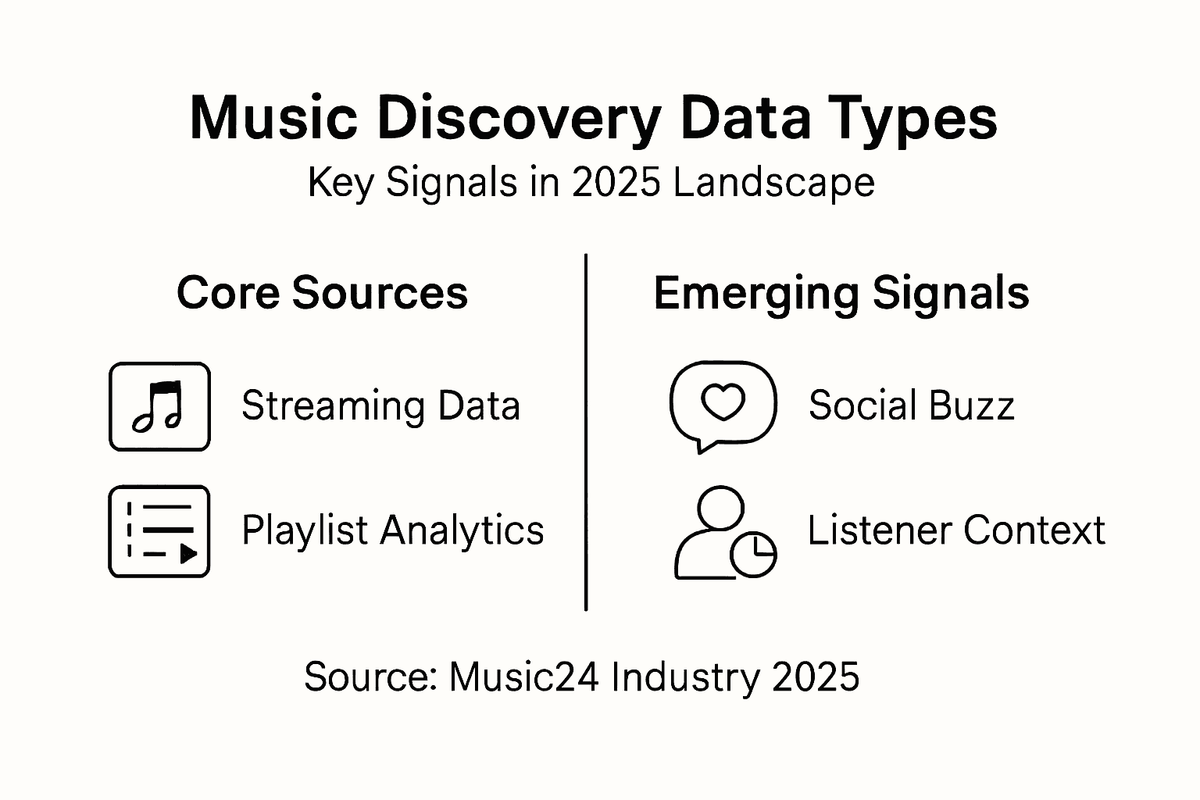
Here's a concise overview of major music discovery data sources and their unique advantages:
| Data Source | Unique Insight | Business Value |
|---|---|---|
| Streaming Platforms | User listening patterns | Predicts trending artists early |
| Social Media | Viral trends, user sharing | Identifies influencer-driven music |
| Private Playlists | Nuanced personal preferences | Reveals hidden genre micro-trends |
| Contextual Metadata | Geolocation, mood analysis | Tailors recommendations regionally |
Pro tip: Develop a multi-source data integration strategy that combines streaming, social media, and proprietary playlist data to gain comprehensive insights into emerging musical trends.
How Private Playlist Analytics Work
Private playlist analytics represent a sophisticated approach to understanding music consumption beyond traditional public streaming metrics. Listener retention and music discovery research reveals that private playlists offer unprecedented insights into nuanced listener preferences and emerging musical trends. These analytics go far deeper than algorithmic recommendations, uncovering complex patterns of musical taste and discovery that are invisible in public-facing data.
The core mechanism of private playlist analytics involves multi-dimensional data extraction and pattern recognition. Researchers analyze playlist composition, track sequencing, genre transitions, and listener interaction signals to develop comprehensive understanding of music consumption behaviors. Advanced machine learning algorithms can detect subtle correlations between playlist structures, identifying potential emerging artists, predicting genre crossover trends, and understanding how listeners curate personal musical experiences.

Key analytical approaches in private playlist analytics include studying playlist coherence, diversity indices, and serendipitous music discovery patterns. These techniques allow A&R professionals to identify not just popular tracks, but also understand the intricate ways listeners explore and integrate new music into their personal collections. By examining how tracks are positioned within playlists, how often they are reordered, and their relationship to other songs, analysts can develop sophisticated predictive models of musical preference and artist potential.
Pro tip: Develop granular playlist segmentation strategies that analyze micro-trends within specific listener demographics to uncover hidden musical discovery patterns.
AI, Machine Learning, and Predictive Tools
The convergence of artificial intelligence and music discovery is rapidly transforming how artists are identified and promoted. Recent advances in AI technologies have revolutionized music analysis through sophisticated deep learning models that can extract complex musical characteristics and predict emerging trends with unprecedented accuracy. These neural network-powered systems go beyond traditional recommendation algorithms, offering nuanced insights into musical preferences and artist potential.
Machine learning algorithms now employ multiple sophisticated techniques to understand music consumption. Collaborative filtering approaches analyze listener behaviors across large datasets, while content-based filtering examines intrinsic musical attributes like tempo, genre, and emotional characteristics. Natural language processing techniques further enhance these models by incorporating sentiment analysis and contextual data, enabling more refined and personalized music discovery experiences that can predict listener preferences with remarkable precision.
Advanced predictive tools in the music industry now leverage complex ensemble models that combine diverse data sources. These integrated systems analyze streaming patterns, social media interactions, playlist dynamics, and demographic information to create comprehensive artist discovery frameworks. By synthesizing multiple data signals, AI-driven platforms can identify potential breakthrough artists before they gain mainstream attention, providing A&R professionals with powerful predictive capabilities that were impossible just a few years ago.
Pro tip: Develop hybrid AI models that combine multiple analytical approaches to create more robust and nuanced music discovery predictions.
Role of Influential Curators and Playlists
Playlist curators have emerged as critical gatekeepers in the modern music discovery ecosystem, wielding significant influence beyond traditional industry channels. Research on Spotify reveals that curator-driven playlists can dramatically shape listener behaviors and artist exposure, often more effectively than mainstream promotional strategies. These influential tastemakers act as sophisticated filters, identifying emerging talent and creating nuanced musical narratives that resonate with specific audience segments.
The strategic power of playlist curators stems from their ability to create contextual musical experiences that transcend individual tracks. Advanced curators develop sophisticated selection methodologies that consider not just musical genre, but emotional trajectory, listener psychology, and subtle sonic relationships between tracks. By crafting intricate playlist architectures, these experts can introduce listeners to new artists through carefully constructed musical journeys that feel organic and personally relevant.
In the 2025 music discovery landscape, playlist curators will increasingly function as hybrid professionals combining data science, musical expertise, and cultural intuition. Their value proposition extends beyond simple track selection to include predictive trend identification, audience segmentation, and emerging artist development. Successful curators will leverage advanced analytics, machine learning insights, and deep musical knowledge to create playlist ecosystems that serve as powerful discovery platforms for both listeners and artists.
Compare the key strengths of AI-driven predictive tools and influential curator-led playlists in music discovery:
| Approach | Key Strength | Best Use Case | Limitation |
|---|---|---|---|
| AI & Predictive Tools | Scalability, data integration | Identifying hidden talent at scale | May inherit algorithmic bias |
| Influential Curators | Nuanced, authentic selection | Creating emotional listener journeys | Limited by personal taste scope |
Pro tip: Develop a curator network that combines data-driven insights with authentic musical passion to create truly compelling playlist experiences.
Risks, Biases, and Ethical Responsibilities
The rapid advancement of predictive analytics in music discovery introduces complex ethical challenges that demand careful consideration and proactive management. Ethical responsibilities in music extend far beyond technological capabilities, requiring a nuanced approach that prioritizes cultural sensitivity, artist representation, and systemic fairness. As data-driven models become increasingly powerful, the potential for unintentional bias and marginalization grows exponentially.
Key ethical risks in music discovery analytics include algorithmic bias, which can systematically underrepresent certain artists, genres, and cultural expressions. Machine learning models trained on historical data may inadvertently perpetuate existing inequities by reinforcing dominant cultural narratives and limiting exposure to diverse musical voices. This challenge requires continuous auditing of recommendation systems, intentional diversification of training datasets, and transparent methodologies that prioritize equitable representation across musical ecosystems.
Navigating ethical responsibilities demands a multifaceted approach that combines technological innovation with cultural awareness. A&R professionals and technology developers must actively work to create discovery platforms that respect artistic integrity, provide meaningful opportunities for emerging artists, and challenge existing power structures in music distribution. This involves developing sophisticated algorithms that can recognize and counteract systemic biases, implementing diverse representation metrics, and creating feedback mechanisms that allow artists and listeners to contribute to ongoing refinement of discovery platforms.
Pro tip: Implement regular bias audits and diverse representation checks in your music discovery algorithms to ensure equitable artist exposure.
Gain the Competitive Edge in the 2025 Music Discovery Landscape
The article highlights the growing complexity of music discovery driven by predictive analytics, private playlist data, and AI technologies. For A&R teams and music professionals aiming to move beyond traditional public metrics and capitalize on hyper-personalization and early trend detection, navigating this evolving ecosystem can feel overwhelming. Challenges like integrating multi-source data and uncovering hidden artist potential before mainstream breakthrough are critical to success.
At Music24.com, we specialize in exactly these areas. Our platform harnesses anonymized private playlist analytics to detect authentic listener patterns and micro-trends that elude conventional tools. By combining predictive insights with deep analysis of influential curators and geographic nuances, Music24 empowers you to identify breakout artists early and build targeted strategies informed by cutting-edge data techniques featured in this article. Discover how our proprietary access differentiates us from competitors relying solely on public streaming data and unlock new opportunities for artist development and marketing.
Take control of your music discovery process today with Music24.

Ready to transform your approach to artist identification and trend forecasting? Visit Music24.com now to access the advanced predictive analytics tools shaping the future of music discovery.
Frequently Asked Questions
What is the significance of predictive analytics in the music discovery landscape of 2025?
Predictive analytics will transform how artists are identified and promoted, offering insights into listener preferences and trends that go beyond traditional metrics.
How do private playlist analytics enhance music discovery?
Private playlist analytics provide deeper insights into listener preferences by analyzing playlist composition and behaviors, allowing A&R professionals to identify emerging artists with greater precision.
What role do influential curators play in music discovery?
Influential curators act as gatekeepers, creating contextual musical experiences that can effectively introduce listeners to new artists and trends, leveraging both data and personal taste in their selections.
How can A&R professionals mitigate algorithmic bias in music discovery?
A&R professionals can mitigate algorithmic bias by conducting regular audits of their systems, diversifying training datasets, and prioritizing transparency to ensure equitable representation of artists.

