Predictive Analytics in Music: Shaping Early Breakouts
Predictive analytics in music reveals early artist breakouts, private playlist trends, and influencer impact. Learn applications and critical risks for 2025.

Most American music executives now rely on data-driven insights to predict which sounds will go viral next. As the industry shifts from instinct to analytics, the ability to forecast emerging trends gives professionals a decisive edge. With over 80 percent of hit songs now identified early through predictive models, understanding these tools separates those leading the charts from those following. Discover how predictive analytics is rewriting the rules of musical discovery and shaping what the American audience hears tomorrow.
Table of Contents
- Defining Predictive Analytics For Music Trends
- Types Of Data Sources: Public Vs. Private Playlists
- How Predictive Models Identify Emerging Artists
- Industry Applications: Targeting And Talent Discovery
- Risks, Limitations, And Ethical Considerations
Key Takeaways
| Point | Details |
|---|---|
| Predictive Analytics Enhances Trend Forecasting | This methodology empowers music professionals to anticipate trends and listener preferences through data analysis, offering more forward-looking strategies than traditional methods. |
| Public vs. Private Playlist Data | Understanding the distinction between these data sources is vital, as private playlists provide authentic insights into listener preferences that can inform targeted marketing. |
| Emerging Artist Identification | Machine learning algorithms revolutionize talent discovery by analyzing complex datasets to predict an artist's potential more accurately than traditional scouting methods. |
| Ethical Considerations are Crucial | As predictive analytics grows in importance, ethical challenges such as algorithmic bias and data privacy must be addressed to ensure fair and responsible practices. |
Defining Predictive Analytics for Music Trends
Predictive analytics represents a transformative approach in the music industry, enabling professionals to anticipate trends and listener preferences before they become mainstream. At its core, this analytical method uses historical data and statistical algorithms to forecast future music consumption patterns, providing unprecedented insights into emerging musical landscapes.
Predictive analytics transforms raw data into strategic intelligence by analyzing complex listener behaviors. Music industry professionals leverage advanced statistical techniques and machine learning algorithms to decode intricate patterns within streaming platforms, playlist compositions, and audience engagement metrics. The goal is straightforward: understand where music trends are heading before traditional indicators catch up.
The power of predictive analytics extends far beyond simple trend tracking. Big data analysis has fundamentally reshaped music enterprise profit models, production strategies, and marketing approaches by offering granular insights into user preferences. Modern music executives can now anticipate genre shifts, identify emerging artist potential, and develop targeted promotional strategies with remarkable precision. This data-driven methodology allows for:
- Early detection of genre cross-pollination
- Identification of breakthrough artist characteristics
- Prediction of listener demographic engagement patterns
- Assessment of potential hit song attributes
Unlike traditional music trend analysis, predictive analytics provides a forward-looking perspective. By integrating multiple data streams - including streaming statistics, social media interactions, playlist compositions, and listener demographic information - music industry professionals can develop nuanced strategies that anticipate market movements rather than simply reacting to them.
Types of Data Sources: Public vs. Private Playlists
In the rapidly evolving music analytics landscape, understanding the nuanced differences between public and private playlist data has become crucial for industry professionals. Playlist data sources represent two distinct yet interconnected streams of music consumption insights, each offering unique perspectives on listener behaviors and emerging trends.
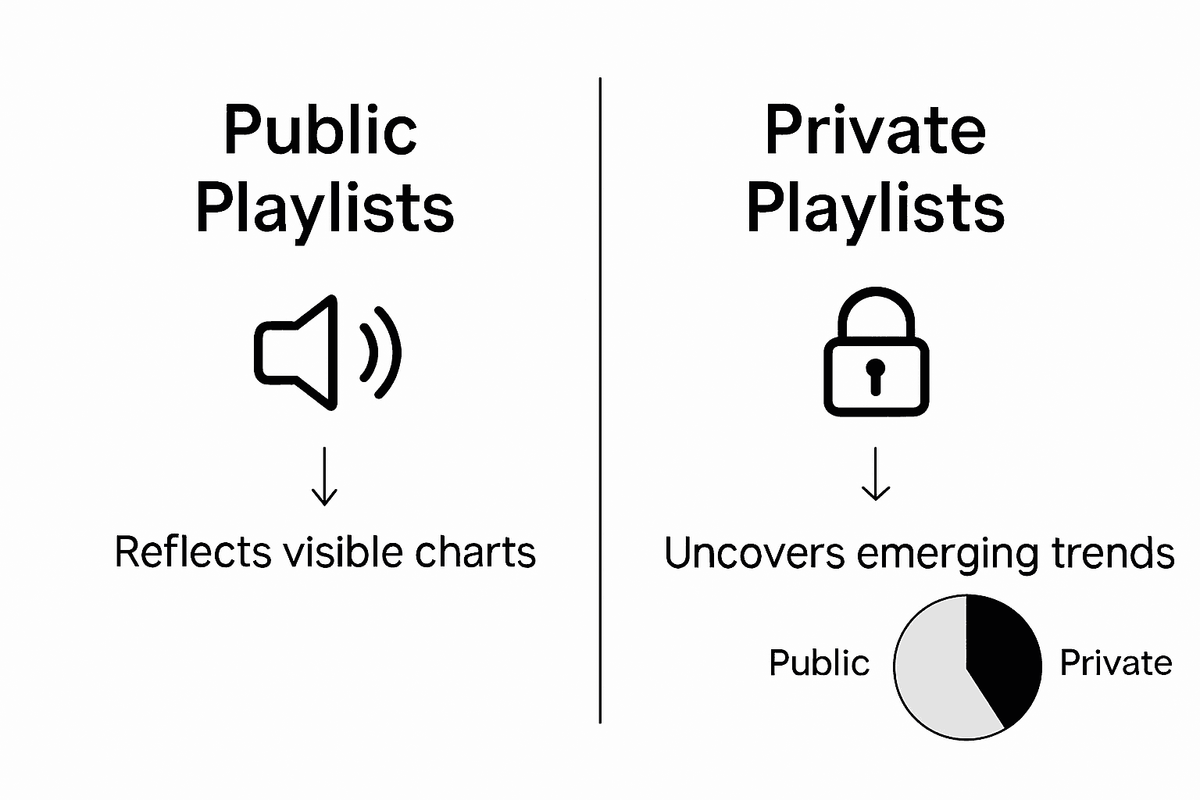
Public playlists constitute the visible, shareable collections typically found on streaming platforms like Spotify and Apple Music. These playlists are curated and shared openly, providing a surface-level view of music preferences. While valuable, public playlists often reflect trending or marketed content rather than authentic listener choices. They represent the performative side of music consumption - playlists designed to be seen and shared, potentially skewing actual listening patterns.
Private playlists, by contrast, offer a more intimate and unfiltered window into genuine music preferences. These personal collections, hidden from public view, capture raw listener behavior without the social performance aspect. Music industry professionals recognize private playlists as a goldmine of actionable insights, revealing unvarnished listener tastes across diverse demographics. The key differences between public and private playlist data include:
- Authenticity: Private playlists reflect true listening habits
- Diversity: Personal collections often include more eclectic music selections
- Unbiased Representation: No external influence or social validation pressures
- Granular Insights: More nuanced understanding of individual listener preferences
The strategic value of private playlist data cannot be overstated. By analyzing these personal collections, music industry professionals can uncover emerging artists, predict genre shifts, and develop more targeted marketing strategies. Unlike public playlists, which often follow mainstream trends, private playlists provide a forward-looking perspective on musical discovery and listener evolution.
How Predictive Models Identify Emerging Artists
Machine learning algorithms have revolutionized the process of identifying emerging musical talent, transforming how music industry professionals discover and predict artist potential. These sophisticated predictive models analyze complex datasets, extracting nuanced insights that traditional methods could never uncover.

Predictive models employ advanced techniques like Random Forest and XGBoost to evaluate multiple dimensions of musical potential. By combining audio features, lyrics, and metadata, these algorithms achieve remarkable accuracy in forecasting artist breakthrough potential. The models investigate intricate characteristics such as genre compatibility, instrumental complexity, lyrical depth, and audience engagement patterns to generate comprehensive artist assessments.
The key components that predictive models analyze include:
- Audio Characteristics: Tempo, rhythm, instrumental composition
- Lyrical Content: Emotional resonance, thematic complexity
- Streaming Metrics: Listen duration, playlist inclusion rates
- Social Media Engagement: Follower growth, interaction intensity
- Genre Compatibility: Cross-genre appeal and adaptability
These sophisticated analytical approaches go beyond traditional talent scouting methods. By leveraging massive datasets and machine learning algorithms, music industry professionals can now identify promising artists with unprecedented precision, reducing financial risks and maximizing potential breakthrough opportunities. The predictive models serve as a powerful complement to human intuition, providing data-driven insights that reveal hidden musical talents before they become mainstream successes.
Industry Applications: Targeting and Talent Discovery
Music companies have transformed talent discovery through sophisticated big data analytics, revolutionizing how record labels, artist managers, and A&R teams identify and nurture emerging musical talent. The traditional approach of relying on gut instinct and industry connections has been fundamentally disrupted by data-driven methodologies that provide unprecedented insights into artist potential.
Predictive analytics enables strategic targeting by decoding complex listener behaviors and emerging trends. Statistical techniques like 'Hit Song Science' help record companies assess a song's commercial viability with remarkable precision, dramatically reducing the financial risks associated with artist development and promotion. These advanced analytical approaches go beyond surface-level metrics, diving deep into nuanced factors that predict musical success.
The core applications of predictive analytics in talent discovery include:
- Early Artist Identification: Detecting promising musicians before mainstream recognition
- Market Segmentation: Understanding precise listener demographics
- Risk Mitigation: Quantifying potential commercial success
- Strategic Marketing: Developing targeted promotional campaigns
- Genre Trend Forecasting: Predicting emerging musical styles and crossover potential
By leveraging these sophisticated analytical tools, music industry professionals can make more informed decisions. The convergence of machine learning, big data, and musical expertise creates a powerful ecosystem that transforms how talent is discovered, developed, and brought to market, ultimately democratizing the path to musical success.
Risks, Limitations, and Ethical Considerations
Predictive analytics in the music industry introduces significant ethical challenges that demand careful navigation, challenging professionals to balance technological insights with responsible data practices. While these analytical tools offer unprecedented capabilities, they simultaneously raise complex questions about privacy, representation, and algorithmic fairness.
The primary ethical concerns center on algorithmic bias and potential discrimination within predictive models. Data-driven marketing approaches inherently risk perpetuating existing systemic inequalities through unintentional technological prejudices, potentially marginalizing artists from underrepresented backgrounds or innovative musical genres that do not conform to mainstream statistical patterns.
Key ethical risks and limitations include:
- Data Privacy Concerns: Potential unauthorized use of personal listener information
- Algorithmic Bias: Systemic discrimination against non-mainstream artists
- Creative Suppression: Potential reduction of musical diversity
- Overreliance on Metrics: Diminishing human intuition and creative judgment
- Commercial Homogenization: Encouraging formulaic musical production
Addressing these challenges requires a multifaceted approach. Music industry professionals must implement robust ethical guidelines, maintain transparency in algorithmic decision-making, and continually audit predictive models for potential biases. The goal is not to abandon data-driven insights, but to develop more nuanced, inclusive technologies that respect artistic diversity and individual creative expression.
Where Music24 fits
Music24 reads millions of public playlists and charts every day. Its public data shows which playlists add songs like the ones you work with, which tracks and artists are gaining playlists fastest in a genre, and the countries where that genre grows. Follow the artists, tracks and playlists you care about and get an email when they move.
Start free with Music24: 7 days of the Pro plan, no card, then a Free plan for as long as you like.
Frequently Asked Questions
What is predictive analytics in music?
Predictive analytics in music involves using historical data and statistical algorithms to forecast future trends and listener preferences, allowing music professionals to anticipate market movements before they become mainstream.
How does predictive analytics identify emerging artists?
Predictive analytics uses machine learning algorithms to analyze various factors, including audio characteristics, lyrical content, streaming metrics, and social media engagement, to accurately identify artists with potential for breakthrough success.
What are the main data sources used in predictive analytics for music?
Predictive analytics leverages both public and private playlist data, with public playlists providing a visible view of trends and private playlists offering deeper insights into genuine listener preferences without social performance influences.
What ethical considerations are associated with predictive analytics in the music industry?
Key ethical considerations include data privacy concerns, algorithmic bias, potential suppression of musical diversity, and the risk of overreliance on metrics, which can diminish human intuition in the creative process.
Recommended
Get your music heard. Skip the content grind.
Add a song. Music24 makes the posts and the videos, plans your release and publishes it on every channel. Free for 7 days on the Pro plan, no card.