
Over 60% of music discovery on Spotify comes from playlist placements, yet many emerging artists miss that opportunity due to ineffective curation strategies. Traditional public charts arrive too late to spot breakout talent. This guide reveals data-driven playlist curation strategies combining private playlist analytics, human expertise, and algorithmic personalization to give music executives a decisive competitive edge in identifying rising artists early.
Table of Contents
- Introduction To Playlist Curation And Its Industry Importance
- Data-Driven Foundations Of Playlist Curation
- Human Vs Algorithmic Curation In Emerging Artist Discovery
- Practical Strategies For Playlist Curation And Curator Engagement
- Playlist Trend Mapping And Early Artist Identification
- Common Misconceptions And Ethical Considerations In Playlist Curation
- Conclusion: Implementing Data-Driven Playlist Strategies For Competitive Advantage
- Leverage Music24's Advanced Analytics For Superior Playlist Curation
Key Takeaways
| Point | Details |
|---|---|
| Discovery dominance | Playlists contribute to over 60% of music discovery on streaming platforms. |
| Early detection advantage | Private playlist data enables earlier detection of emerging artists than public charts reveal. |
| Human plus algorithm synergy | Human curation adds cultural context and credibility alongside algorithmic personalization. |
| Niche engagement wins | Smaller, mood or genre-specific playlists yield higher engagement than massive general ones. |
| Authenticity validation critical | Verifying curator authenticity prevents wasted pitching efforts on bot-driven playlists. |
Introduction to Playlist Curation and Its Industry Importance
Playlist curation has evolved from simple song collections into the primary engine of music discovery. In 2026, curators act as tastemakers who shape listener behavior and launch artist careers. Understanding how curation works is essential for music executives aiming to spot talent before competitors do.
Three main playlist types exist today: algorithmic, human-curated, and hybrid. Algorithmic playlists use listener data to generate personalized recommendations automatically. Human-curated playlists feature expert editorial selections adding cultural insight and context. Hybrid models blend both approaches, combining editorial song pools with personalized ordering.
The numbers tell a compelling story. Spotify playlist placement drives over 60% of music discovery and a targeted curation strategy can increase plays by 20–50%. That means playlist exposure directly impacts artist revenue and fanbase growth. Missing playlist opportunities leaves money on the table.
Effective curation requires understanding what drives listener engagement. Key factors include:
- Mood consistency and flow between tracks
- Genre coherence balanced with fresh discovery
- Playlist length optimized for listening context
- Regular updates maintaining freshness and relevance
- Curator reputation and audience trust
Executives who master these elements gain early access to breakout talent. They spot trends before public charts reflect them. They build relationships with influential curators who can amplify artist reach exponentially.
Pro Tip: Track which playlists drive the highest save rates and repeat listens, not just total plays. Those metrics reveal genuine engagement versus passive background listening.
Data-Driven Foundations of Playlist Curation
Private playlist data offers a goldmine of early signals missed by traditional public metrics. While Spotify charts show what millions already stream, private playlists reveal what engaged listeners actively save and share before trends go mainstream. This lead time creates competitive advantage.

Analyzing private playlist behavior uncovers patterns invisible in public data. You see which tracks listeners pair together, revealing unexpected genre blends. You identify micro-communities forming around niche sounds. You spot which creators consistently surface new talent before others.
The amplification effect of playlist placement proves substantial. Targeted curation strategy can increase plays by 20–50% compared to organic discovery alone. That boost translates directly into algorithmic momentum, as platforms prioritize tracks gaining traction.
Several analytics methods unlock private playlist insights:
- Track appearance frequency across anonymized collections
- Co-occurrence patterns revealing listener associations
- Creator influence scores based on downstream adoption
- Geographic clustering showing regional trend emergence
- Temporal analysis detecting acceleration curves
You can spot rising artists using private playlists weeks before they appear on public charts. This early window lets you sign talent at favorable terms, develop marketing campaigns, and secure playlist placements before competition intensifies.
Tracking private playlists also reveals curator behavior patterns. Which curators consistently add tracks that later break out? Who discovers artists earliest? Which playlists serve as feeder systems for larger editorial playlists?
Pro Tip: Monitor private playlist velocity, the rate tracks get added to new collections weekly. Sharp upward curves signal emerging hits before streaming counts reflect the trend.
The key advantage lies in predictive power. You detect breakout artists based on private playlist momentum, not after public success validates them. That foresight defines competitive positioning in 2026.
Human vs Algorithmic Curation in Emerging Artist Discovery
Understanding the strengths of human and algorithmic curation helps you deploy each strategically. Algorithmic playlists represent roughly 40% and editorial or human-curated roughly 30% of Spotify placements, with hybrid playlists combining strengths of both.
Algorithmic playlists excel at scale and personalization. They analyze listener history, skip rates, save behavior, and contextual factors to generate millions of unique recommendations. Discover Weekly exemplifies this approach, refreshing every Monday with personalized picks based on individual taste profiles.
Human curators provide cultural context algorithms cannot replicate. They understand scene dynamics, recognize artistic intent, and make subjective judgments about quality and relevance. Editorial playlists like RapCaviar or Lorem carry curator brand credibility that influences listener trust.
Hybrid models deliver superior results by blending both approaches. Spotify's editorial playlists now use human curators to select a core song pool, then algorithms personalize track ordering and additions for each listener. This combines expert taste with individual preference.
| Playlist Type | Strengths | Best Use Cases |
|---|---|---|
| Algorithmic | Scale, personalization, real-time adaptation | Ongoing discovery, contextual listening |
| Human-curated | Cultural insight, early exposure, credibility | Genre definition, scene building, tastemaking |
| Hybrid | Expert curation plus personalization | Maximizing reach while maintaining quality |
When targeting emerging artists, human-curated playlists often provide better early exposure. Curators willing to take risks on unknown talent create entry points algorithmic systems miss. Once artists gain initial traction, algorithms amplify that momentum through personalized recommendations.
You should track private playlist data to identify which human curators consistently discover talent early. Their playlists become priority targets for pitching. You can also spot rising artists with private playlist data that shows momentum building across both curator types.
Pro Tip: Pitch human curators six to eight weeks before release to allow time for consideration. Algorithmic placement requires strong early streaming signals, so focus human outreach first, then let algorithms amplify success.
Practical Strategies for Playlist Curation and Curator Engagement
Turning insights into action requires systematic approaches to curator identification, validation, and engagement. Start by building a target list prioritizing quality over quantity.
Validating curator authenticity using stream-to-follower ratios and engagement growth patterns excludes bot-driven playlists. Healthy playlists show follower counts aligned with average streams per track. Suspicious playlists display thousands of followers but minimal play counts, indicating fake audiences.
Check these authenticity signals:
- Stream-to-follower ratio above 5:1 minimum
- Consistent monthly listener growth, not sudden spikes
- Regular playlist updates, not abandoned collections
- Track variety showing curation, not algorithm dumps
- Curator social presence and engagement
Effective playlist pitching targets 15–30 curated playlists per release, starting with niche lists before major editorial ones. This sequence builds momentum. Small playlist placements generate early streams that make larger curators take notice.
Prioritize niche playlists by mood or micro-genre. A focused 5,000-follower indie folk playlist delivers better engagement than a generic 50,000-follower pop playlist. Listeners on niche playlists actively seek that specific sound, yielding higher save rates and repeat listens.
Building long-term curator relationships requires consistent value delivery. Share genuine enthusiasm for their work. Provide clean press materials and high-quality assets. Follow up respectfully without pestering. Thank curators when they add your artists, and share performance results later.
You can leverage curator authenticity metrics to refine your targeting. Prioritize curators who spot rising artists with data proven track records. Apply emerging artist spotting tips using playlist analytics to identify which curators consistently surface breakout talent.
Common pitfalls to avoid:
- Mass emailing generic pitches to hundreds of curators
- Ignoring playlist genre and mood alignment
- Pitching incomplete tracks or poor quality recordings
- Demanding placement instead of requesting consideration
- Neglecting follow-up or relationship maintenance
Pro Tip: Personalize every pitch by referencing specific tracks the curator recently added that share qualities with your artist. This proves you understand their taste and did homework.
Playlist Trend Mapping and Early Artist Identification
Mapping playlist trends reveals underground movements before they surface publicly. This strategic capability lets you position artists within emerging scenes and capitalize on shifting listener preferences.
Playlist trend mapping analyzes how tracks, artists, and sounds spread across playlist ecosystems over time. You track which songs appear together frequently, revealing genre blending patterns. You monitor playlist title language, spotting new mood descriptors or scene labels gaining traction.
Several metrics enable effective trend detection:
- Cross-playlist appearance velocity for specific tracks
- Emerging keyword frequency in playlist titles and descriptions
- Geographic concentration of related playlists
- Curator adoption sequences showing influence networks
- Listener demographic shifts within trend clusters
Private playlist data provides critical lead time. Public charts reflect mainstream adoption that arrives weeks or months after early adopters embrace new sounds. Early music discovery using private playlists captures signals during the formation phase, not after validation.
Analyzing music trend analysis tips helps you distinguish genuine emerging trends from temporary fluctuations. Real trends show sustained growth across expanding curator networks. False signals display isolated spikes without broader adoption.
| Trend Detection Stage | Private Playlist Signal | Public Chart Lag | Strategic Opportunity |
|---|---|---|---|
| Underground Formation | 500+ playlist adds weekly | 8-12 weeks | Early artist signing |
| Scene Consolidation | 2,000+ adds, curator clustering | 4-6 weeks | Marketing campaign prep |
| Mainstream Breakout | 10,000+ adds, geographic spread | 0-2 weeks | Maximum promotional push |
| Peak Saturation | Declining add velocity | Already peaked | Pivot to next trend |
This lead time transforms artist development strategy. You identify artists within trends during formation, when competition remains low and deal terms favor you. You develop marketing narratives aligned with emerging movements before messaging becomes crowded.
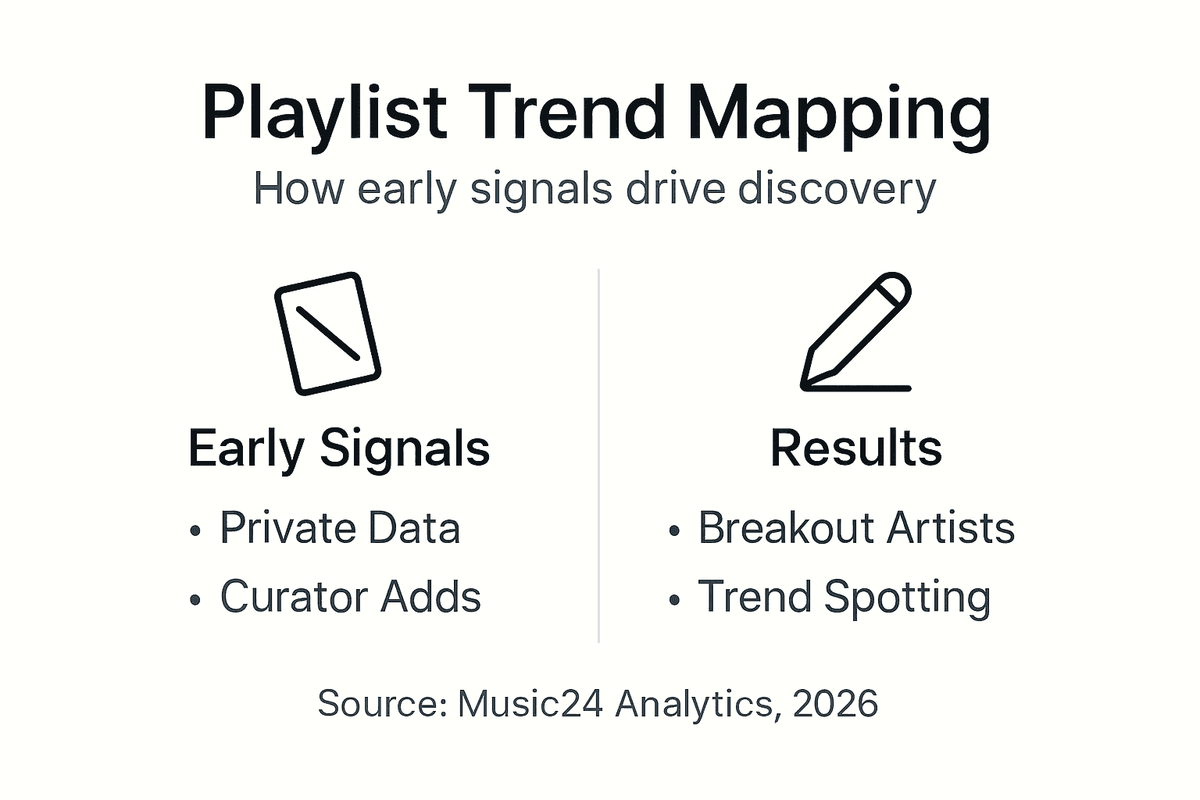
Trend mapping also reveals micro-genre opportunities. Niche sounds like bedroom pop, phonk, or hyperpop emerged from playlist ecosystems before industry labels existed. Spotting these early lets you define categories and position artists as pioneers.
Common Misconceptions and Ethical Considerations in Playlist Curation
Several myths about playlist curation persist despite contradictory evidence. Clearing these misconceptions helps you make smarter strategic decisions.
Myth one: algorithms completely dominate playlist influence. Reality shows human curation still drives roughly 30% of placements, with hybrids blending both approaches. Dismissing human curators means missing critical early exposure opportunities.
Myth two: bigger playlists always deliver better results. Niche playlists with engaged audiences often outperform massive general playlists. A 5,000-follower mood playlist can generate higher save rates and fanbase conversion than a 500,000-follower pop playlist where tracks get skipped.
Myth three: all playlists with substantial followers are authentic. Bot manipulation remains widespread, with fake playlists buying followers to appear influential. Always validate authenticity before investing time in pitching.
Ethical considerations require attention as data analytics capabilities expand. Analyzing private playlist data must respect user privacy through proper anonymization and consent. Platforms providing this data should implement strict privacy protections preventing individual identification.
Bot manipulation risks extend beyond wasted pitching effort. Artificially inflated play counts corrupt algorithmic systems, reducing their effectiveness for genuine discovery. Supporting authentic curation maintains ecosystem health benefiting everyone.
Fair curation principles emphasize:
- Transparent selection criteria and processes
- Equal consideration based on music quality, not payment
- Proper artist credit and metadata accuracy
- Honest engagement metrics without artificial inflation
- Respect for listener preferences and authentic discovery
Transparency builds trust with both curators and listeners. When you validate authenticity, prioritize genuine engagement, and respect ethical boundaries, you contribute to healthier music discovery ecosystems. Ethical playlist curation practices create sustainable competitive advantages versus shortcuts that corrupt data integrity.
Continuous validation remains essential as manipulation tactics evolve. Regularly audit your curator lists, removing accounts showing suspicious patterns. Update authentication methods as platforms change algorithms and data access.
Conclusion: Implementing Data-Driven Playlist Strategies for Competitive Advantage
Integrating private playlist analytics with human curation expertise and algorithmic understanding creates comprehensive discovery strategies. You gain early artist identification capability unavailable through public metrics alone.
Critical actions to operationalize these insights:
- Build private playlist monitoring systems tracking anonymized user collections for emerging patterns
- Develop curator authentication processes validating engagement metrics before pitching
- Create tiered pitching strategies starting with niche playlists before targeting major editorial ones
- Implement trend mapping protocols identifying micro-genres during underground formation phases
- Establish long-term curator relationships through consistent value delivery and respect
- Combine human curation cultural insight with algorithmic amplification for maximum reach
- Monitor ethical standards maintaining data privacy and authentic engagement
Ongoing trend analysis remains essential as listener preferences continuously evolve. What works today may become oversaturated tomorrow. Sustained competitive advantage requires adaptive systems detecting shifts early and repositioning quickly.
Niche targeting delivers superior results versus broad approaches. Mood-specific and micro-genre playlists yield higher engagement, stronger fanbase building, and better conversion metrics than generic placements.
Future advances will make playlist curation even more precise. Machine learning models will better predict breakout potential from early signals. Geographic micro-trend detection will improve targeting regional opportunities. Real-time sentiment analysis will refine mood-based curation.
You can apply the artist discovery checklist to systematically implement these strategies. The competitive edge goes to executives who combine data sophistication with human judgment, moving faster than competitors still relying on outdated public metrics.
Leverage Music24's Advanced Analytics for Superior Playlist Curation
Music24 transforms playlist curation strategy through proprietary private playlist analytics unavailable elsewhere. Our platform analyzes millions of anonymized user collections, detecting emerging artists and trends weeks before public charts reflect them.
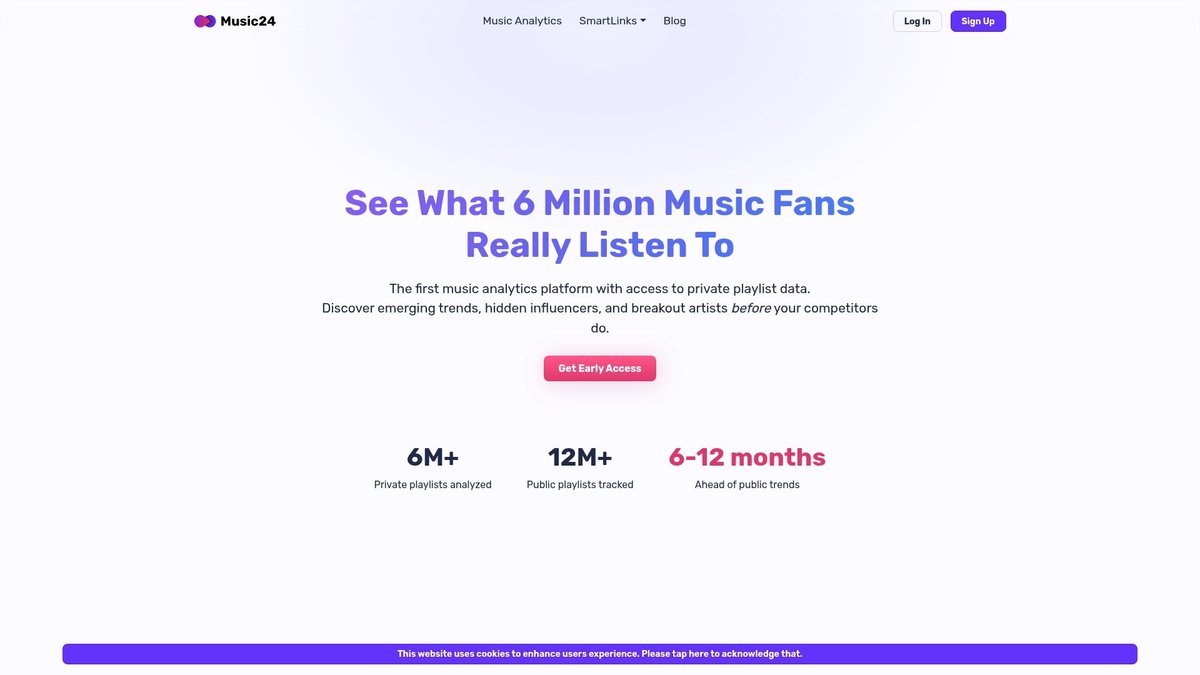
You gain access to tools identifying authentic curators based on proven discovery track records. Our influence scoring reveals which playlist creators consistently surface breakout talent first. Geographic micro-trend mapping shows where new sounds emerge before spreading nationally.
Our early artist discovery analytics empower smarter signing decisions with quantifiable risk assessment. Private playlist analysis tools provide the competitive intelligence needed to spot talent ahead of competitors. Apply our top artist discovery strategies to systematically uncover rising stars before mainstream validation.
Explore our detailed guides and blog resources for deeper insights into leveraging playlist data. Music24 gives you the foresight to act decisively while others wait for public confirmation.
Frequently Asked Questions
What are the main differences between algorithmic and human-curated playlists?
Algorithmic playlists use listener data to automatically generate personalized recommendations at massive scale. Human-curated playlists involve expert editorial selections that add cultural context, recognize artistic merit, and provide early exposure to emerging artists before algorithms surface them.
How can I verify the authenticity of playlist curators before pitching?
Examine stream-to-follower ratios, looking for healthy ratios above 5:1 that indicate genuine engagement. Check for consistent monthly growth patterns rather than suspicious sudden spikes. Review playlist update frequency and curator social presence to confirm active, authentic curation rather than bot-driven manipulation.
Why are niche playlists more effective for emerging artist growth than large general playlists?
Niche playlists attract listeners actively seeking specific moods or micro-genres, yielding higher save rates and repeat listening. These engaged audiences convert to genuine fans more effectively than passive listeners on massive general playlists where tracks compete with hundreds of others and often get skipped quickly.
Recommended
- How Music Discovery Works: Complete Guide for 2025 - Blog - Music24.com
- 7 Essential Playlist Curation Tips for Music Industry Pros - Blog - Music24.com
- Curated Playlist Definition: Shaping Music Discovery Trends - Blog - Music24.com
- Music Curator Influence: Unlocking Data-Driven Discovery - Blog - Music24.com

