
Spotting the next breakout artist rarely comes from following the crowd. For A&R executives and talent scouts aiming to move ahead of the curve, understanding how multi-dimensional data points are transforming music trend analysis is crucial. As AI algorithms, cross-platform patterns, and private playlist insights merge, today's analysis uncovers hidden artist potential and shifting genre lines before they become obvious. This evolving approach empowers professionals to decode authentic listener choices and spot micro-trends that shape tomorrow's global hits.
Table of Contents
- Defining Music Trend Analysis in 2026
- Leveraging Private Playlist Data for Insights
- Identifying Breakout Artists and Micro-Trends
- Evaluating Curator Influence and Genre Blending
- Common Pitfalls in Trend Analysis Methods
Key Takeaways
| Point | Details |
|---|---|
| Modern Trend Analysis | In 2026, music trend analysis incorporates multi-dimensional data, moving beyond traditional charts to understand cultural shifts in music creation and consumption. |
| Private Playlist Insights | Analyzing private playlists reveals genuine listener preferences, offering a deeper understanding of emerging trends and artist discovery. |
| Role of Curators | Curators significantly shape music exploration by blending genres and introducing innovative sounds, acting as key influencers in the music landscape. |
| Avoiding Analytical Pitfalls | To enhance trend analysis accuracy, practitioners must be mindful of biases and employ robust validation techniques to ensure meaningful insights. |
Defining Music Trend Analysis in 2026
Music trend analysis in 2026 represents a sophisticated approach to understanding the complex, dynamic landscape of musical evolution. Unlike traditional methods that relied solely on chart performance or streaming numbers, contemporary analysis now integrates multi-dimensional data points to capture the nuanced ways music is created, consumed, and experienced globally.
The core of modern trend analysis centers on several critical dimensions:
- Hybrid genre exploration
- AI-assisted discovery mechanisms
- Cross-platform consumption patterns
- Emotional and cinematic sound mapping
At its essence, trend analysis now transcends linear genre categorization. Music trend forecasting increasingly examines how sounds blend, transform, and serve multiple contextual purposes - from background ambiance to narrative storytelling. This approach recognizes music as a fluid, adaptive medium that reflects broader cultural shifts.
Technology plays a pivotal role in this evolution. Digital streaming platforms and AI algorithms now provide unprecedented insights into listener behavior, enabling analysts to detect emerging trends with remarkable precision. Streaming innovations have democratized music discovery, allowing independent artists unprecedented opportunities to reach global audiences without traditional gatekeeping mechanisms.
Pro tip: Develop a multidisciplinary approach to trend analysis by combining quantitative streaming data with qualitative emotional and cultural context.
To clarify the changing landscape of music trend analysis, here is a summary of traditional methods vs. modern approaches:
| Aspect | Traditional Analysis (Pre-2020s) | Modern Analysis (2026) |
|---|---|---|
| Data Sources | Charts, radio, sales | Streaming, AI, playlists |
| Genre Focus | Rigid categories | Hybrid, fused genres |
| Technology Use | Manual tracking | AI-driven machine learning |
| Artist Discovery | Gatekeeper control | Democratized via platforms |
Leveraging Private Playlist Data for Insights
Private playlist data has emerged as a revolutionary tool for understanding music consumption patterns and discovering emerging artists. By analyzing these intimate musical collections, industry professionals can uncover nuanced insights that traditional public metrics often miss. User attribute mining reveals how playlist compositions reflect deep psychological and demographic characteristics of listeners.
The power of private playlist analysis lies in its ability to capture several key dimensions:
- Granular listener preferences
- Emerging genre fusion trends
- Early-stage artist discovery
- Listener demographic segmentation
- Emotional and contextual music consumption patterns
Machine learning algorithms have dramatically enhanced the ability to extract meaningful insights from seemingly unstructured playlist data. These advanced techniques allow analysts to detect subtle connections between musical selections that might appear random to the human eye but reveal complex listener behaviors and emerging trends.

Most critically, private playlist data provides an unfiltered view of authentic listener choices. Unlike curated public charts or algorithmic recommendations, these personal collections represent genuine musical preferences uninfluenced by external promotional mechanisms. By understanding these nuanced selections, record labels and artist managers can identify promising talents before they become mainstream.
Pro tip: Develop machine learning models that can decode the semantic and emotional connections between tracks within private playlists to predict future music trends with unprecedented accuracy.
Here’s a comparison of playlist data types and their value for trend identification:
| Playlist Type | Data Accessibility | Value for Trend Analysis |
|---|---|---|
| Public Playlists | Easily accessed | Reflect mainstream tastes |
| Private Playlists | Hard to access | Reveal genuine preferences |
| Curated Playlists | Platform-selected | Influence genre exposure |
Identifying Breakout Artists and Micro-Trends
Discovering emerging musical talent requires sophisticated analytical approaches that go beyond traditional metrics. Visual analytics and knowledge graphs have revolutionized how industry professionals identify potential breakout artists by mapping complex musical ecosystems and predicting trend trajectories.
Key strategies for identifying emerging artists and micro-trends include:
- Analyzing collaborative network dynamics
- Tracking genre fusion patterns
- Monitoring geographic music evolution
- Examining temporal production metrics
- Mapping cross-genre influence networks
Machine learning algorithms play a crucial role in decoding the intricate relationships between artists, genres, and listener behaviors. These advanced computational techniques can detect subtle signals of emerging talent that conventional methods might overlook, providing A&R professionals with unprecedented insights into musical innovation.
Micro-trends represent localized musical movements that often precede broader genre shifts. By carefully examining these granular patterns, industry professionals can identify artists who are not just following trends, but actively reshaping musical landscapes. This approach requires a nuanced understanding of cultural context, technological innovation, and listener psychology.
Pro tip: Develop a multi-dimensional scoring system that integrates collaborative network analysis, genre evolution metrics, and listener engagement data to create a comprehensive artist potential index.
Evaluating Curator Influence and Genre Blending
In the rapidly evolving music landscape, curators have emerged as pivotal architects of cultural discovery, transcending traditional gatekeeping roles. Curators as epistemological practitioners now shape audience awareness by strategically bridging musical genres and challenging established boundaries.
Key dimensions of curator influence include:
- Discovering emerging artists
- Defining genre transformation
- Creating cross-cultural musical narratives
- Challenging traditional genre classifications
- Facilitating innovative sonic experiments
Genre blending represents a sophisticated approach to musical innovation, where curators actively deconstruct traditional sonic boundaries. By crafting playlists and collections that juxtapose seemingly disparate musical styles, these cultural intermediaries create new sonic landscapes that reflect complex contemporary experiences.
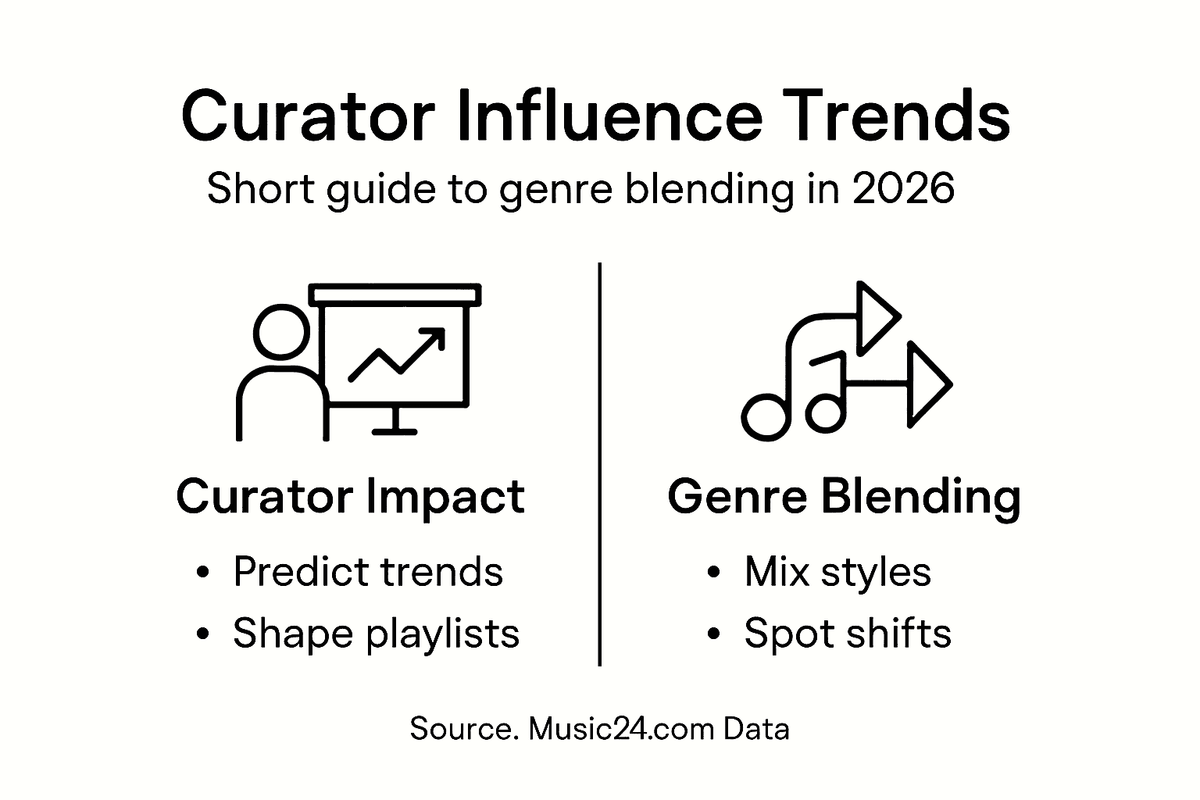
Modern curation goes beyond simple playlist compilation, functioning as a dynamic form of cultural commentary. Curators now operate as sophisticated translators of musical language, interpreting subtle shifts in listener preferences and anticipating emerging artistic movements before they become mainstream trends.
Pro tip: Develop a comprehensive scoring framework that quantifies a curator's ability to predict and influence genre evolution by tracking their historical playlist innovations and emerging artist introductions.
Common Pitfalls in Trend Analysis Methods
Trend analysis in the music industry demands rigorous methodological approaches to avoid critical errors that can derail insights. Common mistakes in trend analysis include systematic biases, oversimplification of complex musical ecosystems, and premature generalization of emerging patterns.
Significant pitfalls in music trend analysis encompass:
- Data collection bias
- Confirmation bias
- Overfitting predictive models
- Neglecting external contextual factors
- Misinterpreting statistical correlations
- Insufficient sample diversity
Statistical limitations can dramatically undermine trend analysis credibility. Researchers must develop sophisticated multi-dimensional frameworks that account for the nuanced, dynamic nature of musical evolution. This requires moving beyond linear predictive models and embracing complexity as an inherent characteristic of cultural trends.
Professional trend analysts recognize that musical landscapes are inherently unpredictable. By maintaining methodological humility and implementing robust validation techniques, they can develop more accurate and meaningful insights. The most effective approach involves continuous model refinement, cross-referencing multiple data sources, and maintaining awareness of potential interpretative blind spots.
Pro tip: Implement a systematic cross-validation process that compares trend predictions against multiple independent datasets to identify and mitigate potential analytical biases.
Discover Breakout Artists Before the Crowd
Struggling to find authentic insights on rising artists and emerging music trends can hold back your ability to innovate. This article highlights how analyzing private playlist data, hybrid genres, and curator influence transforms early artist discovery by revealing genuine listener preferences hidden from traditional public charts. Capture those fleeting micro-trends and genre-blending movements that define tomorrow’s hits by embracing advanced, data-driven strategies.
At Music24.com, we specialize in delivering these crucial insights through our proprietary platform that scrapes millions of private playlists to uncover emerging talent and uncharted musical trends. Our solutions empower A&R teams, artist managers, and music marketers to predict breakout potential with precision, decode curator impacts, and understand nuanced geographic and emotional consumption patterns. Stop guessing. Start identifying real opportunities, early and effectively.
Unlock your competitive edge now with our expert analytics platform that goes beyond public metrics to deliver unparalleled access to authentic music discovery data.

Ready to lead the industry by spotting the next big artists and trends first Visit Music24.com to explore how our predictive analytics and private playlist insights will revolutionize your approach today
Frequently Asked Questions
What is music trend analysis?
Music trend analysis involves examining multi-dimensional data points to understand the evolution of music, focusing on how it is created, consumed, and experienced, rather than just relying on chart performance and streaming numbers.
How do modern methods of trend analysis differ from traditional methods?
Modern trend analysis incorporates advanced technologies like AI, focuses on hybrid genre exploration, and emphasizes cross-platform consumption patterns, moving away from rigid genre categories typical in traditional analysis.
What role does private playlist data play in identifying early-stage artists?
Private playlist data provides insights into genuine listener preferences and emerging trends that public charts might miss, making it a valuable tool for uncovering authentic musical choices and potential breakout artists.
What strategies can be used to identify emerging musical talent?
Strategies include analyzing collaborative network dynamics, tracking genre fusion patterns, and using machine learning algorithms to detect subtle signals of emerging talent, which can lead to identifying artists before they reach mainstream success.

