
Most advice about music discovery misses how deeply personal and unpredictable the process really is for every American listener. With streaming platforms now fueling over 80 percent of all music consumption in the United States, understanding the unique pathways people follow to find their next favorite artist is more valuable than ever. This guide uncovers the hidden stages and overlooked data that shape what you hear, revealing fresh strategies for staying ahead in the dynamic world of new music.
Table of Contents
- Defining The Music Discovery Lifecycle
- Stages Of Music Discovery Evolution
- Private Playlists Vs Public Metrics
- Role Of Influential Curators And Micro-Trends
- Predictive Analytics For Early Artist Breakouts
- Common Pitfalls And Industry Opportunities
Key Takeaways
| Point | Details |
|---|---|
| Understanding the Music Discovery Process | Music discovery is a nonlinear, complex journey involving multiple engagement stages from initial exposure to long-term appreciation. |
| Importance of Private Playlists | Private playlists provide genuine insights into listener preferences, revealing early trends and emerging artists that public metrics do not capture. |
| Role of Influential Curators | Curators significantly shape music discovery, amplifying micro-trends and offering deeper context than algorithmic recommendations. |
| Need for Predictive Analytics | Leveraging predictive analytics can transform artist evaluation into proactive identification of potential breakouts by analyzing multidimensional data. |
Defining the Music Discovery Lifecycle
Music discovery represents a complex, nonlinear journey where listeners encounter, engage with, and ultimately adopt new musical experiences. At its core, this process transcends mere passive listening and transforms into an active exploration of sonic landscapes. Understanding the intricate patterns of music discovery reveals a multifaceted ecosystem driven by individual preferences, technological platforms, and social interactions.
The music discovery lifecycle typically encompasses several critical stages that reflect how listeners interact with emerging artists and genres. These stages include initial exposure, curiosity generation, active exploration, sustained engagement, and potential long-term appreciation. Research investigating user behaviors in domestic music environments demonstrates that discovery is rarely a straightforward progression, but rather a dynamic, iterative process influenced by personal taste, recommendation algorithms, and social networks.
Key components of the music discovery lifecycle involve multiple interaction points. These include algorithmic recommendations from streaming platforms, playlist curation, social media sharing, peer recommendations, live performances, and radio or podcast discoveries. Each touchpoint represents a potential gateway for listeners to encounter new musical content, with some channels proving more influential than others depending on individual listener profiles and genre preferences.
Pro Tip for Music Professionals: Develop a holistic understanding of listener discovery patterns by tracking multiple engagement metrics across different platforms, not just streaming numbers, to gain a comprehensive view of an artist's true discovery potential.
Advanced Discovery Strategy: Monitor private playlist data and micro-genre trends to identify emerging artist breakout opportunities before they become mainstream.
Stages of Music Discovery Evolution
Music discovery has undergone dramatic transformations, driven by technological innovations and changing listener behaviors. Research exploring music discovery among young people reveals significant shifts in how individuals encounter and engage with new musical content, demonstrating a complex, multifaceted evolution across digital and social platforms.
Historically, music discovery progressed through distinct technological stages. In the pre-digital era, listeners primarily discovered music through radio, physical record stores, and personal recommendations. The emergence of digital platforms dramatically reshaped these traditional pathways, introducing algorithmic recommendations, streaming services, and global connectivity that fundamentally altered music consumption patterns. Analyzing popular music's stylistic revolutions from 1960 to 2010 highlights how technological and cultural shifts directly influence musical discovery mechanisms.
The contemporary music discovery ecosystem encompasses multiple interconnected stages: initial exposure, algorithmic recommendation, social validation, deep exploration, and long-term engagement. Each stage represents a sophisticated interaction between listener preferences, technological infrastructure, and social networks. Modern platforms leverage machine learning, collaborative filtering, and extensive user data to create increasingly personalized discovery experiences that transcend traditional genre and geographic boundaries.
Pro Tip for Music Industry Professionals: Develop adaptive discovery strategies that recognize music consumption as a dynamic, nonlinear process, integrating multiple data sources to understand emerging listener trends.
Advanced Discovery Insight: Track micro-genre emergence and cross-platform listener behaviors to anticipate future musical trends before they become mainstream.
Private Playlists vs Public Metrics
Analyzing user music discovery behaviors reveals a critical distinction between private playlist interactions and public streaming metrics. Traditional music industry analytics have predominantly relied on publicly visible data points such as total streams, chart rankings, and social media engagement. However, private playlists represent a more nuanced and authentic representation of listener preferences and emerging musical trends.

The fundamental difference between private playlists and public metrics lies in their underlying motivations and contextual authenticity. Public metrics are often influenced by promotional strategies, algorithmic recommendations, and external marketing pressures. In contrast, private playlist trajectories provide a more genuine mapping of user musical exploration, capturing organic listener behaviors that are unfiltered by commercial imperatives. These private collections represent personal soundtracks, reflecting individual musical journeys that often precede and predict broader market trends.
Private playlist data offers music industry professionals unprecedented insights into listener behavior. By analyzing these curated personal collections, researchers and strategists can identify emerging genre blends, detect nascent artist breakouts, and understand micro-trends before they become mainstream. The granularity of private playlist data allows for more sophisticated predictive modeling, revealing listener preferences that traditional public metrics might obscure or misrepresent. This approach transforms music discovery from a reactive process to a proactive strategy of trend anticipation and artist development.
Here's a comparison of private playlist data and public streaming metrics in music discovery:
| Aspect | Private Playlists | Public Streaming Metrics |
|---|---|---|
| Authenticity | Reflect true personal taste | Influenced by external promotion |
| Discovery Insights | Reveal early trends and breakout artists | Measure broader, established popularity |
| Commercial Influence | Less affected by marketing tactics | Shaped by label promotion and marketing |
| Predictive Value | Strong for identifying emerging patterns | Limited in predicting new phenomena |
Pro Tip for Music Strategists: Develop predictive models that prioritize private playlist data over traditional public metrics to uncover authentic listener preferences and emerging musical trends.
Advanced Discovery Insight: Implement machine learning algorithms that can decode the subtle patterns within private playlist configurations to forecast potential artist breakouts.
Role of Influential Curators and Micro-Trends
Analyzing music discovery among young people reveals the critical role of influential curators in shaping contemporary musical landscapes. These cultural intermediaries—including playlist creators, music bloggers, underground radio hosts, and social media influencers—possess extraordinary power to amplify emerging artists and introduce niche musical genres to broader audiences. Their curative abilities extend far beyond traditional recommendation systems, creating nuanced pathways for musical exploration that transcend algorithmic suggestions.
Micro-trends represent the granular, rapidly evolving musical subcultures that emerge and disseminate through these influential curator networks. Tracking musical stylistic revolutions from 1960 to 2010 demonstrates how these micro-trends function as critical indicators of broader cultural shifts, often predicting significant transformations in musical expression long before mainstream recognition. These nascent trends typically originate in highly specialized, interconnected communities where tastemakers and early adopters collaborate to introduce innovative sonic experiences.
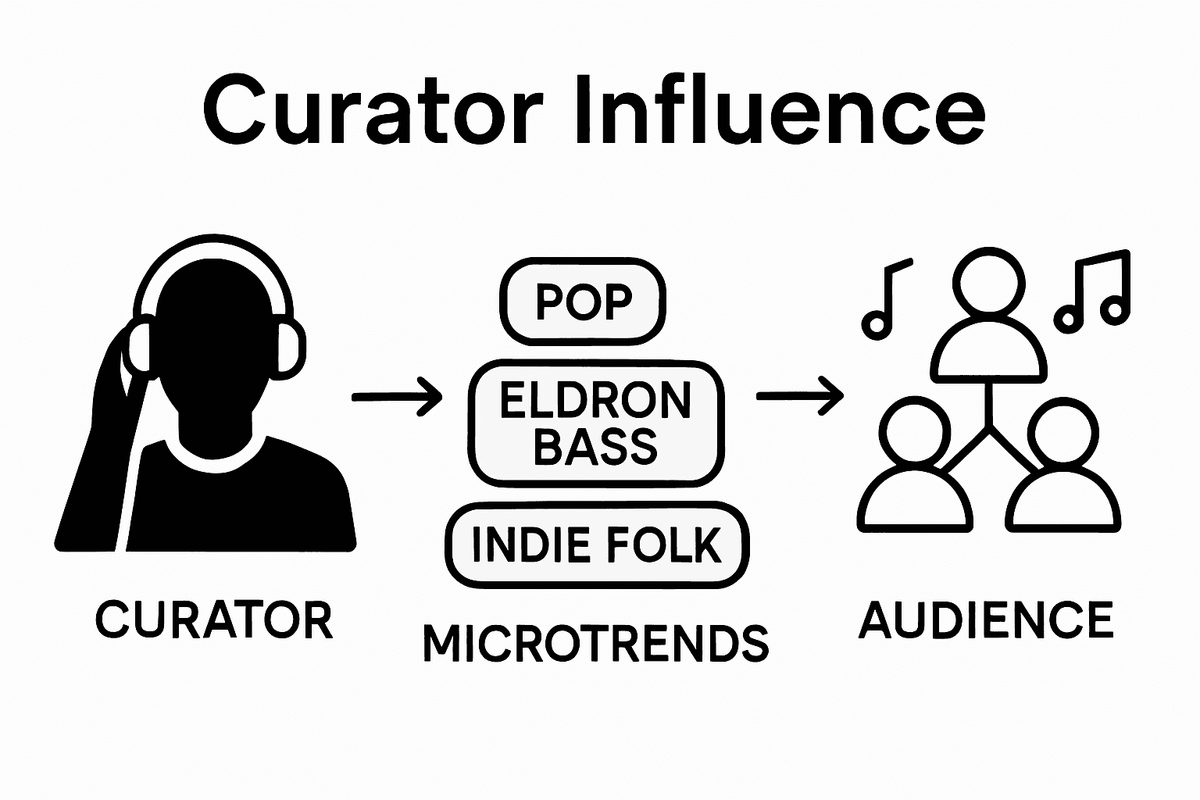
The symbiotic relationship between influential curators and micro-trends creates a dynamic ecosystem of musical discovery. Curators serve as critical filters and amplification mechanisms, identifying promising artists and genres that challenge existing musical boundaries. Their expertise lies not just in selecting music, but in contextualizing and narrativizing emerging sounds, helping listeners understand the cultural significance and emotional resonance of new musical expressions. This process transforms music discovery from a passive consumption experience into an active, collaborative journey of artistic exploration.
The following table summarizes essential roles and impacts of influential curators versus algorithmic recommendations:
| Factor | Influential Curators | Algorithmic Recommendations |
|---|---|---|
| Personalization | High; based on expert taste | High; based on user data |
| Trend Propagation | Drive niche and micro-trends | Amplify mainstream discovery |
| Contextual Storytelling | Deep cultural context for selections | Limited contextual information |
| Impact on Artist Exposure | Highlight emerging or underrepresented artists | Elevate established or trending artists |
Pro Tip for Music Discovery Professionals: Develop comprehensive networks of diverse curators across different musical subcultures to gain multifaceted insights into emerging trends.
Advanced Discovery Insight: Create sophisticated tracking mechanisms that map curator influence and micro-trend propagation across different digital and physical musical ecosystems.
Predictive Analytics for Early Artist Breakouts
Modeling user trajectories across musical genres represents a groundbreaking approach to identifying emerging artist potential through sophisticated data analysis. Predictive analytics in music discovery transforms traditional artist evaluation from retrospective assessment to forward-looking forecasting, enabling music industry professionals to anticipate breakthrough talents before they achieve mainstream recognition. By leveraging complex algorithmic techniques, researchers can now decode intricate patterns of musical consumption and artist emergence with unprecedented precision.
The core methodology of predictive analytics involves analyzing multidimensional data points that extend far beyond traditional streaming metrics. Quantitative research on musical harmonic evolution demonstrates how nuanced characteristics like sonic complexity, listener engagement patterns, and cross-genre interactions can serve as powerful predictors of potential artist breakouts. These advanced analytical frameworks incorporate machine learning algorithms that can detect subtle signals of artistic innovation, tracking emerging artists through their early developmental stages.
Successful predictive analytics for artist breakouts requires integrating diverse data sources, including private playlist interactions, social media sentiment, genre-blending indicators, and listener behavioral patterns. The most sophisticated models combine statistical modeling with contextual understanding, recognizing that musical success is not merely a function of quantitative metrics but a complex interplay of cultural resonance, artistic innovation, and listener psychology. By creating dynamic, continuously learning predictive systems, music industry professionals can transform artist discovery from a reactive process to a proactive strategy of talent identification and development.
Pro Tip for Music Industry Strategists: Develop holistic predictive models that combine quantitative data with qualitative cultural insights to identify truly transformative musical talents.
Advanced Discovery Strategy: Create adaptive machine learning frameworks that can dynamically recalibrate artist potential based on emerging listener behaviors and genre evolution.
Common Pitfalls and Industry Opportunities
Digital music discovery research among young listeners reveals critical challenges facing the music industry in understanding and adapting to rapidly evolving listener behaviors. The primary pitfall lies in the industry's tendency to rely on outdated, linear models of music consumption that fail to capture the complex, nonlinear nature of contemporary musical engagement. Traditional metrics and discovery platforms often create echo chambers that limit listener exposure to genuinely innovative musical experiences.
Analysis of user music exploration patterns highlights significant opportunities for industry transformation. These opportunities center on developing more sophisticated, adaptive discovery ecosystems that prioritize listener agency, contextual diversity, and personalized musical journeys. Successful platforms will need to move beyond algorithmic recommendation systems that merely reinforce existing preferences, instead creating dynamic environments that actively challenge and expand listener musical horizons.
The most promising industry opportunities emerge from reimagining music discovery as a collaborative, contextually rich experience. This requires developing technologies and platforms that can capture nuanced listener preferences, understand cross-genre interactions, and provide intelligent, serendipitous musical recommendations. Key strategic focus areas include enhancing user privacy protections, developing more transparent recommendation algorithms, and creating tools that empower listeners to actively shape their musical exploration rather than passively consuming predetermined content streams.
Pro Tip for Music Innovation Professionals: Design discovery platforms that balance algorithmic precision with human creativity, creating systems that surprise and delight listeners while respecting their individual musical identities.
Advanced Strategy Recommendation: Develop adaptive recommendation frameworks that can dynamically adjust musical suggestions based on contextual and emotional listener signals.
Unlock the Future of Music Discovery with Music24.com
The article highlights the challenge of relying on traditional public metrics that often miss the authentic, organic music discovery process driven by private playlists and influential curators. You want to identify breakout artists early, understand complex listener behaviors, and capitalize on micro-trends before they go mainstream. This calls for a powerful solution that transcends superficial streaming numbers and embraces the nuanced lifecycle of music discovery discussed in the article.
Music24.com addresses these pain points by leveraging proprietary private playlist data that reveals genuine listener preferences hidden from public view. By analyzing millions of anonymized personal playlists, the platform detects emerging trends, genre blending, and rising artists with unmatched predictive insight. This enables record labels, artist managers, and A&R teams to develop data-driven strategies and get ahead in today’s dynamic music ecosystem.
Experience firsthand how Music24 transforms complex discovery patterns into actionable intelligence and empowers your team to identify artist breakouts early and navigate evolving listener tastes.
Elevate your music discovery strategy today with Music24.com.
Discover the power of private playlist analysis at Music24.com and redefine how you uncover tomorrow’s music stars.
Explore our platform now.

Frequently Asked Questions
How does the music discovery lifecycle work?
The music discovery lifecycle involves several stages: initial exposure, curiosity generation, active exploration, sustained engagement, and potential long-term appreciation. It reflects how listeners interact with emerging artists and genres through various channels, including playlists, social media, and recommendations.
What role do private playlists play in music discovery?
Private playlists offer a nuanced view of listener preferences, capturing organic exploration of music that may not be influenced by commercial marketing. They help identify emerging artists and trends before they hit the mainstream, providing valuable insights into genuine listener behavior.
How can predictive analytics help identify emerging artists?
Predictive analytics uses data analysis to interpret complex listener patterns, such as sonic complexity and cross-genre interactions. By analyzing diverse data sources, industry professionals can forecast artist breakouts and anticipate new trends in music discovery.
What are some common pitfalls in understanding modern music discovery?
A common pitfall is relying on outdated, linear models of music consumption which don't reflect the nonlinear nature of contemporary listening. This can create echo chambers that limit exposure to innovative music. Embracing adaptive, personalized discovery systems can address these challenges.
Recommended
- 7 Data-Driven Examples of Rising Artists for Executives - Blog - Music24.com
- How to Leverage Playlist Analytics for Artist Growth - Blog - Music24.com
- Music Trend Analysis Step by Step to Spot Breakout Artists - Blog - Music24.com
- 7 Top Artist Discovery Strategies Every Music Pro Needs - Blog - Music24.com

