Step by Step Music Trend Analysis for Industry Pros
Master step by step music trend analysis using private playlist data. Learn to detect rising trends, analyze curators, and validate insights to stay ahead.

Over 80 percent of american music industry professionals now rely on advanced analytics to predict future hits before they chart. In today’s fast-moving music world, having access to deep insights from private playlist data can set you apart. This guide shows how to uncover hidden patterns, spotlight rising artists, and use smart analytics tools so you can stay ahead of trends and make informed decisions that drive real impact.
Table of Contents
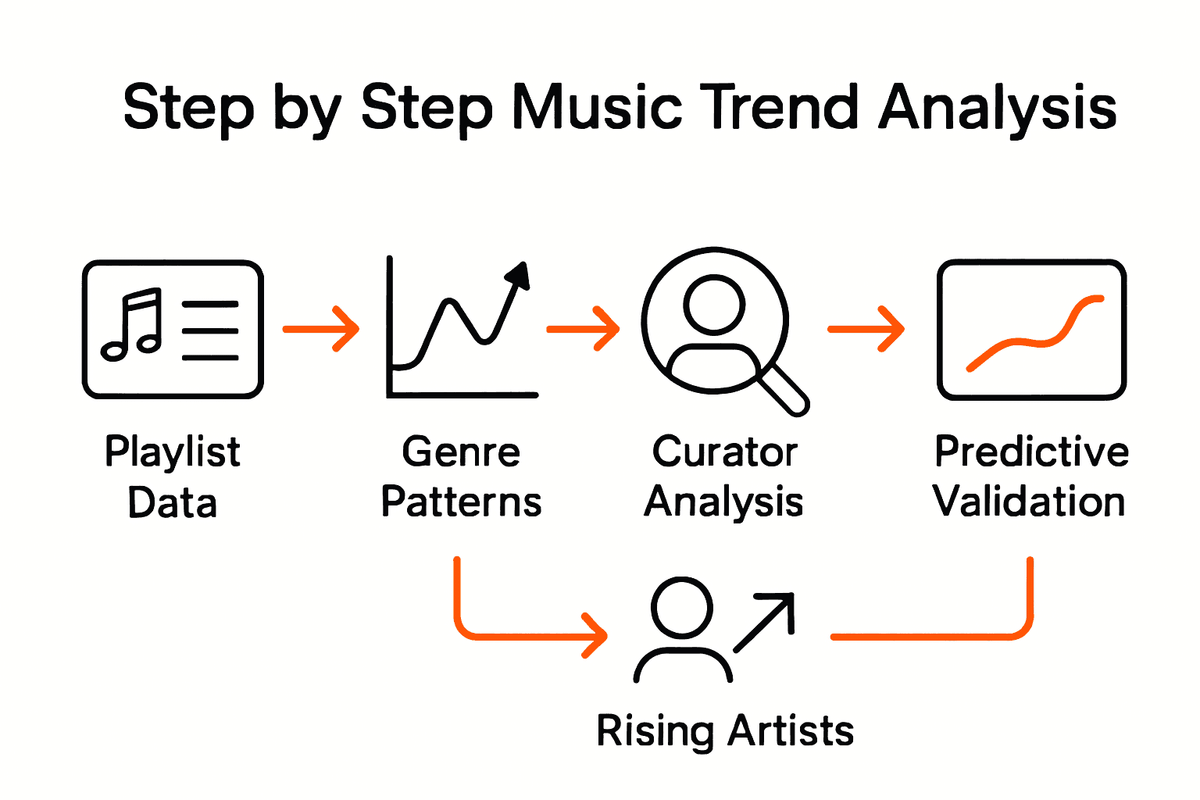
- Step 1: Set Up Access to Private Playlist Data
- Step 2: Identify Emerging Patterns and Genres
- Step 3: Analyze Influential Curators and Playlists
- Step 4: Pinpoint Rising Artists and Micro-Trends
- Step 5: Validate Results with Predictive Analytics
Quick Summary
| Key Takeaway | Explanation |
|---|---|
| 1. Authenticate with a music analytics platform | Create an account with a service that provides private playlist data to access comprehensive insights. |
| 2. Leverage advanced data filtering | Utilize specific filtering options to segment data by genre, demographics, and trends for targeted analysis. |
| 3. Analyze curators beyond followers | Evaluate curators through playlist composition and engagement metrics to identify influential tastemakers in emerging genres. |
| 4. Focus on micro-trends and artist growth | Track rising artists by monitoring engagement and inclusion rates in niche playlists to predict mainstream success. |
| 5. Validate predictions with model comparisons | Continuously compare your trend predictions against real-world data to ensure accuracy and adapt strategies accordingly. |
Step 1: Set Up Access to Private Playlist Data
Accessing private playlist data requires strategic preparation and understanding of specialized music analytics platforms. According to research from ijset, these platforms leverage advanced time series analysis and machine learning models to extract meaningful insights about music consumption patterns.
To begin, you will need to create an authenticated account with a music analytics service that specializes in private playlist tracking. This process typically involves selecting a professional tier subscription that grants you comprehensive data access. Look for platforms offering granular filtering capabilities, allowing you to segment playlist data by genre, geographic region, listener demographics, and emerging music trends.
When setting up your account, prioritize services with robust data anonymization protocols. Explore this guide on private playlist data to understand how professional platforms protect individual user privacy while providing aggregated trend insights. The key is accessing statistically significant playlist information without compromising individual listener confidentiality.
Your next step involves configuring data extraction parameters that align with your specific music industry research goals. Whether you are an A&R representative searching for emerging artists or a marketing professional tracking genre shifts, precise data filtering will be crucial to generating actionable intelligence.
Step 2: Identify Emerging Patterns and Genres
Identifying emerging music patterns and genres requires sophisticated analytical techniques that go beyond traditional listening methods. Research from arxiv reveals advanced approaches for musical genre classification, including innovative feature extraction methods that convert musical sequences into complex network mappings and analyze their topological characteristics.
To effectively detect emerging trends, leverage multiple data points from your private playlist analytics platform. Pay close attention to micro shifts in listener behavior, unexpected genre blending, and recurring musical motifs that signal potential breakthrough styles. Learn more about tracking music micro-trends to refine your analysis strategy and identify nascent musical movements before they become mainstream.
Advanced genre detection involves examining both quantitative and qualitative data signals. According to additional research, successful trend identification relies on extracting repeating musical patterns and using these as representative indicators of potential genre evolution. This means looking beyond surface level streaming numbers and diving deep into the structural characteristics of emerging musical compositions.
Your analytical toolkit should include machine learning algorithms capable of detecting subtle pattern variations, comparative genre mapping, and predictive trend modeling. By combining technological insights with human musical intuition, you can develop a comprehensive approach to identifying the next groundbreaking musical movement before it hits the mainstream charts.

Step 3: Analyze Influential Curators and Playlists
Successfully analyzing influential playlist curators requires a strategic approach that goes beyond surface level metrics. Understanding playlist curator types is crucial for identifying the most impactful tastemakers in your target music segments.
According to research from ijset, effective curator analysis allows for targeted marketing efforts and the development of customized promotional campaigns. Focus on identifying curators who demonstrate consistent influence in emerging genres, tracking their playlist composition, audience engagement rates, and track selection patterns.
Your analytical process should include examining several key dimensions of playlist curation. Look beyond raw follower numbers and investigate factors such as playlist update frequency, genre diversity, listener retention rates, and the curator's ability to introduce new artists before they become mainstream. The goal is to map out influencers who consistently demonstrate musical discovery capabilities and have a proven track record of shaping listener preferences.
Pro tip: Pay special attention to niche curators who specialize in specific subgenres or emerging musical styles.
These tastemakers often provide the most accurate early indicators of potential breakout trends and can offer invaluable insights into listener behavior before broader market recognition occurs.
Step 4: Pinpoint Rising Artists and Micro-Trends
Pinpointing emerging artists and micro-trends requires a sophisticated analytical approach that combines data science with musical intuition. Learn about trend analysis strategies to develop a comprehensive method for identifying potential breakout talents.
According to research from ijset, effective trend prediction involves leveraging time-series analysis and advanced machine learning models like ARIMA and LSTM. These sophisticated techniques can help forecast potential chart-topping tracks and predict shifts in music preferences before they become mainstream.
Your analytical process should focus on multiple data points beyond traditional streaming metrics. Examine factors such as playlist inclusion rates, engagement velocity, social media momentum, and geographic streaming patterns. Look for artists experiencing exponential growth in niche communities or those generating significant buzz in specific music subgenres.
Pro tip: Pay special attention to artists demonstrating consistent audience growth and unique sonic characteristics. By analyzing song release dates, listening peak patterns, and seasonal trends, you can anticipate when an artist is likely to break into broader musical consciousness and potentially become the next significant industry breakthrough.
Step 5: Validate Results with Predictive Analytics
Validating music trend analysis requires a rigorous approach that combines statistical modeling with comprehensive data verification. Learn advanced predictive analytics techniques to ensure the accuracy and reliability of your trend identification process.
According to research from ijset, effective validation involves leveraging sophisticated time-series analysis and machine learning models like ARIMA and LSTM. These advanced techniques enable music industry professionals to forecast potential chart-topping tracks and predict genre shifts with remarkable precision.
Your validation strategy should incorporate multiple cross-referencing methods. Compare your initial trend predictions against actual streaming data, playlist inclusion rates, social media engagement metrics, and geographic listening patterns. Look for consistent correlation between your predictive models and real-world music consumption behaviors. Pay special attention to the predictive model's accuracy in identifying emerging artists and genre transitions before they become widely recognized.
Pro tip: Develop a dynamic validation framework that continuously updates your predictive models based on new data inputs. By implementing a flexible analytical approach that adapts to changing music consumption patterns, you can maintain the highest level of trend analysis accuracy and stay ahead of the rapidly evolving music industry landscape.
Unlock the Power of Private Playlist Analysis for Music Industry Success
The challenge described in "Step by Step Music Trend Analysis for Industry Pros" is clear: breaking through the noise to identify emerging artists, micro-trends, and influential curators before the public charts catch on. Many professionals struggle with incomplete data that overlooks private playlist insights and subtle genre shifts. This leaves key decisions vulnerable to guesswork rather than data-driven confidence.
At Music24.com, we provide the exact solution to these critical pain points. Our specialized platform uses proprietary access to anonymized private playlist data to reveal authentic music discovery patterns invisible to others. With powerful predictive analytics and detailed curator influence tracking, you gain the competitive edge needed to identify breakout talent and emerging micro-trends in real-time. This deep insight transforms your approach to marketing campaigns and artist development by grounding every move in robust data rather than surface-level streaming numbers.
See how data from private playlists can redefine your strategy and give you the early advantage you need.

Experience the future of music trend analysis today. Visit Music24.com and start uncovering tomorrow’s hits before anyone else. Elevate your music research by learning how to understand private playlist data and track music micro-trends with expert precision. Don't wait for trends to surface publicly act now and secure your position at the forefront of the music industry.
Frequently Asked Questions
How do I set up access to private playlist data for trend analysis?
To set up access, create an authenticated account with a music analytics service that specializes in private playlist tracking. Choose a professional tier subscription that provides comprehensive data access and focuses on user privacy protocols.
What techniques can I use to identify emerging music patterns and genres?
Utilize data points from your playlist analytics platform and monitor micro shifts in listener behavior, genre blending, and musical motifs. Analyze these trends using machine learning algorithms to detect subtle pattern variations and forecast potential breakthroughs.
How can I analyze influential playlist curators?
To analyze playlist curators, examine their influence by looking at their playlist composition, audience engagement rates, and update frequency. Focus on curators who consistently introduce new artists, as they can offer valuable insights into emerging trends.
What data points should I focus on when pinpointing rising artists and micro-trends?
When identifying rising artists, look at factors such as playlist inclusion rates, engagement velocity, and social media activity. Consider artists with significant growth in niche communities or those generating buzz in specific music subgenres.
How do I validate my music trend analysis results?
To validate your analysis, cross-reference your initial predictions against actual streaming data and engagement metrics. Develop a dynamic validation framework to continuously update your models based on new data inputs, ensuring ongoing accuracy in your trend analysis.
What role do predictive analytics play in music trend analysis?
Predictive analytics enhances your trend analysis by providing sophisticated modeling techniques that forecast chart-topping tracks and genre shifts. Implement advanced models and regularly check for consistency between predictions and real-world music consumption behaviors.
Recommended
Get your music heard. Skip the content grind.
Add a song. Music24 makes the posts and the videos, plans your release and publishes it on every channel. Free for 7 days on the Pro plan, no card.