Music data can predict hits, spot tomorrow’s superstars, and guide every move by top labels. Yet even with all that power, most professionals still dive in with goals that are far too vague. The real breakthrough starts with objectives so precise that a single research question can change the course of a campaign and drive music industry innovation like never before.
Table of Contents
- Step 1: Define Your Analytics Goals And Objectives
- Step 2: Gather Relevant Data Sources For Analysis
- Step 3: Analyze Data Using Music Analytics Tools
- Step 4: Interpret Insights And Identify Trends
- Step 5: Apply Findings To Inform Strategy
- Step 6: Monitor Results And Adjust Tactics
Quick Summary
| Key Point | Explanation |
|---|---|
| 1. Define Specific Objectives | Establish clear, measurable analytics goals to guide data analysis effectively. |
| 2. Aggregate Diverse Data Sources | Curate varied information from streaming platforms, social media, and more for deeper insights. |
| 3. Use Advanced Analytical Tools | Implement specialized software to process data and uncover trends within the music industry. |
| 4. Contextualize Insights | Connect quantitative findings to industry narratives for strategic decision-making. |
| 5. Monitor and Adapt Strategies | Continuously track performance and adjust tactics based on real-time data feedback. |
Step 1: Define Your Analytics Goals and Objectives
Successful music analytics requires a strategic foundation built on clear, measurable objectives. Your initial step involves establishing precise goals that transform raw data into meaningful insights for industry decision making. Before diving into complex analytical processes, understanding exactly what you want to discover or improve becomes paramount.
Most music industry professionals approach analytics with broad, unfocused intentions. Instead, your objectives must be laser targeted and specific. Are you seeking to understand listener behavior across different demographics? Looking to identify emerging artist trends before they hit mainstream charts? Pinpointing precise research questions will dramatically improve the quality and relevance of your analytics efforts.
Crafting Strategic Analytical Objectives
Begin by conducting an internal assessment of your organization's most critical music industry challenges. According to research from music analytics experts, successful data strategies emerge from well-defined questions rather than generic exploration. Your objectives might include discovering niche audience segments, predicting genre crossover potential, tracking playlist curator influence, or understanding streaming platform dynamics.
Consider establishing objectives across multiple dimensions:
- Artist Development: Tracking early signals of potential breakthrough musicians
- Marketing Optimization: Understanding listener engagement patterns
- Revenue Projection: Analyzing potential monetization strategies
- Audience Segmentation: Identifying nuanced listener demographics and preferences
Each objective should connect directly to actionable business outcomes. Vague goals like "understand music trends" will not provide meaningful insights.
 Instead, frame objectives as specific questions: "Which emerging indie rock subgenres are gaining traction among 18-25 year old listeners in urban markets?"
Effective goal setting requires collaboration between data analysts, marketing teams, and creative executives. This cross functional approach ensures that your analytics process remains aligned with broader organizational strategies. By establishing clear, measurable objectives upfront, you transform data from a passive resource into an active strategic tool driving music industry innovation.
Step 2: Gather Relevant Data Sources for Analysis
Data collection represents the critical backbone of any robust music analytics process. After establishing clear objectives in your initial step, you must now strategically identify and aggregate diverse data sources that will provide comprehensive insights into music industry dynamics. The goal is not simply collecting data, but curating a high quality information ecosystem that supports meaningful analysis.
Successful data gathering requires understanding the multifaceted nature of music industry information. Streaming platforms, social media metrics, playlist data, listener demographics, and geographical engagement statistics each contribute unique perspectives to your analytical framework. Professional music analysts recognize that no single data source tells the complete story.
Comprehensive Data Source Strategy
Begin by mapping potential data sources across different domains. Digital streaming platforms like Spotify, Apple Music, and YouTube offer granular listener engagement metrics. Social media channels provide sentiment analysis and fan interaction data. According to research on music analytics methodologies, integrating multiple data streams significantly enhances predictive capabilities.
Consider collecting data from these strategic sources:
- Streaming Platform APIs: Detailed listener behavior and consumption patterns
- Social Media Engagement Metrics: Fan interactions, trending artist conversations
- Radio Airplay Tracking Systems: Traditional media exposure measurements
- Concert and Live Performance Data: Audience size and geographic distribution
- Playlist Curator Networks: Influencer and playlist momentum tracking
Authentic data collection requires both technical infrastructure and strategic partnerships. Many professional music analytics teams develop relationships with data providers, negotiate API access, and invest in specialized data aggregation tools. Recognize that raw data must be processed, cleaned, and normalized to generate meaningful insights.
Verify your data gathering process by ensuring comprehensive coverage, cross referencing multiple sources, and maintaining consistent data collection protocols. The quality of your subsequent analysis depends entirely on the breadth, depth, and reliability of the information you compile in this crucial step.
The table below provides a quick overview of major data sources in music analytics and the unique insight each contributes to a comprehensive industry analysis.
| Data Source | Unique Insight Provided | Example Use Case |
|---|---|---|
| Streaming Platform APIs | Granular listener behavior, consumption patterns | Identifying top geographies for a new single launch |
| Social Media Metrics | Fan engagement, sentiment analysis | Tracking viral artist conversations across platforms |
| Radio Airplay Data | Traditional media exposure | Measuring cross-market radio impact for a song |
| Concert and Live Performance Data | Audience size, geographic attendance | Assessing fan bases for potential tour stops |
| Playlist Curator Networks | Influencer impact, playlist momentum | Spotting influential playlists driving artist growth |
Step 3: Analyze Data Using Music Analytics Tools
Transforming raw data into actionable insights requires sophisticated analytical tools designed specifically for the music industry's complex ecosystem. This step moves beyond data collection, diving deep into computational analysis that uncovers hidden patterns, trends, and strategic opportunities. Professional music analytics demands precision, advanced algorithmic processing, and nuanced interpretation.
Modern music analytics platforms leverage machine learning and advanced statistical models to extract meaningful information from massive datasets. These tools go far beyond simple statistical tracking, providing predictive models that can anticipate listener behaviors, genre shifts, and emerging artist potential. You will need specialized software capable of processing multiple data streams simultaneously while generating comprehensive, intelligible reports.
Strategic Tool Selection and Implementation
Choosing the right analytical tools requires careful consideration of your specific objectives. Some platforms specialize in streaming data analysis, while others focus on social media sentiment or playlist curator influence. According to research from music industry analytics experts, successful analysis depends more on the analyst's strategic approach than on any single tool.
Key capabilities to seek in music analytics tools include:
- Advanced algorithmic pattern recognition
- Multi platform data integration
- Real time trend tracking
- Predictive modeling capabilities
- Comprehensive visualization options
Professional analysts recommend a holistic approach to tool selection. No single platform will provide complete insights. Instead, consider building a complementary toolkit that allows cross referencing and validation. Learn more about detecting music trends early to understand the nuanced strategies top industry professionals employ.
Successful data analysis requires more than technical proficiency. You must develop an analytical mindset that views data as a narrative waiting to be understood. Each dataset tells a story about listener preferences, artist potential, and industry dynamics. Your role is to become a skilled interpreter, translating complex mathematical models into strategic recommendations that drive music industry innovation.

Step 4: Interpret Insights and Identify Trends
Interpreting data insights represents the critical moment where raw numbers transform into strategic understanding. This step transcends mere statistical observation, requiring sophisticated analytical thinking that connects quantitative patterns to meaningful music industry narratives. Successful trend identification demands both technical expertise and creative intuition.
Professional analysts approach trend interpretation as a nuanced art form, recognizing that data points are interconnected signals revealing deeper industry dynamics. You must move beyond surface level metrics to understand the contextual significance of emerging patterns, distinguishing between temporary fluctuations and genuine transformative trends.
Contextualizing Musical Trend Signals
Effective trend analysis requires a multidimensional perspective that considers genre evolution, listener behavior, technological shifts, and cultural influences. According to research examining music industry analytics, successful interpretation involves comparing current data against historical benchmarks and understanding complex interconnected variables.
Key approaches for comprehensive trend identification include:
- Cross referencing multiple data sources
- Examining longitudinal performance metrics
- Identifying emerging subgenre micro trends
- Tracking listener demographic shifts
- Analyzing geographic music consumption patterns
Professional music strategists develop a holistic analytical framework that synthesizes quantitative data with qualitative understanding. Numeric trends mean little without contextual interpretation. Learn more about interpreting music data effectively to refine your analytical approach.
Verification of successful trend identification involves establishing clear predictive markers. Can your insights anticipate future music industry movements? Are your observations supported by multiple independent data streams? Rigorous trend analysis transforms data from passive information into a powerful strategic tool, enabling music industry professionals to make informed, forward thinking decisions that capitalize on emerging opportunities.
Step 5: Apply Findings to Inform Strategy
Transforming analytical insights into actionable business strategies represents the most critical phase of the music analytics process. This step bridges the gap between data interpretation and real world implementation, where sophisticated research translates into concrete industry decisions. Strategic application requires both creative thinking and systematic execution.
Successful music industry professionals understand that raw data means nothing without strategic translation. Your analytical findings must directly inform marketing approaches, artist development, audience targeting, and revenue optimization. This is where technical analysis meets creative strategic planning.
Developing Targeted Organizational Strategies
Effective strategy development involves cross functional collaboration, ensuring that insights from data analysis permeate multiple organizational departments. Marketing teams, artist management, and executive leadership must work together to implement data driven recommendations. According to research examining music business intelligence, organizations that effectively translate analytical insights outperform competitors by significant margins.
Key strategic implementation approaches include:
- Developing targeted marketing campaigns based on listener demographic insights
- Refining artist recruitment and development strategies
- Optimizing release timing and promotional efforts
- Identifying potential collaboration and cross genre opportunities
- Adjusting resource allocation based on predictive trend analysis
The most powerful strategic applications require nuanced interpretation beyond surface level metrics. Your goal is not just to understand data, but to anticipate future industry movements and position your organization strategically ahead of emerging trends.
Verification of successful strategy application involves establishing clear performance metrics and conducting periodic reassessments. Can you demonstrate tangible improvements in audience engagement, revenue generation, or artist development resulting from your analytical insights? Continuous iteration and refinement separate exceptional music industry strategists from average performers.
Step 6: Monitor Results and Adjust Tactics
Continuous performance monitoring represents the critical final phase of the music analytics process, transforming static strategies into dynamic, responsive organizational approaches. This step ensures that your initial insights evolve alongside rapidly changing music industry landscapes. Effective monitoring goes beyond simple data tracking, requiring sophisticated adaptive mechanisms that enable real time strategic refinement.
Professional music industry analysts understand that initial strategies are merely starting points. The most successful organizations develop robust feedback loops that allow immediate tactical adjustments based on emerging performance indicators. Your monitoring approach must be both comprehensive and agile, capturing nuanced shifts in listener behavior, market dynamics, and artistic trends.
Implementing Adaptive Performance Tracking
Establishing a dynamic monitoring framework involves creating multiple performance measurement streams that provide holistic visibility into your strategic outcomes. According to research examining music industry analytics, organizations that implement continuous monitoring strategies demonstrate significantly higher adaptability and competitive resilience.
Key monitoring and adjustment tactics include:
- Implementing real time performance dashboards
- Establishing periodic strategic review cycles
- Creating flexible response protocols
- Developing early warning measurement systems
- Tracking comparative performance against initial projections
Successful monitoring requires developing an organizational culture of continuous learning and adaptation. Your analytics process should not be a static exercise but a dynamic, iterative approach that embraces uncertainty and rapid change. Learn more about detecting music trends early to enhance your monitoring capabilities.
Verification of effective monitoring involves demonstrating tangible strategic pivots driven by performance data. Can you articulate specific instances where your initial approach was modified based on emerging insights? The most sophisticated music industry professionals view their analytical process as a living, breathing ecosystem of continuous improvement and strategic refinement.
Below is a summary checklist to help verify each phase of your music analytics process is thorough, robust, and aligned with industry best practices.
| Step | Verification Criteria | How to Confirm Completion |
|---|---|---|
| Define Objectives | Objectives are specific, measurable, and actionable | Evaluate against business outcomes and seek stakeholder alignment |
| Gather Data | Data is comprehensive, diverse, and high quality | Cross-reference sources and ensure coverage of key domains |
| Analyze Data | Tools chosen match objectives and capability needs | Review tool capability checklists and ensure integration |
| Interpret Insights | Trends are validated and contextually understood | Compare across multiple historical and demographic benchmarks |
| Apply Strategy | Findings directly influence actual business actions | Check for strategic implementation and adjust as needed |
| Monitor & Adjust | Performance is tracked and tactical pivots made | Document changes based on performance data and regular reviews |
Unlock Industry-Leading Music Trends Before Anyone Else
Many music professionals feel frustrated by slow or incomplete analytics. You want to move with confidence through each step of the process. But public data and surface-level insights make trend discovery difficult. When you need to detect true breakout artists or predict the next genre shift, relying only on traditional tools leaves you trailing behind the competition.
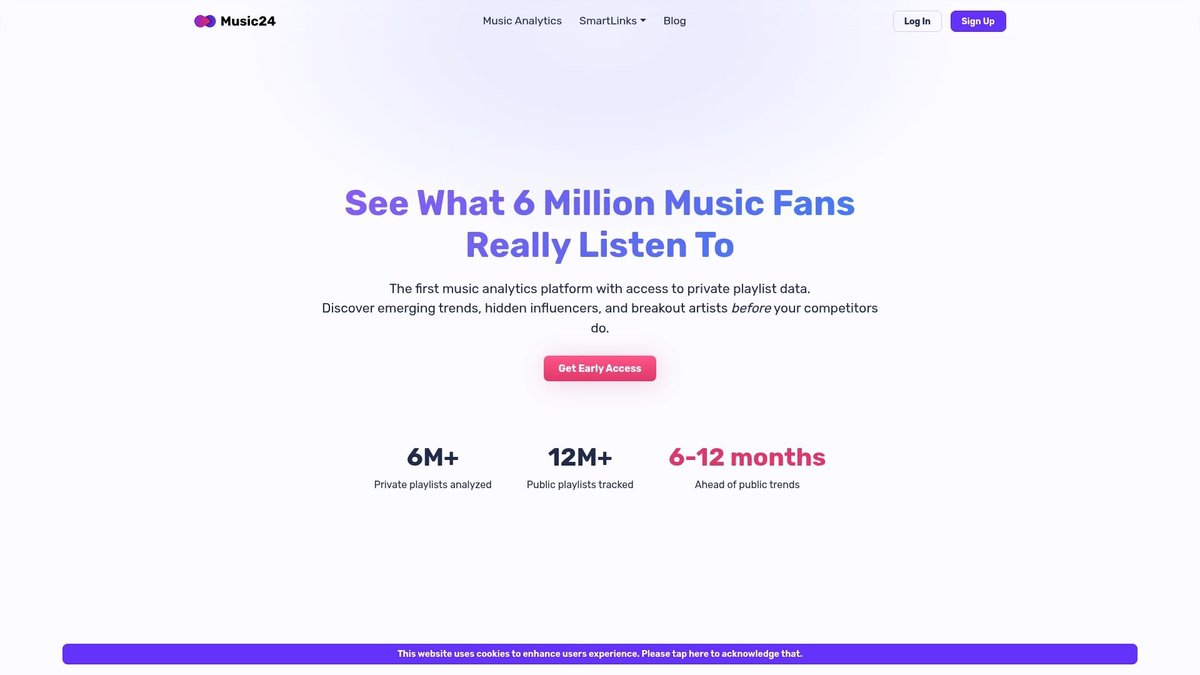
Break free from surface analysis. Music24.com helps you reach your analytics goals by opening up unique private playlist data. You can spot trends and rising stars before they are visible anywhere else, and make smarter, faster decisions with tools built for high-impact professionals. Discover how true music analytics works. Explore possibilities and start transforming your strategy with the edge only Music24.com can deliver. Visit our main platform now to get started.
Frequently Asked Questions
What are the essential steps in the music analytics process?
The essential steps in the music analytics process include defining analytics goals and objectives, gathering relevant data sources, analyzing data using music analytics tools, interpreting insights and identifying trends, applying findings to inform strategy, and monitoring results while adjusting tactics.
How can I define effective analytics objectives in the music industry?
To define effective analytics objectives, start by conducting an internal assessment of your organization's challenges. Focus on creating specific, measurable questions such as understanding listener behavior or predicting artist trends, rather than vague goals.
What types of data sources should I consider for music analytics?
Consider a variety of data sources for music analytics, including streaming platform APIs, social media engagement metrics, radio airplay tracking systems, concert and live performance data, and playlist curator networks. Each source provides unique insights into the music industry landscape.
How do I interpret insights from music analytics?
Interpreting insights involves analyzing data patterns in context, comparing them against historical benchmarks and other data sources. Look for emerging trends, demographic shifts, and genre evolutions to gain a well-rounded understanding of the music landscape.
Recommended
- Understanding the Guide to Music Data Interpretation - Blog - Music24.com
- How to Detect Music Trends Early and Stay Ahead in 2025 - Blog - Music24.com
- 7 Playlist Analytics Examples to Boost Your Strategy - Blog - Music24.com
- How to Leverage Private Playlist Data for Artist Growth - Blog - Music24.com

