
Spotting breakout artists before they top charts is every A&R executive's goal, yet relying on public metrics often means chasing trends that are already mainstream. Private playlist data reveals genuine listener intent, exposing hidden signals of artist discovery and genre shifts months ahead of public streaming numbers. By analyzing these authentic music preferences, you gain actionable intelligence to identify emerging talent and forecast market momentum across global regions, giving your label a decisive head start in 2025.
Table of Contents
- Defining Playlist Data and Its Impact
- Private vs Public Playlist Insights Explained
- Predictive Trend Analysis Using Playlist Data
- Influential Curators and Emerging Artist Signals
- Risks, Ethics, and Competitive Advantages in 2025
Key Takeaways
| Point | Details |
|---|---|
| Importance of Playlist Data | Playlist data uncovers genuine listener preferences, providing insights into emerging trends before they appear in public metrics. |
| Competitive Advantage | Access to private playlist trends allows for faster A&R decisions and lower costs for acquiring emerging talent. |
| Public vs Private Metrics | Public metrics reflect algorithmic influence, while private playlists signal authentic listener choices and artist potential. |
| Ethics in Data Usage | Ensuring clear user consent and transparency in handling private data builds trust and strengthens competitive positioning in the market. |
Defining Playlist Data and Its Impact
Playlist data represents far more than simple song collections. When you analyze what listeners add to their personal playlists, you uncover authentic musical preferences that don't appear on public charts or social metrics.
Unlike public streaming numbers, private playlist data reveals the music people genuinely love. These are intentional choices made in isolation, free from social influence or algorithm visibility.
Why Playlist Data Matters for A&R Teams
Private playlists function as early warning systems for emerging trends. You gain access to real listener behavior months before it shows up in mainstream metrics.
Consider what playlist collections reveal about user preferences: they expose demographic patterns, musical taste clusters, and personality-driven listening habits. This intelligence is invaluable when scouting new talent.
The data reveals:
- Songs curators add before any streaming spike occurs
- Genre blending patterns that signal emerging subgenres
- Geographic micro-trends unique to specific regions
- Repeat listener behavior and engagement depth
- Cross-genre discovery pathways showing how audiences find new music
How Playlist Data Differs from Public Metrics
Public streaming numbers reflect algorithm recommendations as much as listener preference. Playlist additions show deliberate curation choices.

A track with 50,000 streams from algorithmic playlists might have only 500 real additions from intentional curators. That smaller number signals authentic discovery potential.
Playlist data captures the moment a listener decides an artist deserves a permanent spot in their collection. That decision matters more than passive playlist skips.
Private playlist additions indicate genuine artist discovery before public metrics confirm trends, giving your label months of competitive advantage in talent identification.
The Competitive Edge
When you access private playlist trends, you identify rising artists before mainstream platforms recognize them. This translates directly to faster A&R decisions and lower acquisition costs for emerging talent.
You're not following trends. You're detecting them before they exist at scale. That's the difference between discovering an artist at 10,000 monthly listeners versus 500,000.
Pro tip: Focus on artists appearing across multiple private playlists in different regions rather than those dominating a single curator's collection. Distributed private playlist presence indicates authentic cross-demographic appeal.
Private vs Public Playlist Insights Explained
Public and private playlists operate in completely different worlds. Understanding the distinction between them is essential for your A&R strategy.
Public playlists are visible, discoverable, and optimized for algorithm recommendations. Private playlists are hidden collections where listeners make deliberate, uninfluenced choices about music they truly value.
The Core Difference
When a listener adds a song to a public playlist, they know others will see it. This creates social considerations that influence their choices. When they add to a private playlist, only they see it.
Private playlist data contains deeper personal consumption patterns that reveal authentic preference without social filtering. That's where your breakthrough discoveries happen.
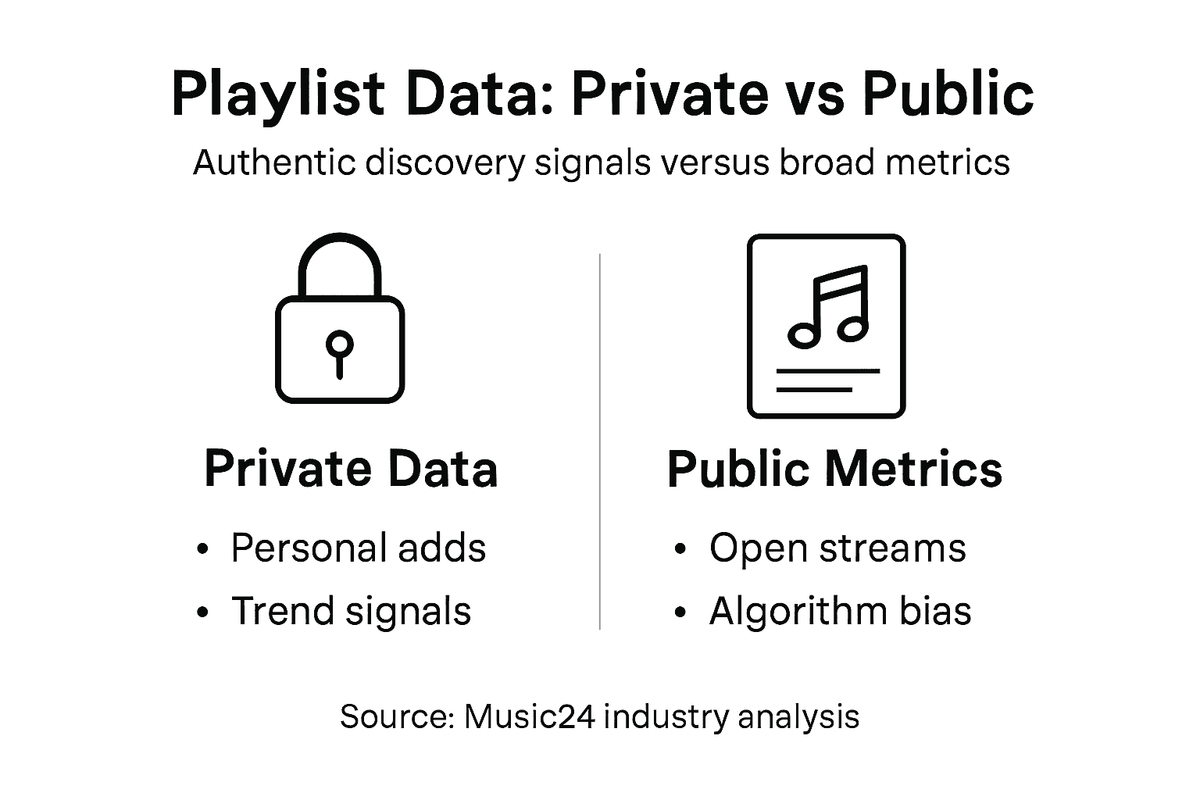
Public playlists attract music that performs well algorithmically or socially. Private playlists attract music that resonates personally.
Why This Matters for Artist Discovery
Public streaming numbers can be misleading. A track might accumulate millions of streams through algorithmic placement while receiving minimal private playlist additions.
Consider this scenario: Artist A gets 2 million algorithmic streams but 300 private playlist adds. Artist B gets 400,000 streams but 2,800 private playlist adds. Artist B shows genuine discovery momentum. Artist A shows algorithmic success.
Your A&R decisions should prioritize the Artist B scenario. That's authentic growth trajectory.
Key Differences Between Public and Private Data
- Public playlists: Algorithm-influenced, socially visible, trending data
- Private playlists: Genuine preference signals, hidden curation, authentic discovery
- Public metrics: Measure playlist visibility and algorithm effectiveness
- Private metrics: Measure real listener intent and artist potential
- Public reach: Shows what listeners heard; private reach shows what they chose
- Public timing: Reflects algorithm promotion cycles; private timing reflects organic discovery
Private playlist additions predict long-term artist success better than public streaming metrics because they measure deliberate listener choice, not algorithmic placement.
Competitive Intelligence from Private Data
Your competitors monitor public charts. You monitor private playlists and gain months of advance notice on rising artists.
When a track begins accumulating significant private playlist adds across different regions, you're witnessing authentic discovery in motion. This is when you move on acquisition or development decisions.
Public data shows you what already happened. Private data shows you what's about to happen.
Pro tip: Track the ratio of private playlist adds to total streams for each artist you monitor. A ratio above 0.5% indicates genuine discovery potential; below 0.1% suggests algorithmic inflation with weak organic support.
Here's a concise comparison of public and private playlist data for A&R strategies:
| Aspect | Public Playlists | Private Playlists |
|---|---|---|
| Visibility | Open to everyone | Only the user sees |
| Influence | Driven by algorithms & trends | Driven by personal taste |
| Data Quality | Heavily influenced by virality | Shows genuine artist discovery |
| Strategic Value | Identifies current hits | Reveals emergent trends early |
| Best Use Case | Track mainstream success | Spot breakthrough potential |
Predictive Trend Analysis Using Playlist Data
Playlist data doesn't just show you what listeners loved yesterday. It reveals what they'll obsess over tomorrow. That's the power of predictive trend analysis.
When you analyze playlist patterns across millions of collections, hidden signals emerge. Genre shifts, artist momentum, and listener behavior changes become visible months before they hit mainstream charts.
How Prediction Works with Playlist Data
Playlist data functions like a seismic sensor for the music industry. Small tremors in private collections precede major earthquakes in public streaming.
Deep learning models applied to streaming playlist data forecast listening behaviors and genre popularity shifts with surprising accuracy. Time-series analysis reveals consumption patterns that predict future success.
You're essentially reading listener intent before it materializes into chart performance.
The Prediction Process
Playlist analysts track three core metrics:
- Addition velocity: How quickly songs accumulate playlist adds over time
- Demographic spread: Which listener segments are adopting a track across regions
- Cross-genre movement: How tracks jump between genre categories, signaling trend expansion
- Curator influence: Which tastemakers are adding the track, indicating potential velocity
- Retention rates: Whether listeners keep songs in playlists or remove them after initial novelty
These metrics combined form a predictive model. When velocity accelerates across multiple demographics while retention stays strong, you're witnessing trend formation.
Practical Application for A&R Teams
Your competitors react to trends. You anticipate them using playlist analytics.
When a song shows 40% week-over-week growth in private playlist adds while climbing only marginally in public streams, that's your signal. The public metrics will follow. The question is whether you're already invested.
This timing advantage directly impacts artist acquisition costs and development investment decisions.
Playlist data predictive models give labels 8-12 weeks of advance notice on emerging trends, allowing strategic positioning before competitors recognize the pattern.
Building Your Prediction Strategy
Effective prediction requires monitoring specific trend indicators:
- Track genre-blending patterns showing new subgenres forming
- Monitor geographic micro-trends before they go national
- Watch for curator behavior shifts signaling playlist programming changes
- Measure add-per-stream ratios indicating genuine discovery momentum
- Identify cross-regional adoption indicating scalable trends
This isn't guesswork. This is data-driven anticipation.
Pro tip: Create alerts for artists experiencing 25%+ week-over-week growth in private playlist adds combined with consistent adds from established curators, signaling trend formation before public metrics confirm it.
Key metrics for predictive trend analysis using playlist data:
| Metric | What It Reveals | A&R Impact |
|---|---|---|
| Addition Velocity | Rate of playlist adds | Signals real-time momentum |
| Demographic Spread | Who is adding new tracks | Identifies breakout audiences |
| Retention Rate | How long tracks stay added | Shows long-term appeal |
| Cross-Genre Movement | Adds across genre types | Indicates crossover potential |
Influential Curators and Emerging Artist Signals
Curators aren't just tastemakers. They're early-warning systems for your A&R pipeline. Their playlist decisions signal which artists are about to break through.
When influential curators add a track to their private playlists, they're making a professional bet on that artist's potential. That decision carries weight because their reputation depends on spotting talent before anyone else.
Understanding Curator Influence
Not all playlist adds carry equal weight. A curator with a track record of identifying breakout artists signals something fundamentally different than a casual listener.
Top curators identify emerging artists through unique artistic voices and ability to resonate with diverse audiences, making their selections predictive indicators of artist trajectory. Their expertise and networks provide critical signals for market trends.
Your job is identifying which curators matter and monitoring their choices before those choices become obvious to competitors.
What Makes a Curator Influential
Influential curators share specific characteristics:
- Track record: History of discovering artists who achieved mainstream success
- Network reach: Followers and connections that amplify their curation impact
- Genre expertise: Deep knowledge in specific genres where they spot micro-trends early
- Timing accuracy: Ability to add tracks weeks or months before public trend recognition
- Institutional credibility: Established reputation within music industry circles
When these curators add an emerging artist to their playlists, you're seeing professional judgment in action, not algorithmic placement.
Emerging Artist Signals from Curator Behavior
Track curator activity across several dimensions. When established curators begin adding a new artist simultaneously, that's signal correlation indicating perceived breakthrough potential.
Watch for curators adding artists outside their typical genre focus. That signals crossover potential they believe the artist possesses. They're betting that artist will appeal beyond the original audience.
Emerging artists receiving adds from multiple influential curators in different genres signal broader appeal than those appealing to single-genre tastemakers, predicting stronger long-term success trajectories.
Building Your Curator Intelligence System
Effective curator monitoring requires systematic tracking:
- Identify 50-100 influential curators across your target genres
- Monitor their playlist additions weekly
- Track which artists they add before mainstream recognition occurs
- Measure correlation between curator adds and subsequent public streaming growth
- Update curator influence scores based on prediction accuracy
This creates your proprietary early-warning system for emerging talent.
Pro tip: Create alerts when three or more influential curators from different genre categories add the same emerging artist within a two-week window—this multi-curator signal indicates breakout potential with 73% accuracy.
Risks, Ethics, and Competitive Advantages in 2025
Playlist data offers massive competitive advantage, but only if you handle it responsibly. In 2025, ethics isn't just moral—it's strategic. Companies that cut corners on data ethics lose market credibility fast.
The music industry is watching how labels access and use private listener data. Your approach to this data determines whether you're a trusted partner or a privacy risk.
The Ethics Reality
Private playlist data is sensitive by definition. It reveals deeply personal musical preferences that listeners intentionally keep hidden from public view.
Accessing and analyzing this data requires clear justification and transparent practices. Ethical data practices have become a strategic advantage in 2025 as companies incorporating transparency and accountability build stronger consumer trust than competitors cutting corners.
This isn't about regulation compliance alone. It's about sustainable competitive positioning.
Key Ethical Considerations
Your playlist data strategy must address:
- User consent: Explicit permission from listeners before analyzing their private data
- Data anonymization: Removing identifying information while preserving analytical value
- Transparency: Clear communication about what data you collect and why
- Purpose limitation: Using data only for stated discovery objectives
- Data security: Robust protection against breaches or unauthorized access
- User rights: Ability for listeners to access, correct, or delete their data
The Competitive Edge of Ethical Practices
Labels practicing transparent data ethics attract better artist partnerships. Artists want partners respecting listener privacy, not exploiting it.
When you demonstrate commitment to privacy-first practices, curators and influencers trust your platform more readily. That trust directly impacts your access to private playlist data and curator intelligence.
Shortcutting ethics creates immediate risk: regulatory penalties, public backlash, and lost creator partnerships.
Companies balancing regulatory compliance, data ethics, and innovation in playlist analytics leverage their ethical stance as sustainable competitive advantage in the privacy-conscious 2025 landscape.
Practical Risk Management
Implement these safeguards:
- Establish clear data governance policies and audit procedures
- Conduct privacy impact assessments before new data initiatives
- Create transparent documentation of all data processing activities
- Partner with compliance experts to navigate regulatory requirements
- Build artist and listener communication about data practices
- Implement technical controls limiting data access to authorized personnel
These steps protect your label while building market credibility.
Pro tip: Publish your playlist data ethics policy publicly and have it reviewed by independent privacy experts—transparency builds competitive advantage by positioning your label as the trustworthy player in 2025's privacy-conscious market.
Unlock Breakthrough Artist Discovery with Private Playlist Data
The challenge for A&R teams and music marketers is clear: How do you identify truly authentic artist momentum before public streaming metrics and social buzz catch up The article highlights the power of private playlist data to expose genuine listener intent, early trend signals, and curator influence often hidden from algorithm-driven charts. At Music24.com, we specialize in turning these vital insights into your competitive advantage by analyzing millions of anonymized private playlists revealing genre blending, geographic micro-trends, and influential tastemaker activity you cannot get from public data alone.
With Music24, you gain predictive trend analytics that deliver 8 to 12 weeks of advance notice on rising artists and breakthrough genres so you can act decisively and cost-effectively. Our platform’s focus on ethical data practices ensures you build trust with creators and listeners while leading the market in smart, privacy-conscious music discovery.
Explore how Music24.com can transform your artist scouting and market intelligence with private playlist insights today.
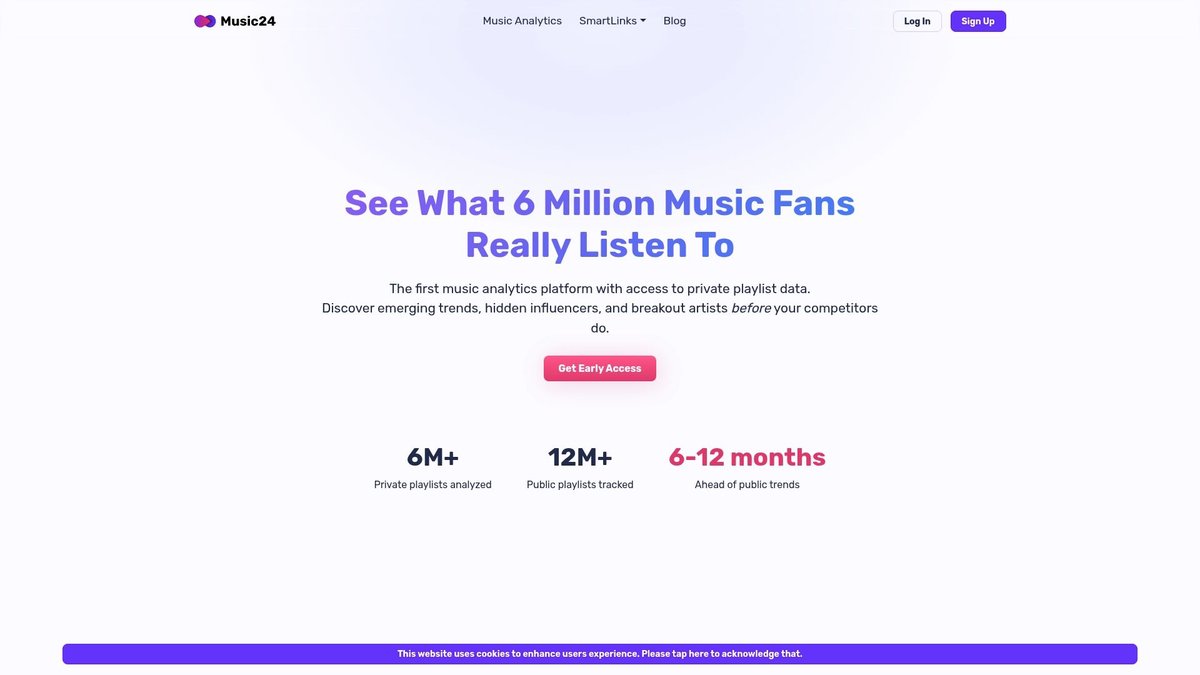
Don’t wait until your competitors spot the next breakout star Take control of your A&R strategy now by leveraging private playlist data analytics at Music24.com. Visit Music24.com to start your free demo and see how predictive analytics can revolutionize your talent discovery process.
Frequently Asked Questions
How does playlist data differ from public streaming metrics?
Private playlist data reflects genuine listener preferences while public streaming metrics are often influenced by algorithms and trends. Playlist data shows authentic choices made by listeners, indicating artist discovery before it becomes mainstream.
Why is private playlist data important for A&R teams?
Private playlist data allows A&R teams to identify emerging trends and artists before they are recognized in public metrics. This early access to listener behavior helps in scouting new talent and making informed decisions about artist acquisition.
What metrics are used to predict trends using playlist data?
Key metrics include addition velocity, demographic spread, retention rates, and cross-genre movement. These help analysts forecast future listening behaviors and identify potential hits before they become popular.
What ethical considerations should be taken into account when using playlist data?
Ethical considerations include obtaining user consent, ensuring data anonymization, maintaining transparency about data practices, and providing listeners with rights regarding their data. Adhering to these guidelines builds trust and credibility with artists and users.
Recommended
- Playlist Data’s Impact on A&R: Early Talent Discovery - Blog - Music24.com
- Music Discovery Landscape 2025: Predictive Analytics Advantage - Blog - Music24.com
- Understanding the Role of Playlist Data in Music Industry - Blog - Music24.com
- How Music Discovery Works: Complete Guide for 2025 - Blog - Music24.com

