AI in Music Analytics: 20% Better Hit Prediction Accuracy
Discover how AI analyzes private playlists to predict hits 20% more accurately, identify emerging artists weeks early, and optimize marketing ROI by 30%.

AI's analysis of millions of private playlists detects emerging artists an average of three weeks before they surface on public charts. This fundamentally changes how A&R teams discover talent and how marketers allocate budgets. By tapping into anonymized listener behavior invisible to traditional metrics, AI in music analytics transforms guesswork into strategic advantage for music industry professionals navigating an increasingly competitive discovery landscape.
Table of Contents
- Introduction To AI In Music Analytics
- Early Artist Discovery With Private Playlist Analytics
- AI In Predictive Music Analytics For A&R
- AI In Marketing And Consumer Insights
- Deep Dive Into AI Mechanisms In Music Analytics
- Common Misconceptions About AI In Music Analytics
- Applications In Marketing Optimization
- Limitations And Challenges In AI Music Analytics
- Explore Advanced Music Analytics Solutions At Music24.com
Key Takeaways
| Point | Details |
|---|---|
| Early Artist Detection | AI identifies emerging artists weeks before public charts through private playlist analysis. |
| Prediction Accuracy | Machine learning models improve hit forecasting accuracy by up to 20% over traditional methods. |
| Marketing ROI | AI-driven strategies increase listener engagement by up to 30% through behavioral targeting. |
| Micro-Trend Discovery | AI reveals genre blends and geographic patterns invisible to standard public metrics. |
| Risk Reduction | Predictive insights help A&R and marketing teams focus resources on high-probability successes. |
Introduction to AI in Music Analytics
Traditional music metrics rely on public streaming counts and social media engagement. These lag behind actual listener discovery by weeks or months. AI changes this paradigm by accessing what matters most: the role of private playlist data that reveals authentic behavior before it becomes mainstream.
AI analyzes private playlist data to detect music discovery patterns before they appear in public charts, enabling earlier identification of emerging artists. This anonymized data comes from millions of user collections, offering signals that public metrics simply cannot provide. When a curator with proven influence adds an unknown artist, AI flags this as a meaningful trend indicator.
For A&R executives, this means spotting talent before bidding wars begin. Marketing managers gain precise audience segments for targeted campaigns. The transformation extends beyond speed. It fundamentally improves decision quality by revealing nuanced patterns in listener behavior.
Key advantages of AI in music analytics include:
- Access to anonymized private playlist data revealing early discovery signals
- Machine learning models that detect patterns across millions of listener collections
- Geographic and demographic micro-trend identification invisible to traditional tools
- Curator influence mapping for strategic outreach and partnership opportunities
- Predictive modeling that forecasts commercial potential with measurable accuracy improvements
These capabilities represent a shift from reactive analysis to proactive strategy. You no longer wait for artists to break through. You identify them during their ascent.
Early Artist Discovery with Private Playlist Analytics
Public charts reflect popularity after it happens. Private playlist analysis catches the wave while it builds. This timing difference creates substantial competitive advantage for labels and managers who act on early signals.
AI analyzes millions of anonymized private playlists to detect early artist discovery signals before public metrics reflect them. When multiple influential curators independently add the same emerging artist, machine learning algorithms recognize this convergence as a predictive indicator. Geographic clustering of playlist additions reveals regional breakouts that could expand nationally.

The process works through systematic monitoring of curator behavior. Using private playlist data as input, AI models identify influential playlist curators who are early adopters of emerging music trends, guiding targeted industry outreach. Not all curators hold equal influence. Some consistently predict broader trends, and AI quantifies this predictive power.
Here is how AI drives early artist discovery:
- Continuous monitoring of millions of anonymized private playlists for new artist additions
- Pattern recognition across curator networks to identify convergent discovery behavior
- Influence scoring based on historical accuracy of curator taste in predicting mainstream success
- Geographic and demographic segmentation to understand where trends originate and spread
- Alert generation when multiple high-influence curators independently feature the same emerging artist
- Comparative analysis against public metrics to confirm lead time advantage
This systematic approach replaces the traditional reliance on industry buzz or random discovery. You gain a structured methodology for why tracking private playlists matters more than ever.
Pro Tip: Focus your A&R efforts on artists appearing in multiple high-influence private playlists within the same week. This convergence signal predicts breakout potential more reliably than isolated playlist adds or early streaming spikes.
Understanding the artist discovery process with private playlist data transforms how you allocate scouting resources and prioritize signings.
AI in Predictive Music Analytics for A&R
Predicting which artists or songs will succeed reduces financial risk dramatically. AI-driven predictive models analyze song structure and streaming trends to forecast commercial success with higher accuracy than traditional methods. Machine learning examines audio features, lyrical patterns, tempo, and production elements alongside listener behavior data.
These models achieve up to 20% improvement in hit prediction accuracy compared to traditional industry forecasting. For A&R teams managing limited budgets, this translates directly to better resource allocation. You invest in artists with quantifiable success indicators rather than gut instinct alone.
Predictive analytics benefits include:
- Song feature analysis identifying commercial potential based on audio characteristics
- Listener trend modeling that forecasts audience growth trajectories
- Genre positioning insights showing where an artist fits in the current market landscape
- Risk scoring that quantifies the probability of mainstream breakthrough
- Competitive benchmarking comparing new artists against similar successful precedents
Consider how predictive analytics in music changes deal structures. When AI models forecast high success probability, you negotiate from a position of data-backed confidence. Conversely, identifying lower probability acts early prevents costly signing mistakes.
Several cases demonstrate AI's forecasting power. Models predicted breakout success for artists who later achieved platinum status, often six to nine months before mainstream recognition. These early signals came from private playlist adoption rates, curator influence metrics, and audio feature analysis combined through machine learning.
Advanced analytics for artist breakouts streamlines A&R workflows. Your team reviews fewer prospects but with higher conversion rates. This efficiency gain matters tremendously in competitive signing environments where speed and accuracy determine outcomes.
The predictive music analytics benefits extend beyond artist selection to release timing, promotional strategy planning, and tour routing decisions.
AI in Marketing and Consumer Insights
Targeted marketing requires understanding listener segments at granular levels. AI processes behavioral data to create precise audience profiles for personalized campaigns. Music streaming platforms using AI personalization have increased user engagement and subscription retention by up to 30%, demonstrating AI's impact on listener behavior modeling.
Personalization operates on multiple dimensions. Geographic targeting identifies where specific genres or artists gain traction. Demographic modeling reveals age and preference patterns. Behavioral segmentation groups listeners by discovery habits, playlist curation styles, and engagement frequency.
Marketing optimization through AI includes:
- Audience segmentation based on listening behavior and discovery patterns
- Campaign targeting that matches artists to receptive listener micro-segments
- Budget allocation optimization focusing spend on high-conversion audience groups
- Timing recommendations for release announcements and promotional pushes
- Influencer identification among playlist curators for partnership outreach
Case studies show labels increasing campaign ROI by 25% through AI-driven targeting. Instead of broad demographic campaigns, marketers reach niche audiences predisposed to specific sounds or artist types. This precision reduces waste and improves conversion rates across awareness, engagement, and streaming metrics.
Music marketing analytics transforms promotional strategy from scattershot to surgical. You know which playlist curators to approach, which geographic markets to prioritize, and which listener segments to target first.
Pro Tip: Combine private playlist curator influence scores with geographic trending data to create hyper-targeted marketing campaigns. Reach curators in regions where an artist is gaining organic traction for maximum amplification effect.
The table below illustrates typical engagement improvements from AI-driven marketing:
| Marketing Approach | Engagement Rate | Conversion to Stream | ROI Improvement |
|---|---|---|---|
| Traditional Broad Campaigns | 2.1% | 0.8% | Baseline |
| Demographic Targeting | 3.4% | 1.3% | +18% |
| AI Behavioral Segmentation | 4.9% | 2.1% | +35% |
| AI + Curator Influence | 6.2% | 2.7% | +48% |
Following music analytics best practices ensures you extract maximum value from AI-powered marketing insights.
Deep Dive into AI Mechanisms in Music Analytics
Understanding how AI detects micro-trends and genre blends requires examining the underlying mechanisms. Machine learning algorithms process massive datasets looking for subtle patterns human analysis would miss. Neural networks identify correlations between seemingly unrelated variables, such as playlist placement timing and subsequent streaming velocity.
AI's reliance on large, high-quality datasets, such as private playlist data, allows it to identify micro-trends geographically and across genre blends that are invisible to public metrics. A fusion of indie folk and electronic elements might emerge in specific urban centers before spreading nationally. Traditional metrics capture this trend only after mainstream adoption. AI flags it during initial emergence.
AI-driven music analytics can reveal genre blending trends not visible in public charts, helping labels and marketers position artists in evolving musical niches. These hybrid genres often grow 15 to 20% annually in targeted markets before broader recognition. Early positioning in these spaces creates competitive moats.
The comparison between traditional and AI approaches:
| Metric Type | Traditional Public Data | AI with Private Playlist Data |
|---|---|---|
| Detection Speed | Weeks to months lag | Real-time to days ahead |
| Trend Granularity | Broad genre categories | Micro-trends and sub-genres |
| Geographic Insight | National/regional only | City and neighborhood level |
| Curator Influence | Not measured | Quantified and tracked |
| Predictive Capability | Limited historical correlation | Machine learning forecasting |
Key technical capabilities include:
- Natural language processing analyzing lyrical themes and sentiment patterns
- Audio fingerprinting detecting production techniques and sonic similarities
- Network analysis mapping curator connections and influence propagation
- Time series forecasting predicting streaming growth trajectories
- Clustering algorithms grouping similar listener behaviors for segmentation
The role of playlist data in 2025 becomes even more critical as AI models grow more sophisticated. Following a comprehensive music trend analysis guide helps you leverage these technical capabilities strategically.
Common Misconceptions about AI in Music Analytics
Several myths persist about AI's role in music. Addressing these clarifies realistic expectations and appropriate use cases. The most common misconception suggests AI replaces human creativity and industry expertise. In reality, AI augments decision-making by providing data-driven insights professionals interpret and act upon.
82% of music producers who don't use AI cite creative control as their main concern, highlighting AI's role as an assistive tool rather than a replacement. Producers and A&R professionals retain creative authority. AI simply informs choices with additional data points previously unavailable.
Key misconceptions to dispel:
- AI guarantees hit prediction: Predictions are probabilistic, improving accuracy but never reaching certainty
- Public data suffices for discovery: Private playlist data provides crucial early signals public metrics miss
- AI eliminates the need for industry expertise: Human interpretation of AI insights remains essential
- All AI models perform equally: Quality varies based on data sources, algorithms, and training approaches
- AI-generated music dominates production: Most applications involve assistive tasks like mixing or mastering
A realistic perspective recognizes AI as a powerful tool requiring skilled operation:
"AI doesn't discover artists. It identifies patterns in discovery behavior that help humans make informed decisions faster and with greater confidence."
Understanding music data terminology prevents misinterpretation of AI outputs and ensures you extract meaningful insights from analytics platforms.
Applications in Marketing Optimization
Practical marketing applications demonstrate AI's business value beyond theoretical benefits. Labels and managers using predictive insights achieve measurable improvements in campaign efficiency and artist development outcomes. AI analytics enables A&R teams to reduce financial risk by focusing promotion budgets on artists and tracks with high predicted success probability, improving marketing ROI.
Marketing optimization follows a systematic implementation process:
- Identify high-potential artists through private playlist analysis and predictive modeling
- Segment target audiences using behavioral and demographic data from AI analytics
- Map curator influence networks to prioritize outreach for maximum amplification
- Time campaigns based on trend velocity predictions and market readiness indicators
- Allocate budgets proportionally to predicted success probability and audience size
- Monitor real-time performance against AI forecasts and adjust strategies dynamically
- Analyze outcomes to refine model inputs and improve future prediction accuracy
Case examples illustrate tangible results. One independent label increased playlist placement success by 40% by targeting curators AI identified as early adopters in relevant genres. Another major label reduced marketing spend by 30% while maintaining stream growth by focusing resources on AI-validated high-potential releases.
Music marketing analytics integrated with music analytics best practices creates systematic competitive advantages. Your team operates from data rather than assumptions, adjusting strategies based on measurable signals.
Implementing top artist discovery strategies for music pros requires combining AI insights with industry experience. The synthesis produces better outcomes than either approach alone.
Limitations and Challenges in AI Music Analytics
Balanced assessment requires acknowledging AI's current limitations. Current AI music analytics face challenges including dataset bias, privacy concerns, and limits in modeling human emotional response, constraining predictions and requiring cautious interpretation. Understanding these constraints prevents over-reliance and sets realistic expectations.
Dataset bias occurs when training data lacks diversity or represents skewed listener populations. Models trained primarily on mainstream genres may miss emerging underground movements. Geographic bias limits effectiveness in underrepresented markets. Addressing bias requires continuous dataset expansion and validation.
Privacy considerations demand ethical governance. Anonymization protects individual listener identity, but maintaining this protection while extracting useful insights requires careful technical implementation. Regulatory compliance across jurisdictions adds complexity, particularly with evolving data protection laws.
Critical limitations include:
- Emotional response modeling remains imperfect, as AI struggles to quantify subjective musical impact
- Cultural context interpretation requires human expertise AI cannot fully replicate
- Prediction accuracy improves but never reaches certainty due to inherent market unpredictability
- Model transparency varies, making some AI recommendations difficult to interpret or validate
- Data quality dependencies mean insights are only as good as underlying dataset accuracy
Ongoing research addresses these challenges through improved algorithms, larger diverse datasets, and better emotional modeling techniques. Transparency initiatives help users understand how AI reaches conclusions, building appropriate trust levels.
Following music analytics best practices includes recognizing when human judgment should override AI recommendations and maintaining healthy skepticism of probabilistic predictions.
Explore Advanced Music Analytics Solutions at Music24.com
Putting AI insights into practice requires the right tools and knowledge base. Music24.com offers specialized resources helping music professionals leverage private playlist data and predictive analytics effectively. Discover comprehensive guides covering types of music analytics and their applications across discovery, marketing, and strategic planning.
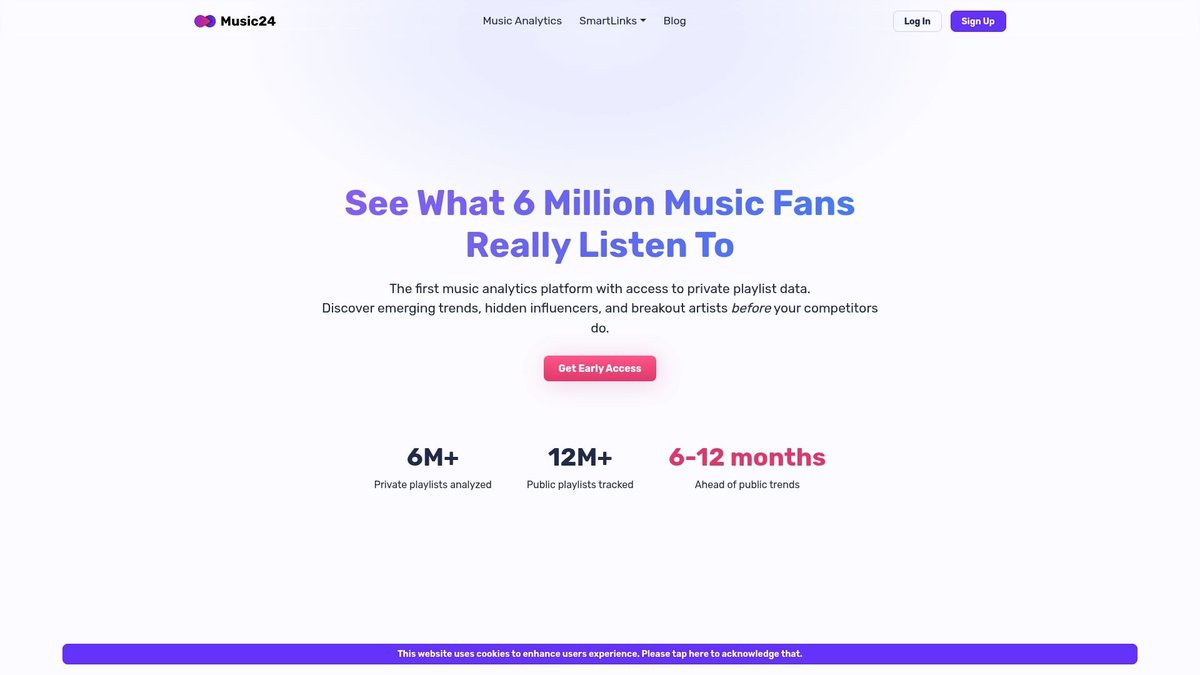
Access expert resources on music marketing analytics that translate AI insights into actionable campaigns. Learn systematic approaches to early artist identification and audience targeting using the platform's proprietary private playlist analysis. Deep dive into understanding private playlist data to grasp why this dataset provides unique competitive advantages unavailable through public metrics alone. Music24.com transforms complex analytics into strategic decisions that advance your artist roster and marketing effectiveness.
Frequently Asked Questions
What data sources does AI use for music analytics?
AI combines anonymized private playlist data with public streaming metrics, social engagement figures, and audio feature analysis. Private playlists reveal early listener behavior and authentic discovery patterns before they surface in public charts, providing crucial predictive signals.
How does AI improve accuracy in predicting hit songs?
Machine learning models analyze song structure elements like tempo, key, and production characteristics alongside listener trend data and curator behavior patterns. This multi-dimensional analysis improves hit predictive analytics advantages by up to 20% compared to traditional forecasting methods.
Can AI replace human creativity in music industry roles?
AI serves as an assistive technology that augments human decision-making rather than replacing creativity or expertise. Industry professionals use AI insights to inform choices while retaining creative authority and strategic control. Understanding AI and human creativity dynamics clarifies appropriate use cases.
What are the privacy concerns with AI music analytics?
Platforms address privacy through rigorous anonymization of listener data, removing personally identifiable information while preserving behavioral patterns useful for analytics. Ethical governance frameworks and regulatory compliance ensure music analytics privacy considerations protect user rights while enabling valuable insights.
Recommended
- Predictive Analytics in Music: Uncovering Hidden Hits - Blog - Music24.com
- Predictive Music Analytics: Transforming Artist Discovery - Blog - Music24.com
- Predictive Analytics in Music: Shaping Early Breakouts - Blog - Music24.com
- Predictive Analytics in Music: Powering Early Discovery - Blog - Music24.com
Get your music heard. Skip the content grind.
Add a song. Music24 makes the posts and the videos, plans your release and publishes it on every channel. Free for 7 days on the Pro plan, no card.