
Most American record labels now realize that raw streaming numbers only tell part of the story. For modern A&R teams, deeper data reveals patterns that traditional methods can miss. Private playlist analytics have uncovered hidden breakout artists months before public charts catch up. This guide explains the core concepts and music data terminology that allow executives to detect trends, understand listener motives, and make smarter artist investments with greater confidence.
Table of Contents
- Core Music Data Terminology And Concepts
- Types Of Music Data And Key Metrics
- Private Playlist Analytics: What Sets It Apart
- How Curator Influence Shapes Artist Discovery
- Common Pitfalls In Interpreting Metrics
Key Takeaways
| Point | Details |
|---|---|
| Understanding Music Data | A&R professionals must grasp core music data terminology to derive strategic insights about artists and listener behavior. |
| Diverse Data Types | The modern music ecosystem relies on various data categories, including consumption metrics and demographic insights, to build a comprehensive understanding of market trends. |
| Private Playlist Analytics | Analyzing private playlists provides authentic insights into listener preferences, allowing A&R teams to detect trends and emerging artists beyond public metrics. |
| Avoiding Metric Pitfalls | A&R professionals need to be cautious of common interpretation pitfalls in music metrics, such as overemphasizing quantitative data without context, to make informed decisions. |
Core Music Data Terminology and Concepts
In the rapidly evolving music industry landscape, understanding core data terminology is crucial for A&R professionals seeking strategic insights. Music data encompasses a complex ecosystem of digital information that provides unprecedented visibility into listener behavior, artist performance, and emerging trends. Modern A&R teams now rely on sophisticated analytical frameworks that transform raw musical signals into actionable intelligence.
At its foundation, music data includes multiple interconnected categories. Digital signal processing techniques enable the conversion of audio waves into quantifiable digital representations, allowing detailed analysis of musical characteristics. These digital signals can be broken down into critical components like:
- Metadata: Descriptive information about musical tracks (artist, genre, release date)
- Acoustic Features: Technical attributes like tempo, key, rhythm complexity
- Listener Interaction Data: Streaming patterns, playlist inclusions, skip rates
- Geographic Streaming Patterns: Regional listener preferences and engagement
The linguistic and cognitive dimensions of music technology terms reveal an intricate landscape of communication. Music technology terminology has evolved to reflect the increasingly technical nature of music production and analysis, bridging artistic expression with data science methodologies. Understanding these nuanced definitions allows A&R professionals to interpret complex datasets more effectively and identify emerging artist opportunities.
Pro tip: Develop a personal glossary of music data terms to rapidly contextualize new analytical insights and stay ahead of industry trends.
Types of Music Data and Key Metrics
The modern music industry relies on a sophisticated ecosystem of data types that provide unprecedented insights into artist performance, listener behavior, and market trends. Methodological approaches to music metadata analysis have transformed how A&R professionals understand and leverage digital music intelligence, breaking down complex information into actionable metrics.
Key music data categories can be comprehensively classified into several critical domains:
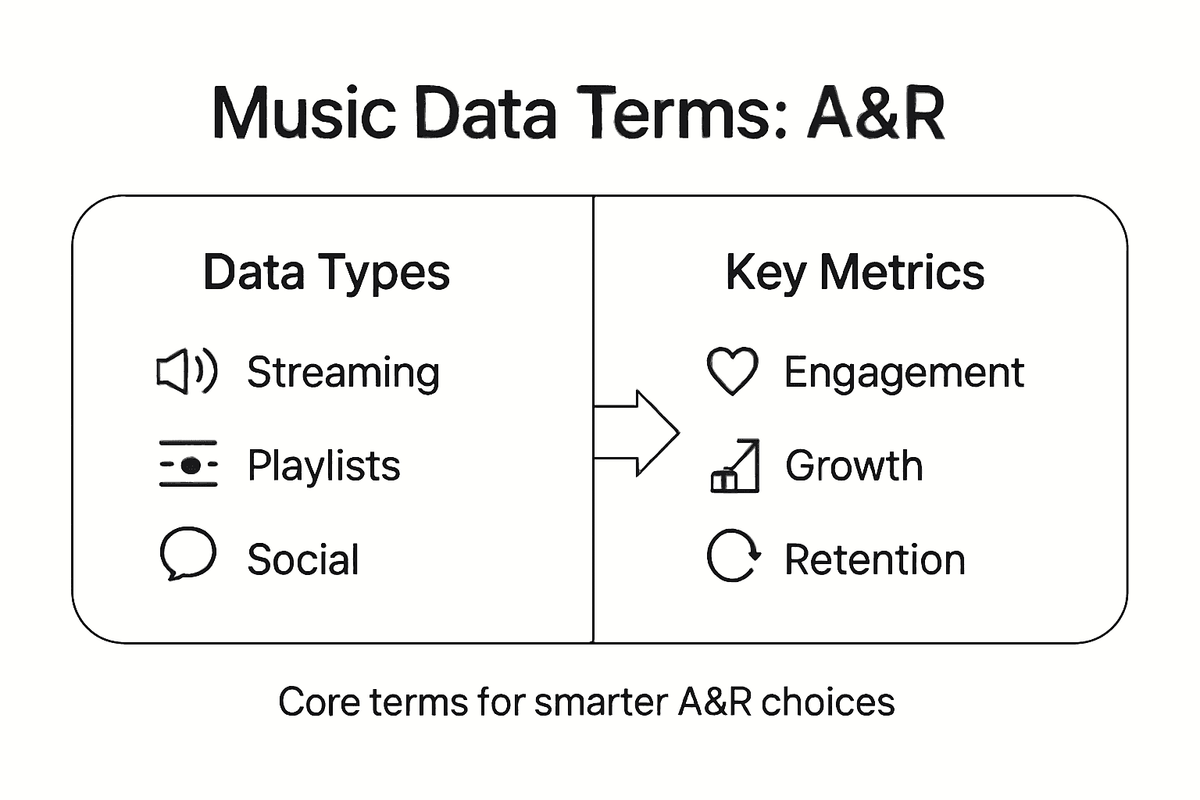
- Consumption Data: Streaming volumes, listener engagement rates, platform-specific performance
- Demographic Metrics: Listener age groups, geographic distribution, gender breakdowns
- Streaming Platform Analytics: Performance across Spotify, Apple Music, YouTube Music
- Social Media Engagement: Follower growth, social media mentions, viral content metrics
- Financial Performance: Royalty earnings, revenue streams, licensing opportunities
These data types work synergistically to create a holistic view of an artist's market potential. Sophisticated analytics platforms now transform raw data points into predictive insights, enabling A&R teams to identify emerging talent, understand listener preferences, and make strategic investment decisions. Types of music industry data have evolved from simple listener counts to complex, multidimensional intelligence systems that capture the nuanced dynamics of musical ecosystems.

Pro tip: Develop a systematic approach to cross-referencing multiple data sources to create more comprehensive and accurate artist assessments.
Private Playlist Analytics: What Sets It Apart
Private playlist analytics represents a revolutionary approach to understanding music consumption that goes far beyond traditional public streaming metrics. How to leverage private playlist data offers A&R professionals an unprecedented window into authentic listener behavior that remains hidden from mainstream tracking systems.
The key differentiators of private playlist analytics include:
- Unfiltered Discovery: Access to curated collections before public visibility
- Authentic Listener Behavior: Insights into personal musical preferences
- Early Trend Detection: Identifying emerging artists and genre shifts
- Contextual Listening Patterns: Understanding how music fits into personal narratives
- Granular Demographic Insights: Precise listener segmentation beyond public metrics
Unlike public streaming data, private playlist analytics captures the nuanced, personal relationships listeners develop with music. These intimate collections reveal deeper connections that transcend algorithmic recommendations or chart performance. By analyzing private playlists, A&R professionals can detect subtle cultural shifts, predict emerging artist potential, and understand listener psychology in ways traditional metrics cannot capture.
Here's a comparative overview of public streaming data and private playlist analytics for A&R strategies:
| Aspect | Public Streaming Data | Private Playlist Analytics |
|---|---|---|
| Visibility | Broadly accessible, high volume | Limited access, curated collections |
| Trend Detection | Focuses on established trends | Enables early identification of trends |
| Listener Insights | Aggregated, generalized behavior | Granular, authentic personal behavior |
| Artist Discovery | Highlights mainstream successes | Reveals emerging, hidden opportunities |
Pro tip: Develop a systematic approach to anonymized private playlist analysis that respects user privacy while extracting actionable musical intelligence.
How Curator Influence Shapes Artist Discovery
In the complex ecosystem of music discovery, curators play a transformative role that extends far beyond simple playlist creation. The curator's role in artist development represents a nuanced partnership that can dramatically accelerate an emerging artist's visibility and career trajectory.
Curator influence manifests through several critical mechanisms:
- Talent Identification: Spotting promising artists before mainstream recognition
- Contextual Positioning: Placing artists within meaningful musical narratives
- Community Amplification: Introducing artists to targeted listener segments
- Credibility Transfer: Lending institutional or personal reputation to emerging talent
- Genre and Trend Validation: Signaling emerging musical movements
Beyond traditional metrics, influential curators function as cultural gatekeepers who shape listener perceptions and artist opportunities. Examples of influential curators demonstrate how strategic playlist placement and thoughtful artist presentation can transform an unknown musician into a breakthrough sensation, bridging the gap between raw potential and widespread recognition.
Pro tip: Build relationships with curators by understanding their specific musical ecosystems and presenting artists that authentically align with their artistic sensibilities.
Common Pitfalls in Interpreting Metrics
Music analytics requires more than superficial number tracking. Critical challenges in music industry metrics interpretation reveal complex cognitive and strategic obstacles that can dramatically mislead A&R professionals if not carefully navigated.
Common interpretation pitfalls include:
- Quantitative Tunnel Vision: Overemphasizing numeric data while ignoring contextual nuances
- Correlation Misconception: Assuming statistical relationships imply causation
- Short-Term Bias: Making decisions based on momentary trends instead of sustained patterns
- Demographic Oversimplification: Reducing listener data to simplistic categorical assumptions
- Algorithmic Echo Chamber: Relying exclusively on platform-generated recommendations
Professional data interpretation demands a sophisticated approach that transcends raw metrics. Understanding music discovery metrics requires triangulating multiple data sources, maintaining healthy skepticism, and developing a holistic understanding of how different metrics interact and influence each other. Successful A&R professionals recognize that numbers tell stories, but context provides the critical narrative framework.
The following table summarizes common pitfalls and recommended actions for interpreting music analytics:
| Pitfall | Example Scenario | Recommended Practice |
|---|---|---|
| Quantitative Tunnel Vision | Overlooking context behind numbers | Integrate qualitative observations |
| Correlation Misconception | Mistaking engagement for popularity | Cross-validate with additional data |
| Short-Term Bias | Making moves on short spikes | Focus on long-term trends |
| Demographic Oversimplification | Ignoring listener diversity | Segment audience in more detail |
Pro tip: Develop a systematic approach to cross-referencing metrics from multiple sources to validate and contextualize your insights.
Unlock the Power of Music Data for Smarter A&R Decisions
The article highlights the challenges A&R professionals face when interpreting complex music data and leveraging private playlist analytics to spot authentic listener behavior and emerging artists early. If you struggle with decoding nuanced metrics like acoustic features, demographic insights, or curator influence, you are not alone. Understanding these key terms and avoiding common data pitfalls is essential to get ahead in artist discovery and trend prediction.
Music24.com offers the perfect solution by analyzing millions of anonymized private playlists to deliver predictive insights that traditional public data misses. Harness exclusive access to private playlist data and get granular views on genre blending, geographic micro-trends, and curator impact so you can confidently identify breakout artists and develop targeted strategies.
Why wait to react to trends once they are public when you can lead the charge with actionable, early intelligence? Join industry professionals who rely on Music24's platform to transform their A&R approach.
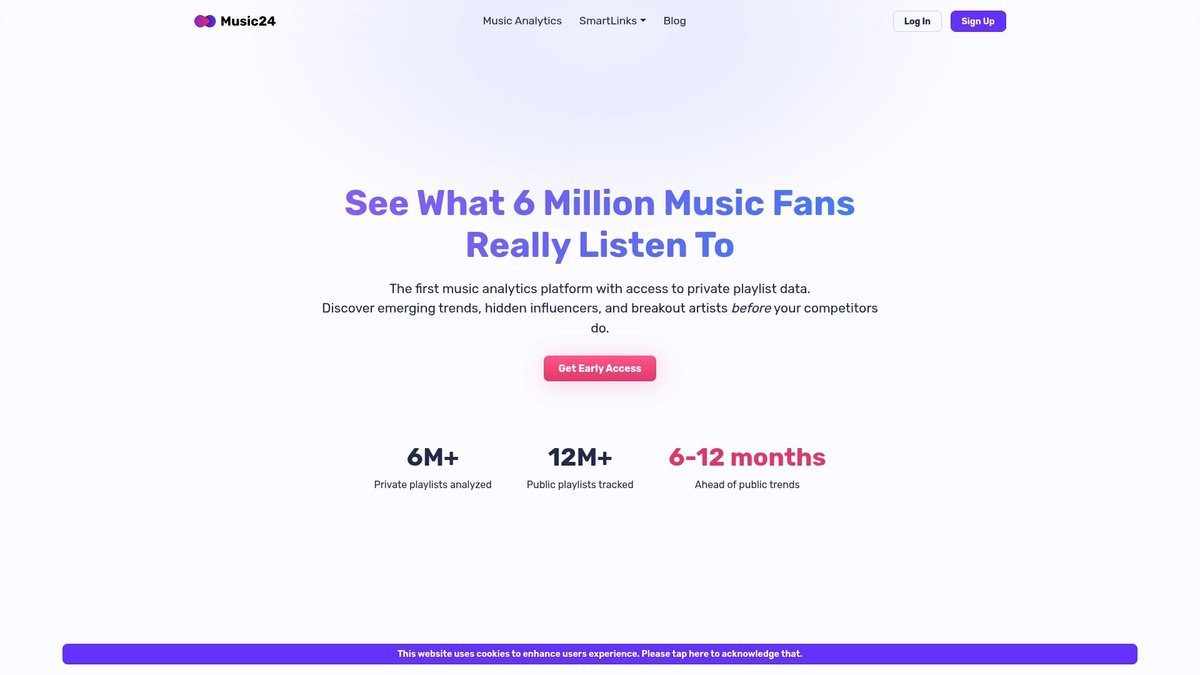
Explore how to decode music data terminology with expert tools at Music24.com. Start your journey toward smarter music analytics today and secure a competitive edge by understanding the full story behind the numbers.
Frequently Asked Questions
What is music data and why is it important for A&R professionals?
Music data refers to the digital information regarding listener behavior, artist performance, and market trends. It is crucial for A&R professionals as it provides insights that help in identifying emerging talent and making informed investment decisions.
How do private playlist analytics differ from public streaming data?
Private playlist analytics offer insights into unfiltered, authentic listener behavior and early trend detection. In contrast, public streaming data focuses on established trends and provides aggregated, generalized information about listener engagement.
What are some common pitfalls when interpreting music metrics?
Common pitfalls include quantitative tunnel vision, correlation misconception, short-term bias, demographic oversimplification, and being trapped in an algorithmic echo chamber. Each can lead to misinformed decisions if not carefully navigated.
What key metrics should A&R professionals focus on when analyzing artist performance?
A&R professionals should consider consumption data, demographic metrics, streaming platform analytics, social media engagement, and financial performance to gain a comprehensive view of an artist's market potential.

