
Finding the next breakout artist before everyone else is the challenge every A&R team faces. Global record labels now turn to private playlist behavior analysis for deeper, earlier insights into listener preferences, micro-trends, and rising stars. Recent research shows that these personal playlists reveal subtle shifts in taste and underground movements that public data often misses, giving A&R executives a powerful tool for strategic discovery and smarter talent scouting.
Table of Contents
- Understanding Predictive Analytics In Music
- How Private Playlist Data Drives Prediction
- Identifying Influential Curators And Micro-Trends
- Real-World Applications For A&R Teams
- Benefits, Pitfalls, And Privacy Challenges
Key Takeaways
| Point | Details |
|---|---|
| Predictive Analytics Transform Industry | Predictive analytics revolutionizes artist discovery, genre evolution, and listener engagement through data-driven insights. |
| Private Playlists Offer Unique Insights | Analyzing private playlist data reveals granular listener behaviors and emerging trends that traditional metrics miss. |
| Influential Curators Shape Trends | Identifying key curators and micro-trends enables industry professionals to anticipate shifts in musical preferences. |
| Balancing Innovation and Privacy | The use of predictive analytics must prioritize data privacy and ethical practices to ensure user trust and compliance. |
Understanding Predictive Analytics in Music
Predictive analytics in music represents a groundbreaking approach to understanding and forecasting emerging musical trends by leveraging sophisticated data science techniques. This methodology transforms raw musical data into actionable insights that can revolutionize artist discovery, genre evolution, and listener engagement strategies.
At its core, predictive analytics combines advanced machine learning algorithms with complex datasets to analyze musical information retrieval patterns. These techniques go far beyond traditional music industry analysis by providing deep, nuanced understanding of listener behaviors, emerging artist potential, and genre dynamics.
Key components of predictive music analytics include:
- Acoustic Feature Analysis: Examining musical attributes like rhythm, tempo, instrumentation
- Metadata Processing: Tracking listener demographics, geographic trends, playlist behaviors
- Machine Learning Modeling: Using neural networks to predict potential hit songs
- Genre Evolution Tracking: Identifying emerging musical fusion and stylistic shifts
Predictive analytics works by processing millions of data points across multiple dimensions. For instance, an algorithm might analyze streaming patterns, social media mentions, playlist additions, and acoustic characteristics to determine an emerging artist's potential breakthrough likelihood. This approach allows record labels and music professionals to make data-driven decisions with unprecedented precision.
Here's how key predictive analytics components impact the music industry:
| Analytics Component | Primary Music Industry Impact | Example Use Case |
|---|---|---|
| Acoustic Feature Analysis | Detects future hit song trends | Identifying rising EDM subgenres |
| Metadata Processing | Personalizes marketing campaigns | Targeting fans by location |
| Machine Learning Modeling | Improves A&R talent scouting | Forecasting new artist success |
| Genre Evolution Tracking | Guides artist development | Spotting emerging genre fusions |
Pro tip: Focus on collecting granular, anonymized listener data to enhance predictive model accuracy and reliability.
How Private Playlist Data Drives Prediction
Private playlist data has emerged as a revolutionary source of musical insights, offering unprecedented depth into listener behaviors and emerging musical trends. Unlike traditional public streaming metrics, these personal collections provide a more intimate and authentic view of music consumption patterns that can dramatically transform predictive analytics strategies.

Big data analytics in music enterprises reveal that private playlists are far more than simple song collections. They represent complex personal narratives that capture nuanced listener preferences, genre crossovers, and underground musical movements long before they become mainstream trends.
Key advantages of leveraging private playlist data include:
- Granular Listener Insights: Understanding individual music consumption patterns
- Micro-trend Detection: Identifying emerging musical styles before public recognition
- Personalization Potential: Creating highly targeted music recommendations
- Early Artist Discovery: Recognizing potential breakthrough musicians
The true power of private playlist analytics lies in its ability to process massive datasets with incredible precision. By analyzing millions of individual playlist compositions, algorithms can detect subtle shifts in musical preferences, predict potential hit songs, and understand the complex ecosystem of listener engagement.
Private playlists are the unfiltered, authentic voices of music listeners - revealing trends that traditional metrics miss.
Pro tip: Prioritize anonymized data collection and robust privacy protocols when developing predictive music analytics models.
Identifying Influential Curators and Micro-Trends
In the rapidly evolving music landscape, identifying influential curators and micro-trends has become a critical strategy for music industry professionals seeking to stay ahead of emerging musical movements. These tastemakers and localized musical patterns represent the cutting edge of musical discovery, offering insights far beyond traditional market research methodologies.
Empirical studies on music trend prediction demonstrate that curator influence can dramatically reshape listener behaviors and accelerate the emergence of new musical styles. These key individuals act as critical nodes in complex musical ecosystems, capable of propelling underground artists into mainstream consciousness.
Characteristics of influential music curators include:
- Niche Genre Expertise: Deep understanding of specific musical subgenres
- Strong Network Connections: Extensive relationships across music platforms
- Consistent Trend-Setting Behavior: Regular introduction of novel musical acts
- High Engagement Metrics: Significant follower interaction and playlist reach
Micro-trends represent hyper-localized musical movements that emerge from specific geographic or demographic communities. These nuanced patterns often indicate broader shifts in musical consumption before they become visible through traditional tracking mechanisms. By analyzing these granular trends, music industry professionals can anticipate and respond to emerging musical preferences with unprecedented precision.
Influential curators are the hidden architects of musical discovery - transforming underground sounds into mainstream sensations.
Pro tip: Develop sophisticated tracking mechanisms that capture both curator activity and subtle geographic variations in musical preferences.
Real-World Applications for A&R Teams
Predictive analytics has fundamentally transformed how A&R teams approach artist discovery, talent scouting, and repertoire management in the modern music industry. By leveraging advanced data science techniques, these professionals can now make more informed, strategic decisions about emerging musical talent and potential breakthrough artists.
Machine learning models for artist prediction have revolutionized the traditional A&R workflow, providing unprecedented insights into artist potential beyond subjective evaluations. These sophisticated algorithms analyze complex datasets, including streaming metrics, acoustic features, and listener engagement patterns to identify promising musical talent.
Key practical applications for A&R teams include:
- Early Talent Detection: Identifying underground artists before mainstream recognition
- Predictive Performance Modeling: Estimating potential track and artist success rates
- Genre Trend Analysis: Tracking emerging musical styles and crossover potential
- Risk Mitigation: Quantifying investment potential for new artist signings
The most advanced A&R teams now integrate predictive analytics as a core component of their talent discovery strategy. By combining human expertise with data-driven insights, these professionals can make more nuanced decisions, reducing the inherent risks associated with artist development and repertoire selection.
Data transforms intuition into strategy - predictive analytics is the new A&R superpower.
Pro tip: Develop a hybrid approach that balances algorithmic insights with traditional artist evaluation techniques.
Benefits, Pitfalls, and Privacy Challenges
Predictive analytics in music presents a complex landscape of transformative potential and ethical considerations, balancing powerful insights with critical privacy concerns. The technology offers unprecedented opportunities for understanding musical trends while simultaneously raising important questions about data usage and individual rights.
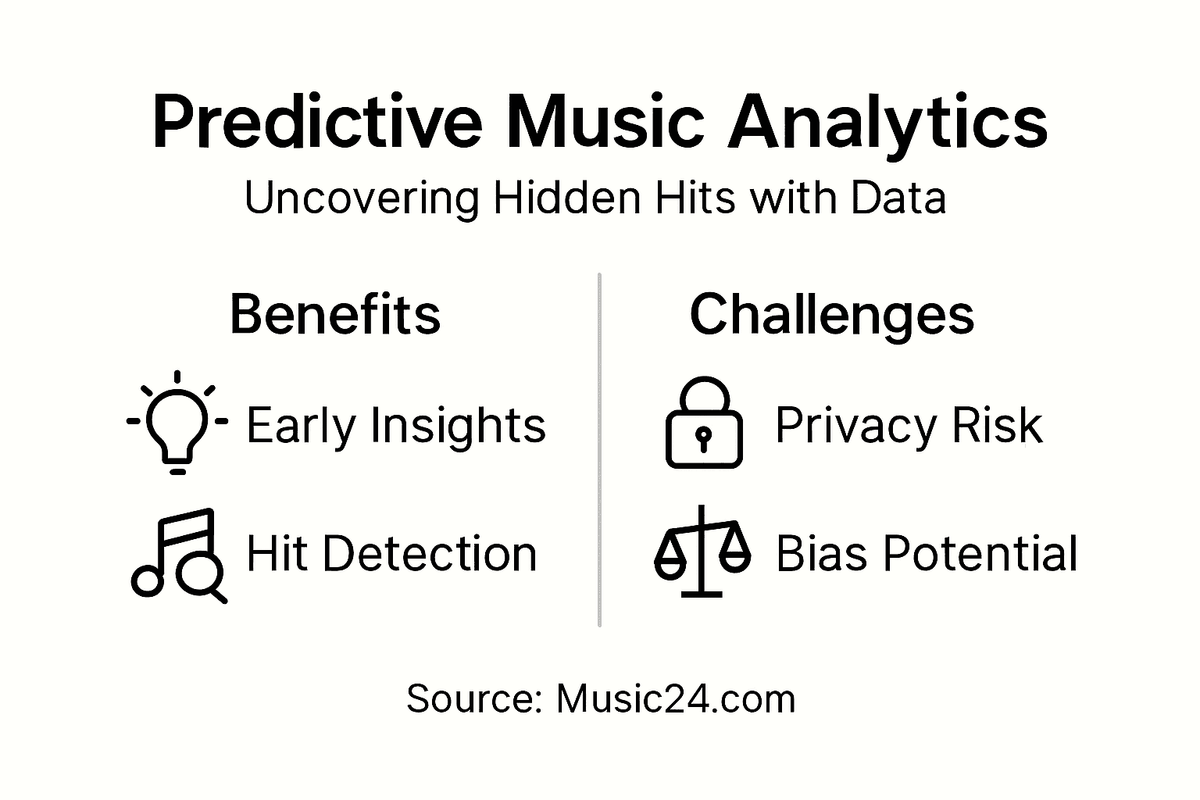
Big data analytics in music enterprises reveal a nuanced ecosystem where innovation and privacy protection must coexist. These advanced analytical approaches provide remarkable benefits but also introduce significant challenges that require careful navigation.
Key benefits and challenges include:
- Personalized Music Discovery: Enhanced listener recommendations
- Artist Exposure: Increased opportunities for emerging talents
- Marketing Precision: Targeted audience engagement
- Data Privacy Risks: Potential misuse of personal listening data
- Algorithmic Bias: Potential reinforcement of existing musical hierarchies
- Consent and Transparency: Ensuring user understanding of data usage
The most sophisticated music analytics platforms prioritize a balanced approach that respects individual privacy while delivering actionable insights. This requires robust anonymization techniques, transparent data governance, and clear user consent mechanisms that protect personal information while enabling technological innovation.
This table highlights music analytics benefits versus privacy challenges:
| Category | Positive Outcome | Caution or Risk |
|---|---|---|
| Personalization | Delivers unique song suggestions | Possible intrusion on user privacy |
| Artist Discovery | Accelerates breaking new talent | Exposes lesser-known listener data |
| Marketing | Enables precise audience targeting | Reinforces musical stereotypes |
| User Trust | Builds loyal platform users | Requires clear consent practices |
Ethical data use is not a constraint but a competitive advantage in music analytics.
Pro tip: Implement comprehensive data anonymization protocols that protect individual user privacy while maintaining analytical integrity.
Gain the Competitive Edge with Predictive Music Analytics
The challenge of uncovering hidden hits before they reach the mainstream is more critical than ever. This article highlights the difficulty in detecting emerging artists and micro-trends using only public data. Your goal is to leverage advanced predictive analytics, private playlist insights, and curator influence to make smarter A&R decisions and personalized marketing strategies. To overcome these challenges, you need a platform that understands the complexities of genre evolution and listener behaviors at a granular level.
Music24.com specializes in turning anonymized private playlist data into powerful, actionable insights. By analyzing millions of user collections, our platform detects authentic music discovery patterns, identifies rising stars, and reveals niche micro-trends long before public charts reflect them. This enables record labels, artist managers, and marketers to anticipate musical shifts, reduce risk, and accelerate artist development like never before.
Ready to transform your music analytics strategy and stay steps ahead of the competition
Explore how predictive analytics with private playlist data can revolutionize your approach by visiting Music24.com today. Discover detailed insights into emerging trends and influential curators that traditional methods miss and start making truly data-driven decisions now.
Frequently Asked Questions
What is predictive analytics in music?
Predictive analytics in music is a data-driven approach that utilizes advanced machine learning algorithms and complex datasets to analyze trends, listener behaviors, and emerging artists, helping the music industry make informed decisions.
How does predictive analytics impact artist discovery?
Predictive analytics assists in artist discovery by providing insights into potential hit songs, evaluating acoustic features, and analyzing listener demographic data, which can lead to the early identification of promising new talent.
What are the benefits of using private playlist data in music analytics?
Using private playlist data allows for granular listener insights, micro-trend detection, personalized recommendations, and early artist discovery, offering a deeper understanding of music consumption patterns that traditional metrics often miss.
What are some ethical considerations related to predictive analytics in music?
Ethical considerations in predictive analytics include data privacy risks, potential algorithmic bias, and the need for transparent consent practices to ensure that personal listening data is used responsibly while delivering actionable insights.
Recommended
- Predictive Analytics in Music: Shaping Early Breakouts - Blog - Music24.com
- Predictive Music Analytics: Transforming Artist Discovery - Blog - Music24.com
- Music Discovery Landscape 2025: Predictive Analytics Advantage - Blog - Music24.com
- Advanced Analytics in Music: Predicting Talent Breakouts - Blog - Music24.com

