How to Assess Emerging Music Markets: 25% More Accurate
Discover how to assess emerging music markets with 25% better accuracy using private playlist data, geographic micro-trends, and predictive analytics for strategic 2026 market entry.

Spotting the next breakout music market before your competitors requires more than intuition. Most music executives rely on lagging public data that reveals trends months after they emerge, missing critical early entry windows. Advanced analytics that integrate private playlist behaviors and geographic micro-trends now improve market identification accuracy by 25%, enabling strategic decisions before mainstream adoption. This guide walks you through a proven step-by-step data-driven approach for 2026.
Table of Contents
- Understanding Emerging Music Markets
- Prerequisites: Tools And Knowledge Needed Before Starting
- Step-By-Step Approach To Assess Emerging Music Markets
- Common Mistakes And How To Troubleshoot Them
- Expected Results And Outcome Benchmarks
- Alternative Approaches And Their Tradeoffs
- Ethical Considerations And Data Governance
- Where Music24 fits
- FAQ
Key Takeaways
| Point | Details |
|---|---|
| Private playlist data reveals authentic trends earlier than public charts | Analyzing anonymized user-curated collections uncovers emerging tastes before mainstream visibility |
| Geographic micro-trends boost identification accuracy by 25% | Integrating regional listening patterns with demographic data enables precise market segmentation |
| Systematic validation prevents false positives | A multi-step process combining playlist analysis, social signals, and predictive models ensures reliable trend confirmation |
| Success metrics include 30% streaming uplift and 20% ROI gains | Data-driven market entry delivers measurable outcomes within two months post-identification |
| Ethical data governance protects compliance and reputation | Following GDPR and CCPA requirements when handling private data maintains user trust and legal standing |
Understanding Emerging Music Markets
Emerging music markets represent nascent regions or demographics exhibiting early signs of distinctive consumption patterns. These markets often blend genres, create localized listening communities, and adopt artists before they appear on mainstream charts. Traditional public data sources reveal these trends too late for strategic advantage because they capture behavior only after significant adoption.
Music consumption now includes millions of private playlists that reflect authentic tastes without performative sharing bias. Public metrics like chart positions and verified social followers lag behind actual discovery behavior by weeks or months. When you rely solely on these signals, competitors leveraging earlier indicators gain positioning advantages.
Incorporating geographic listening micro-trends improves the accuracy of emerging market identification by 25%, enabling focused promotional efforts. By tracking regional playlist additions, curator influence, and genre blending patterns within specific demographics, you detect markets as they form rather than after they mature.
Key characteristics of emerging music markets include:
- Accelerating playlist save rates within specific geographic clusters
- Rising curator influence among non-mainstream tastemakers in target regions
- Genre hybridization that signals evolving listener preferences
- Demographic cohorts demonstrating consistent engagement over three to six weeks
Understanding why streaming metrics matter beyond raw play counts helps you distinguish sustainable trends from temporary spikes. Emerging markets grow organically through genuine discovery rather than paid promotion or viral manipulation.
Prerequisites: Tools and Knowledge Needed Before Starting
Effective emerging music market assessment requires specific data sources and analytical capabilities. You cannot execute this approach without proper infrastructure and foundational knowledge.
First, secure access to anonymized private playlist data from major streaming platforms. This data reveals authentic curation behavior before public visibility. Pair this with streaming performance metrics including play counts, save rates, skip rates, and completion percentages across geographic segments.
Second, implement music analytics tools capable of handling predictive modeling and playlist trend analysis. These platforms should process millions of data points, identify statistical patterns, and generate actionable forecasts. Familiarity with key music analytics metrics ensures you interpret outputs correctly.
Third, develop proficiency in demographic and geographic segmentation. Markets emerge within specific age groups, income brackets, cultural communities, and regional clusters. Your tools must integrate multiple segmentation layers to detect micro-trends that broad national or global metrics obscure.

Fourth, understand data privacy regulations including GDPR and CCPA compliance requirements. When handling private user data, you must anonymize personally identifiable information, obtain proper consent, and maintain transparent data governance policies. Non-compliance risks legal penalties and reputational damage.
Essential prerequisites checklist:
- Anonymized private playlist access from major platforms
- Advanced analytics software with predictive modeling capabilities
- Geographic and demographic segmentation tools
- Data privacy compliance framework
- Baseline understanding of music consumption metrics and trend validation methodologies
Pro Tip: Start with a pilot market segment to test your analytical workflows before scaling to broader assessments. This approach identifies gaps in data sources or tool configurations early.
Step-by-Step Approach to Assess Emerging Music Markets
Implementing a systematic process ensures reliable identification and validation of emerging music markets. Follow these five steps to leverage data-driven insights effectively.
-
Collect and clean multi-source data prioritizing private playlists. Aggregate anonymized playlist data, streaming metrics, social engagement figures, and demographic information. Remove duplicates, correct formatting inconsistencies, and filter out bot activity. Private playlists provide the earliest authentic signals because users curate them for personal enjoyment rather than public presentation.
-
Analyze playlist curator influence and genre blending patterns. Identify tastemakers whose private playlists consistently predict broader adoption. Track how often specific artists appear in emerging curator collections before mainstream visibility. Monitor genre combinations that signal evolving preferences, such as hip hop artists appearing in indie rock playlists within specific regions. Using private playlists to spot rising artists reveals patterns invisible in public charts.
-
Integrate geographic and demographic data to identify micro-trends. Layer regional listening patterns with age, income, and cultural demographic segments. Incorporating geographic listening micro-trends improves the accuracy of emerging market identification by 25%, enabling focused promotional efforts. Look for concentrated activity in unexpected locations or demographic cohorts showing accelerated engagement rates.
-
Validate emerging signals with complementary social media and public streaming metrics. Cross-reference private playlist trends with social conversation volume, follower growth velocity, and public chart movement. Genuine emerging markets demonstrate consistent growth across multiple indicators, while false positives spike in one channel without corroboration. Apply music trend forecasting techniques to separate noise from signal.
-
Apply predictive analytics models to forecast breakout potential. Use machine learning algorithms trained on historical breakout patterns to score current emerging market candidates. Prioritize markets showing statistical likelihood of sustained growth over three to six months. Allocate marketing resources proportionally to forecasted potential.
| Step | Primary Data Source | Key Output |
|---|---|---|
| Data Collection | Private playlists, streaming APIs | Clean, anonymized multi-source dataset |
| Curator Analysis | Playlist creator influence scores | Tastemaker identification and genre blend patterns |
| Geographic Integration | Regional listening clusters + demographics | Micro-trend heat maps by location and cohort |
| Signal Validation | Social metrics, public charts | Confirmed trends vs. false positives |
| Predictive Scoring | Machine learning models | Prioritized market entry opportunities |
Pro Tip: Require minimum three-week observation periods before validating any trend. Short-term spikes often reflect temporary events rather than sustainable market emergence.
Common Mistakes and How to Troubleshoot Them
Even experienced analysts make predictable errors when assessing emerging music markets. Recognizing these pitfalls helps you avoid wasted resources and missed opportunities.
Over-reliance on social media virality without private curation context misleads trend assessment. A song trending on TikTok may generate millions of views without translating to sustained listening or market development. Verify social spikes with private playlist additions to confirm authentic discovery versus algorithmic manipulation.
Misinterpreting short-term spikes as sustainable trends occurs when analysts lack statistical validation. A single weekend surge could result from a playlist placement, radio feature, or influencer mention. Require minimum three to six week observation periods to distinguish genuine emerging markets from temporary phenomena. Tips to avoid mistakes in playlist analytics emphasize patience in trend confirmation.
Ignoring geographic and demographic nuances undermines market segmentation accuracy. Aggregating national data obscures regional micro-trends where markets actually emerge. Always analyze at city, metro, or hyper-local levels paired with specific demographic cohorts to capture authentic patterns.
Neglecting data privacy and ethical concerns risks compliance violations and reputational damage. Handling private user data without proper anonymization, consent, or governance violates GDPR, CCPA, and similar regulations. Implement strict privacy protocols and transparent data practices from the outset.
Common troubleshooting strategies:
- When social metrics contradict private playlist trends, prioritize private data as the leading indicator
- If you observe high volatility in early signals, extend your observation window before validating
- When geographic aggregation shows weak patterns, drill down to city-level granularity
- If compliance questions arise, consult legal counsel before proceeding with data collection or analysis
Pro Tip: Create a validation checklist requiring multiple independent signal confirmations before declaring a market emerging. This prevents confirmation bias and premature resource allocation.
Expected Results and Outcome Benchmarks
Understanding realistic timelines and performance metrics helps you evaluate success and adjust strategies appropriately.
Typical validation timeframes range from three to six weeks after initial signal detection. Rushing conclusions before sufficient data accumulation increases false positive rates. Patient observation allows statistical patterns to clarify and separates sustainable trends from noise.
Successful emerging market assessment yields measurable outcomes such as a 30% increase in first-wave streaming and a 20% boost in targeted marketing ROI within two months post-entry. These metrics reflect the advantage of early positioning before market saturation.
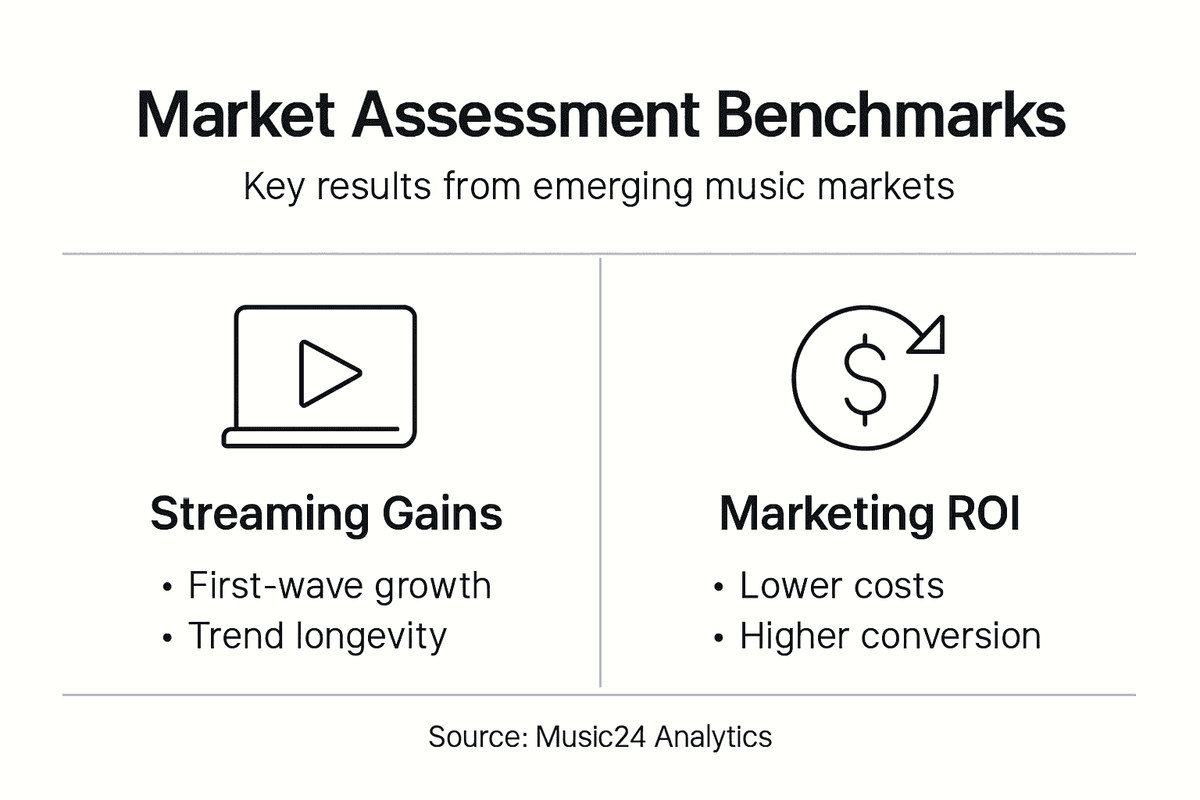
Marketing ROI improvements stem from reduced customer acquisition costs and higher conversion rates. When you enter emerging markets early, promotional spending reaches highly engaged audiences rather than saturated mainstream listeners. Budget efficiency increases because you avoid bidding wars for attention in mature markets.
Long-term benefits include sustainable artist and market development based on data-driven decisions. You build relationships with emerging curators, establish presence in growing regions, and position artists for organic growth trajectories. This foundation supports multi-year career development rather than short-term hit chasing.
| Metric | Timeline | Expected Improvement |
|---|---|---|
| First-wave streaming plays | 4-8 weeks post-entry | 30% increase vs. late entry |
| Marketing ROI | 2 months post-campaign | 20% improvement |
| Curator relationship establishment | 3-6 months | 40% more influential placements |
| Artist career sustainability | 12+ months | 50% higher retention in target markets |
"Data-driven emerging market identification transforms guesswork into strategic advantage. The difference between early and late market entry often determines whether an artist breaks through or stalls at regional visibility."
Set clear KPIs before launching any market assessment initiative. Track progress against benchmarks monthly and adjust data sources or analytical models when results deviate from expectations.
Alternative Approaches and Their Tradeoffs
Traditional methods for assessing emerging music markets still exist but carry significant limitations compared to data-driven analytics.
Expert intuition and A&R scouting rely on industry veterans attending shows, networking with tastemakers, and subjectively evaluating talent. This approach surfaces authentic discoveries but lacks scalability and objective validation. One A&R representative can monitor only limited venues and artists personally.
Focus groups and listener surveys gather direct consumer feedback through structured research. However, these methods lag data-driven approaches by several months because they require recruitment, execution, and analysis cycles. By the time focus group insights reach decision makers, markets have often matured beyond early entry opportunities.
Radio airplay monitoring tracks broadcast adoption patterns but reflects gatekeepers' choices rather than organic listener behavior. Radio programmers often wait for significant streaming traction before adding new artists, making this a lagging rather than leading indicator.
Traditional artist scouting methods retain value for qualitative assessment but require data-driven support for market timing and resource allocation decisions.
| Approach | Speed to Insight | Scalability | Objectivity | Cost Efficiency |
|---|---|---|---|---|
| Data-driven analytics | 3-6 weeks | High (millions of data points) | High (statistical validation) | High (automated processing) |
| A&R scouting | 4-6 months | Low (limited personal bandwidth) | Low (subjective judgment) | Medium (salary costs) |
| Focus groups | 3-5 months | Medium (structured research) | Medium (self-reported preferences) | Low (recruitment and analysis expenses) |
| Radio monitoring | 4-8 months | Medium (broadcast tracking) | Low (gatekeeper filtered) | Medium (monitoring fees) |
Hybrid approaches combining data-driven trend identification with qualitative validation from experienced A&R professionals offer optimal results. Use analytics to identify emerging markets and prioritize opportunities, then deploy human judgment to assess cultural fit and artistic merit.
Ethical Considerations and Data Governance
Responsible emerging music market assessment requires strict adherence to privacy regulations and ethical data handling practices.
Compliance with GDPR, CCPA, and similar privacy laws is mandatory when accessing private playlist and user data. These regulations require explicit user consent, data anonymization, purpose limitation, and transparent disclosure of data usage. Violations trigger substantial fines and legal liability.
Mitigation of algorithmic biases ensures fair and accurate trend predictions. Machine learning models trained on historical data can perpetuate existing industry biases regarding genre, geography, or artist demographics. Regularly audit algorithms for discriminatory patterns and adjust training data to promote equitable market identification.
Transparency with users about data collection and usage builds trust and reduces legal risks. Clearly communicate what data you collect, how you anonymize it, why you analyze it, and how users benefit from improved music discovery. Privacy and ethics in private playlist analytics should guide all platform policies.
Balancing commercial goals with user privacy rights requires ongoing governance rather than one-time compliance checks. Establish internal review boards, conduct regular privacy impact assessments, and update policies as regulations evolve.
Ethical data governance principles:
- Obtain informed consent before collecting private user data
- Anonymize all personally identifiable information immediately upon collection
- Limit data retention to necessary time periods and securely delete expired data
- Provide users transparent access to their data and meaningful opt-out mechanisms
- Conduct regular algorithmic bias audits and implement corrective measures
- Maintain compliance with evolving privacy regulations across all operating jurisdictions
Establishing strong data governance frameworks protects your organization legally while demonstrating respect for the listeners whose data powers your insights. This ethical foundation supports sustainable business practices and industry trust.
Where Music24 fits
Music24 is built for the work around a release. Add a song and it makes the posts and the videos, plans the rollout and publishes to TikTok, Instagram, YouTube, Facebook and Threads. Every song also gets one link page with pre-save, so fans are waiting on release day. Its analytics put your Spotify for Artists, YouTube and social numbers in one place, with each post next to the streams of the day it went out, so you can see what actually moved.
Start free with Music24: 7 days of the Pro plan, no card, then a Free plan for as long as you like.
FAQ
What are the earliest data indicators for emerging music markets?
Private playlist additions from influential curators provide the earliest reliable signals, typically appearing three to six weeks before public chart movement. Geographic clustering of playlist saves within specific demographics and accelerating save rates among non-mainstream tastemakers indicate nascent market formation. Emerging artist detection tips emphasize monitoring these private curation patterns for predictive advantage.
How can private playlist data complement social media trend analysis?
Private playlists reveal authentic listening preferences without performative sharing bias, while social media captures viral awareness and conversation volume. Cross-referencing both sources validates sustainable trends versus temporary hype. When private playlist growth precedes social momentum, you identify organic discovery; when social spikes lack playlist support, you recognize promotional campaigns rather than genuine market emergence.
What timeline should I expect before seeing results from data insights?
Initial trend identification typically occurs within three to six weeks of sustained observation. Actionable market entry strategies emerge after validating signals across multiple data sources. Measurable outcomes including streaming uplift and ROI improvements manifest within two months post-implementation, with long-term career development benefits accruing over 12 plus months.
How do privacy laws impact data gathering in music market assessments?
GDPR and CCPA require explicit user consent, immediate anonymization of personally identifiable information, and transparent data usage disclosure. You must limit data collection to necessary purposes, provide users opt-out mechanisms, and securely delete data after retention periods expire. Non-compliance triggers substantial fines and legal liability, making robust data governance frameworks essential for lawful market assessment.
Can traditional scouting methods be integrated with data analytics strategies?
Hybrid approaches combining data-driven trend identification with qualitative A&R assessment deliver optimal results. Use analytics to surface emerging markets and prioritize opportunities objectively, then deploy experienced scouts to evaluate cultural fit, artistic merit, and relationship-building potential. This integration leverages the speed and scalability of data with the contextual judgment of industry veterans.
Recommended
Get your music heard. Grow the fans who stay.
Add a song. Music24 makes the posts and the videos, plans your release and publishes it on every channel. Free for 7 days on the Pro plan, no card.