Why Streaming Metrics Matter for Music A&R
Discover why streaming metrics are vital for A&R. Learn about private playlist data, early artist discovery, genre-blending trends, and targeted marketing insights.

Spotting the next global phenomenon often comes down to interpreting the right signals. For A&R representatives and music marketers, the challenge is no longer just about streaming totals but about understanding the story hidden within streaming metrics such as play counts, audience demographics, and playlist placement data. With the rise of sophisticated analytics, uncovering authentic trends through private playlists gives a deeper look into genuine listener behavior, empowering you to identify talent and craft targeted promotional strategies before mainstream numbers ever catch up.
Table of Contents
- Defining Streaming Metrics In Music Analytics
- Types Of Streaming Metrics And Their Impact
- How Private Playlist Data Unlocks Early Trends
- Tracking Genre-Blending And Geographic Micro-Trends
- Influence Of Curators And The Role Of Predictive Analytics
- Comparing Private Vs. Public Metrics In Artist Discovery
Key Takeaways
| Point | Details |
|---|---|
| Importance of Streaming Metrics | Streaming metrics provide vital insights into artist potential and audience engagement, influencing strategic decisions in artist development. |
| Types of Metrics | Categories such as real-time performance, audience reach, engagement quality, and technical performance offer a comprehensive view of artist success. |
| Value of Private Playlist Data | Private playlist insights reveal genuine listener preferences and allow for early trend detection, which can significantly enhance talent identification. |
| Comparing Public and Private Metrics | Public metrics may be manipulated, while private metrics offer authentic consumption patterns, leading to more accurate artist potential assessment. |
Defining Streaming Metrics in Music Analytics
In the rapidly evolving music industry, streaming metrics have become the new gold standard for understanding artist potential and audience engagement. These quantitative measurements provide unprecedented insights into listener behavior, artist trajectory, and market trends that were previously impossible to capture.
Streaming metrics encompass a comprehensive set of data points that go far beyond simple play counts. Digital music analytics platforms now track multiple sophisticated indicators that help A&R professionals make strategic decisions:
- Play Count: Total number of times a track has been streamed
- Listener Demographics: Geographic and age distribution of an artist's audience
- Engagement Rate: Percentage of listeners who complete an entire track
- Playlist Placements: Number and influence of curated playlist inclusions
- Repeat Listen Ratio: Frequency with which listeners return to a specific track
These metrics represent more than just numbers—they tell a story about an artist's potential and audience connection. By analyzing these data points, music industry professionals can identify emerging talent, predict trends, and develop targeted marketing strategies with unprecedented precision.
The digital revolution has fundamentally transformed how music discovery and artist development occur. Streaming platforms now serve as primary gatekeepers, replacing traditional radio and physical album sales as the primary measure of musical success. Professionals who understand and leverage these metrics gain a significant competitive advantage in identifying and nurturing new talent.
Pro tip: Focus on tracking engagement metrics beyond simple play counts to truly understand an artist's potential audience connection and growth trajectory.
Types of Streaming Metrics and Their Impact
Streaming metrics represent a sophisticated ecosystem of data points that provide A&R professionals with unprecedented insights into artist performance and audience behavior. Comprehensive live streaming analytics have evolved far beyond simple play counts, offering nuanced understanding of audience engagement and potential.
The primary categories of streaming metrics can be strategically classified into several key groups:
- Real-Time Performance Metrics
- Total concurrent viewers
- Peak audience engagement
- Live chat activity
- Audience Reach Metrics
- Total unique listeners
- Geographic distribution
- Demographic breakdown
- Engagement Quality Metrics
- Average listen duration
- Track completion rate
- Repeat listen frequency
- Technical Performance Metrics
- Stream stability
- Audio/video quality
- Buffering rates
These metrics provide a multidimensional view of an artist's digital presence. By analyzing detailed streaming performance data, A&R professionals can identify emerging talent, predict market trends, and develop targeted marketing strategies with unprecedented precision.
Understanding these metrics requires a holistic approach. Each metric tells a part of the story—total plays might indicate popularity, but engagement rates reveal true audience connection. Successful A&R professionals synthesize these data points to create comprehensive artist development strategies that go beyond surface-level statistics.
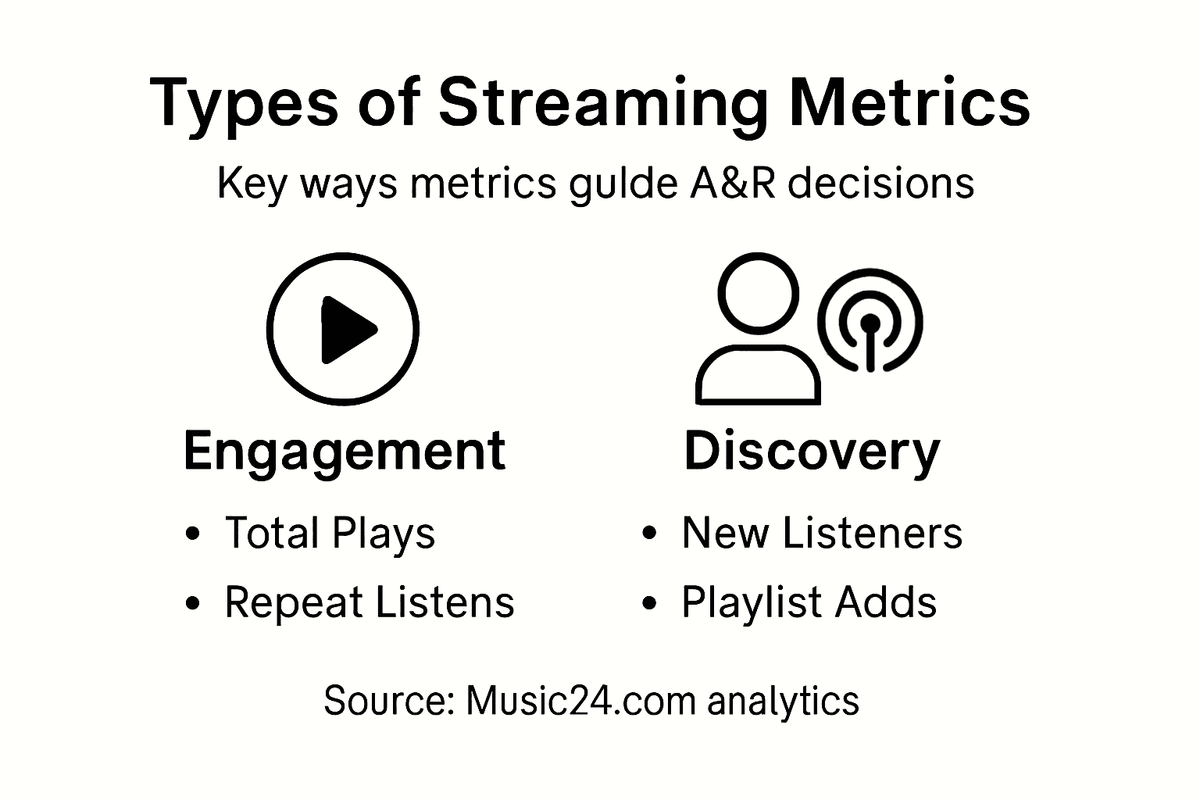
Here's how major streaming metric categories differ in their strategic value:
| Metric Category | Typical Data Collected | Strategic Business Use |
|---|---|---|
| Real-Time Performance | Viewers, chat activity | Assess live event success |
| Audience Reach | Unique listeners, location | Target market segmentation |
| Engagement Quality | Listen duration, completion | Evaluate true audience loyalty |
| Technical Performance | Stream stability, quality | Ensure optimal user experience |
Pro tip: Develop a systematic approach to tracking multiple streaming metrics simultaneously to gain a more comprehensive understanding of an artist's true potential.
How Private Playlist Data Unlocks Early Trends
Private playlist data represents a hidden goldmine of musical insights that traditional industry metrics often overlook. Spotify playlist mining techniques reveal complex listener behaviors that are far more nuanced than public streaming statistics, offering A&R professionals an unprecedented window into emerging musical trends.
The unique value of private playlist data stems from its authenticity and depth:
- Genuine Listener Preferences
- Unfiltered music selections
- No social media performance pressure
- True personal taste representation
- Early Trend Detection
- Identifies emerging artist potential
- Captures niche genre crossovers
- Predicts future mainstream movements
- Demographic Insights
- Granular listener segmentation
- Geographic music preference mapping
- Age and interest correlations
- Behavioral Analysis
- Repeat listening patterns
- Track sequence and mood connections
- Unexpected genre combinations
Unlike public playlists, which often reflect social performativity, private playlists provide a raw, unfiltered view of genuine musical consumption. These collections reveal intricate listener preferences that can signal an artist's true breakthrough potential long before traditional metrics catch up.

A&R professionals who leverage these insights gain a significant competitive advantage. By understanding the subtle dynamics of private playlist curation, they can identify promising artists, predict genre shifts, and develop more targeted marketing strategies that resonate with authentic listener behaviors.
Pro tip: Develop advanced analytical frameworks that prioritize private playlist data over public metrics to uncover truly innovative musical talent.
Tracking Genre-Blending and Geographic Micro-Trends
The modern music landscape is increasingly characterized by fluid genre boundaries and hyper-localized listening patterns. Music streaming diversity research reveals complex listener behaviors that challenge traditional genre classifications and highlight the dynamic nature of musical consumption.
Key characteristics of contemporary music trend tracking include:
- Genre Blending Dynamics
- Cross-genre collaboration
- Hybrid musical styles
- Breaking traditional genre boundaries
- Geographic Micro-Trend Indicators
- Local music preference mapping
- Cultural influence tracking
- Regional sonic innovation detection
- Listener Behavior Analysis
- Individual playlist diversity
- Unexpected genre transitions
- Personalized music discovery patterns
- Cultural Specificity Metrics
- Domestic music preference intensity
- Regional sonic identity markers
- Sub-cultural music trend propagation
Geographic influences remain surprisingly strong in the digital streaming era. Global music streaming trends demonstrate that while digital platforms create global access, local cultural contexts continue to shape musical preferences in profound and nuanced ways.
A&R professionals who understand these complex dynamics can develop more sophisticated strategies for artist development, targeting, and international expansion. By recognizing the intricate interplay between genre fluidity and geographic specificity, they can identify emerging talent and predict future musical movements with unprecedented precision.
Pro tip: Develop multi-dimensional analytical frameworks that simultaneously track genre hybridization, geographic micro-trends, and listener behavioral shifts.
Influence of Curators and the Role of Predictive Analytics
Music curators have emerged as pivotal gatekeepers in the digital streaming ecosystem, wielding significant influence over artist discovery and audience engagement. Music curator influence strategies demonstrate how data-driven insights are transforming traditional music recommendation paradigms.
The strategic landscape of music curation encompasses several critical dimensions:
- Curator Impact Metrics
- Playlist inclusion power
- Audience reach and engagement
- Trend-setting capabilities
- Predictive Analytics Components
- Machine learning algorithms
- Listener behavior modeling
- Early trend identification
- Discovery Ecosystem Dynamics
- Cross-platform recommendation systems
- Personalization accuracy
- Emerging artist visibility
- Technological Transformation
- AI-powered curation tools
- Real-time listening pattern analysis
- Adaptive recommendation engines
Predictive analytics represent a revolutionary approach to understanding musical landscapes. By leveraging sophisticated algorithms and massive datasets, these technologies can anticipate listener preferences, identify emerging artists, and create increasingly personalized music experiences.
The synergy between human curators and advanced analytics creates a powerful mechanism for music discovery. A&R professionals who effectively integrate these tools can identify promising talent faster, understand audience dynamics more deeply, and make more informed strategic decisions about artist development and promotion.
Pro tip: Develop a hybrid approach that combines algorithmic insights with human musical expertise to maximize discovery potential.
Comparing Private vs. Public Metrics in Artist Discovery
Public and private streaming metrics represent two fundamentally different lenses for understanding musical consumption and artist potential. Types of music discovery metrics reveal crucial distinctions that can dramatically impact A&R decision-making strategies.
Key differences between public and private metrics include:
- Public Metrics Characteristics
- Visible to entire industry
- Potentially manipulated performance data
- Social media influenced statistics
- Private Metrics Characteristics
- Authentic listener behavior
- Unfiltered consumption patterns
- True audience engagement indicators
- Comparative Analysis Points
- Listener genuine interest
- Actual track completion rates
- Long-term audience connection
- Strategic Evaluation Dimensions
- Performance predictability
- Trend identification accuracy
- Artist potential forecasting
Public metrics often present a curated, performative version of musical success that can be artificially inflated through marketing strategies. In contrast, private metrics offer a raw, unfiltered glimpse into genuine listener preferences, providing A&R professionals with more authentic insights into an artist's true potential. Metrics that look strong still need artificial streaming due diligence before an advance leaves the building.
Here's a quick overview contrasting private and public streaming metrics in artist discovery:
| Metric Type | Data Authenticity | Trend Detection Accuracy | Example Use in A&R |
|---|---|---|---|
| Public | Often influenced | Detects mainstream shifts | Industry-wide benchmarking |
| Private | Unfiltered listener | Finds early and niche trends | Spotting breakthrough artists |
Successful music industry professionals understand that combining both public and private metrics creates a comprehensive view of artist development. By synthesizing these different data perspectives, they can make more nuanced and accurate decisions about talent identification and promotional strategies.
Pro tip: Develop a holistic analytical framework that weights private metric insights more heavily than public performance statistics.
Unlock True Artist Potential with Advanced Streaming Metrics
The challenge in today’s music A&R is clear Most professionals struggle to gain authentic insights from public streaming data that can be misleading or artificially inflated This article highlights the critical importance of going beyond surface-level metrics to track private playlist data engagement rates and genre blending to uncover genuine audience connections and emerging trends
Music24.com specializes in exactly this kind of in-depth analysis by leveraging anonymized private playlists to reveal breakthrough artists and micro-trends before they show up on mainstream charts Our platform empowers A&R teams to make data-driven decisions using verified listener behavior and predictive analytics
Experience how accessing private playlist data, detailed geographic insights, and curator influence can transform your artist discovery and marketing strategies today
Explore how Music24.com can give your team the competitive edge you need
Discover smarter music analytics now and stay ahead of industry shifts
Discover Music24’s Power
Learn More About Our Approach
Frequently Asked Questions
What are streaming metrics and why are they important for A&R?
Streaming metrics are quantitative measurements that provide insights into listener behavior, artist potential, and market trends. They are crucial for A&R professionals to identify emerging talent and understand audience engagement.
How do private playlist data differ from public streaming metrics?
Private playlist data offers unfiltered insights into genuine listener preferences, while public metrics may reflect manipulated performance influenced by marketing strategies. Private metrics can provide a more authentic view of audience engagement.
What types of streaming metrics should A&R professionals focus on?
A&R professionals should focus on a variety of metrics including engagement rates, listener demographics, repeat listen ratios, and playlist placements to gain a comprehensive understanding of an artist’s potential.
How can predictive analytics enhance artist discovery in the music industry?
Predictive analytics utilize machine learning algorithms to analyze listener behavior and anticipate music preferences, helping A&R professionals identify promising artists and emerging trends more effectively.
Recommended
Get your music heard. Skip the content grind.
Add a song. Music24 makes the posts and the videos, plans your release and publishes it on every channel. Free for 7 days on the Pro plan, no card.