
Private playlists reveal emerging music trends up to 12 weeks before public charts, offering A&R executives and talent scouts an unparalleled competitive advantage. The playlist lifecycle is the journey every playlist experiences from creation through growth, peak, maturity, and decline, each phase revealing distinct patterns of listener behavior and track adoption. Understanding these lifecycle phases unlocks the ability to detect breakout artists early, time releases strategically, and forecast market shifts before they appear in mainstream metrics.
Table of Contents
- Phases Of The Playlist Lifecycle
- Role Of Private Playlists In Early Trend Forecasting
- Common Misconceptions About Playlist Data And Lifecycle
- Framework To Analyze Playlist Lifecycle For Music Professionals
- Practical Applications And Strategic Benefits
- Conclusion
- Unlock The Power Of Playlist Lifecycle Insights With Music24
- FAQ
Key takeaways
| Point | Details |
|---|---|
| Playlist lifecycle phases | Creation, growth, peak, maturity, and decline stages each reveal unique listener behaviors and track adoption patterns. |
| Private playlist advantage | Private playlists offer authentic, early trend signals 12 weeks ahead of public data with higher discovery rates. |
| Strategic applications | Lifecycle metrics enable optimized release timing, early artist discovery, and curator identification for competitive edge. |
| Common misconceptions | Relying solely on public playlist data creates blind spots and delays in trend detection. |
| Measurable impact | Tracking lifecycle inflection points drives 30% listener base growth and maximizes streaming adoption. |
Introduction to playlist lifecycle
The playlist lifecycle represents the predictable evolution every music playlist undergoes, from initial creation through periods of rapid growth, sustained engagement, maturity, and eventual transformation or decline. Each phase exhibits distinct characteristics in track turnover rates, curator engagement patterns, and listener interaction metrics that directly impact how music spreads through streaming platforms.
Private playlists matter significantly more than public collections for early discovery because they capture authentic, unfiltered listening preferences before tracks gain mainstream visibility. While public playlists often showcase already popular songs or editorial selections, private collections reflect genuine personal taste and emerging genre exploration. The role of private playlist data becomes critical for professionals seeking to identify rising talent before competition intensifies.
For A&R executives, talent scouts, and marketing strategists, understanding lifecycle dynamics transforms how you approach artist discovery and campaign timing. These insights reveal when tracks gain momentum within niche communities, which curator behaviors signal broader trend adoption, and where geographic micro-trends emerge first.
Key distinctions between private and public playlists include:
- Private playlists capture first-time exposures and experimental listening patterns
- Public collections typically lag market trends by several weeks or months
- Curator diversity in private data provides broader genre and demographic coverage
- Anonymized private analytics reveal authentic engagement without performance bias
Phases of the playlist lifecycle
Every playlist progresses through five distinct stages, each offering unique signals for music professionals tracking artist momentum and trend development.
-
Creation phase: New playlist formation with initial track selection, typically 5 to 15 songs representing a specific mood, genre, or purpose. Curators experiment with combinations and establish thematic direction.
-
Growth phase: Rapid expansion as curators actively add tracks, refine themes, and increase listening frequency. This stage shows highest track turnover and discovery activity.
-
Peak phase: Maximum engagement with stable listening patterns, optimized track selection, and frequent sharing or revisiting. Playlists reach their most influential state during this window.
-
Maturity phase: Slower track additions with established core songs, reduced curator activity, and more passive listening behavior. The collection serves as a stable go-to rather than active discovery tool.
-
Decline or transformation phase: Decreased engagement leading either to abandonment or complete reimagining with new thematic focus and track replacement.
Tracking lifecycle metrics like creation rate and engagement growth reveals timing inflection points critical for artist exposure. Understanding when playlists transition between phases helps you identify optimal moments for track placement and promotional efforts.

| Lifecycle Phase | Typical Duration | Track Turnover Rate | Curator Activity | Strategic Value |
|---|---|---|---|---|
| Creation | 1 to 2 weeks | High (80% new) | Very active | Early theme detection |
| Growth | 4 to 8 weeks | Moderate (40% new) | Active | Prime discovery window |
| Peak | 8 to 16 weeks | Low (15% new) | Moderate | Maximum influence |
| Maturity | 16+ weeks | Very low (5% new) | Minimal | Stable exposure |
| Decline | Variable | Negligible | Inactive | Transformation signals |
The private playlist monitoring workflow leverages these phase characteristics to automate trend detection and artist alerts. Growth phase playlists provide the strongest signals for emerging tracks gaining organic traction within targeted listener communities.
Role of private playlists in early trend forecasting
Private playlist data uncovers micro-trends months before they surface in public charts or social metrics because it captures authentic discovery behavior free from algorithmic curation or promotional influence. The anonymity factor ensures listeners feel comfortable experimenting with new genres, blending styles, and adding obscure tracks without social pressure or performance considerations.
Curator diversity in private collections spans demographics, geographies, and musical preferences far broader than public playlist ecosystems dominated by platform editors and influencers. This breadth creates a richer dataset for detecting niche movements before they cross into mainstream awareness. Private playlists drive 65% of first-time track exposures compared to just 30% on public collections.
The lead-time advantage proves substantial: while public charts reflect listening behavior from weeks prior, private playlist patterns show real-time adoption as it happens. Artist tracks on private playlists show 30% listener base growth at lifecycle inflection points over just four weeks, providing actionable signals for immediate marketing response.
Practical applications include:
- Identifying genre-blending experiments that predict next-wave fusion trends
- Detecting geographic clusters where specific artists gain unexpected traction
- Spotting curator archetypes whose additions reliably forecast broader adoption
- Mapping track progression from niche private collections to public visibility
Pro Tip: Cross-reference private playlist additions with lifecycle phase data to distinguish genuine trend signals from random experimentation. Tracks appearing across multiple growth-phase playlists simultaneously indicate authentic momentum worth investigating.
"The most valuable insights come not from what's already popular, but from what's quietly gaining traction in the collections nobody sees."
Integrating private playlist signals into your trend detection workflow requires systematic monitoring of creation patterns, engagement velocity, and cross-playlist track overlap. The combination of these metrics with lifecycle context creates a predictive framework far more powerful than traditional chart analysis. Understanding how to map music micro trends through private data transforms reactive marketing into proactive artist development.
Common misconceptions about playlist data and lifecycle
Many music professionals mistakenly treat all playlists as equivalent discovery vehicles, missing critical differences in how public versus private collections function and influence listener behavior. Public playlists serve primarily as consumption channels for already validated tracks, while private collections act as genuine discovery laboratories where listeners explore without audience consideration.
Another prevalent misconception assumes playlist size correlates with influence, when smaller, highly engaged private playlists often drive more meaningful artist adoption than massive public collections with passive followers. The role of private playlist data demonstrates how curator quality matters more than follower quantity for early trend detection.
Relying exclusively on public playlist metrics creates dangerous blind spots. Public playlists often lag in real-time interest representation compared to private collections because they reflect editorial decisions, promotional placements, and algorithmic recommendations rather than organic discovery. By the time a track gains public playlist traction, early adopter opportunities have typically passed.
Key misconceptions to avoid:
- Assuming high follower counts equal higher discovery value
- Treating all lifecycle phases as equally valuable for artist exposure
- Ignoring private playlist signals because they lack public visibility metrics
- Believing editorial playlists provide earlier trend insights than user-created collections
- Expecting lifecycle patterns to mirror across different playlist types
Pro Tip: Customize your analytics strategy by playlist type and lifecycle phase. Use private growth-phase data for early artist discovery, peak-phase public playlists for visibility amplification, and maturity-phase analysis to understand longevity patterns. This layered approach captures the full spectrum of market dynamics.
Framework to analyze playlist lifecycle for music professionals
A systematic framework for lifecycle analysis combines quantitative metrics with qualitative pattern recognition to identify actionable inflection points and strategic opportunities. Focus on metrics that reveal phase transitions and momentum shifts rather than vanity numbers.
Key lifecycle metrics include:
- Creation rate: Number of new playlists featuring specific tracks or genres per week, indicating emerging interest
- Engagement growth: Rate of increase in listening sessions, track additions, and curator activity
- Track turnover: Percentage of playlist content replaced within defined time periods
- Inflection points: Moments when growth accelerates or decelerates, signaling phase transitions
- Cross-playlist overlap: Frequency of same tracks appearing across multiple independent collections
Applying the framework involves these steps:
- Establish baseline metrics for your target artists, genres, or market segments
- Monitor creation rate patterns to detect unusual spikes or sustained increases
- Track engagement velocity across playlist cohorts segmented by lifecycle phase
- Identify inflection points where growth rates change direction or magnitude
- Validate signals by checking cross-playlist overlap and geographic distribution
- Time marketing and A&R actions to leverage identified momentum windows
Key metrics such as creation rate, engagement growth, and track turnover enable informed timing for artist exposure and campaign launches. The table below illustrates benchmark ranges for each phase.
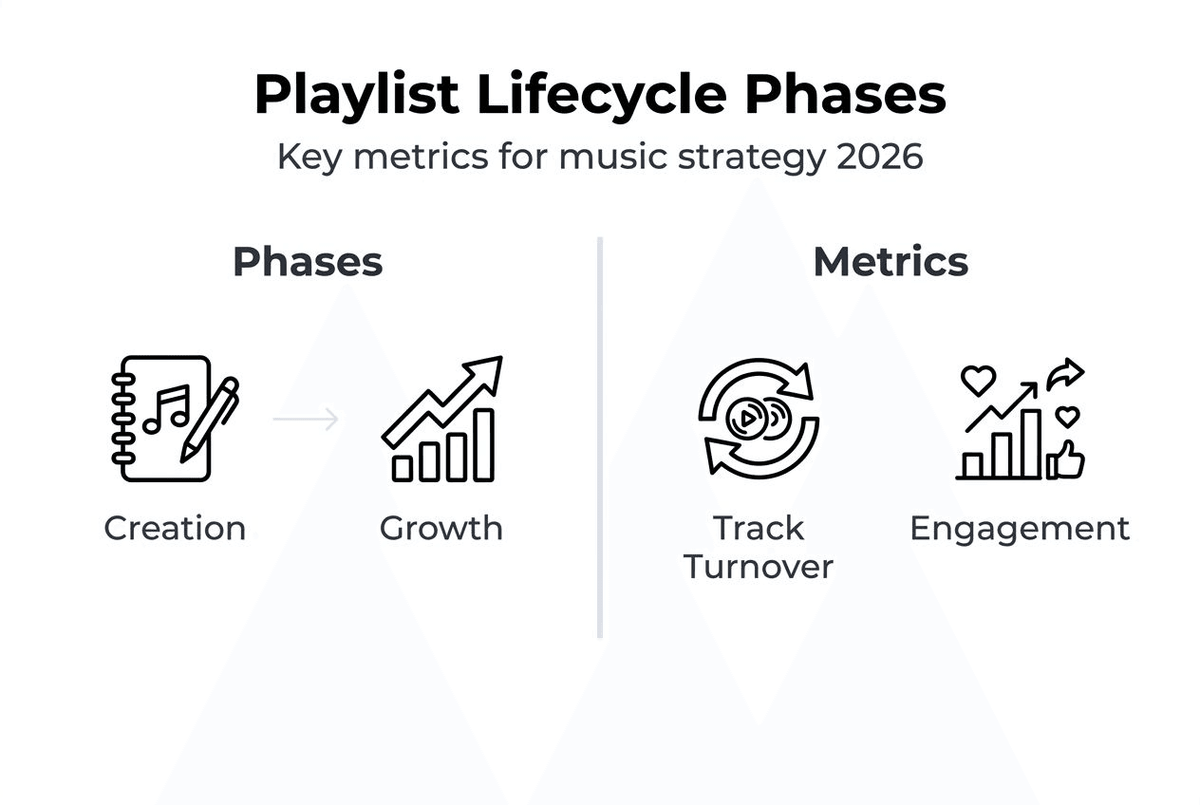
| Metric | Creation Phase | Growth Phase | Peak Phase | Maturity Phase |
|---|---|---|---|---|
| Weekly track additions | 8 to 12 | 4 to 7 | 1 to 3 | 0 to 1 |
| Engagement growth rate | 15% to 25% | 8% to 15% | 2% to 5% | 0% to 2% |
| Track turnover (monthly) | 60% to 80% | 30% to 50% | 10% to 20% | 0% to 10% |
| Listening session frequency | Daily | 3 to 5x weekly | 1 to 2x weekly | Sporadic |
Use this framework to optimize release timing by targeting growth-phase playlists when curator engagement peaks and track adoption accelerates. The playlist data interpretation steps guide provides deeper tactical implementation details for translating metrics into marketing decisions.
Practical applications and strategic benefits
Translating lifecycle insights into competitive advantage requires connecting analytical findings with specific industry actions across A&R, marketing, and talent development functions.
Timing track releases to align with growth-phase peaks maximizes initial streaming impact and organic playlist adoption. When private playlist data shows specific genres or styles entering growth phases across multiple curator segments, launching complementary tracks captures momentum at its strongest point. Aligning track releases with growth phase peaks maximizes streaming impact and adoption rates.
Identifying influential private playlist curators enables strategic relationship building and early track placement. Curators whose playlists consistently transition from growth to peak phases, showing high engagement and track turnover, act as taste-makers whose additions signal broader trend potential. Engaging these individuals before they gain massive public followings creates partnership opportunities competitors miss.
Measuring and forecasting trend impacts becomes possible by tracking how tracks progress through private playlist lifecycles before crossing into public visibility. This progression pattern, from niche private growth phases to mainstream public peaks, provides a predictive roadmap for market timing and resource allocation.
Strategic benefits include:
- Reducing artist discovery risk by validating talent through private playlist momentum before major investment
- Optimizing marketing spend by focusing resources during optimal lifecycle windows
- Building curator networks that provide sustainable discovery channels
- Forecasting genre shifts and demographic preferences months ahead of competition
Pro Tip: Establish a continuous monitoring system tracking your priority artist roster and competitive landscape across all lifecycle phases. Weekly reviews of phase transitions and inflection points keep your strategy responsive to market dynamics. Understanding why track private playlists matters transforms this from occasional analysis into core operational practice.
Conclusion
The playlist lifecycle framework provides music industry professionals with a systematic approach to understanding how tracks gain traction, curators influence trends, and markets evolve before traditional metrics reflect change. Each phase from creation through decline offers distinct signals that, when properly interpreted, enable earlier artist discovery, better release timing, and more effective marketing strategies.
Private playlist analytics deliver the most valuable lifecycle insights because they capture authentic discovery behavior free from promotional influence or algorithmic bias. The 12-week lead time advantage over public data translates directly into competitive edge for labels, managers, and A&R teams willing to invest in comprehensive monitoring systems.
Consistent application of lifecycle analysis across your workflow transforms reactive decision-making into proactive market leadership. As streaming platforms evolve and listener behavior fragments across more niche communities, the ability to detect and interpret lifecycle patterns within private playlist data becomes increasingly essential for sustained success.
The music industry landscape in 2026 rewards professionals who move beyond surface-level metrics to understand the deeper dynamics of how music spreads and gains momentum. Playlist lifecycle analytics provides that deeper understanding.
Unlock the power of playlist lifecycle insights with Music24
Music24's platform gives you direct access to the private playlist analytics framework described throughout this article, turning complex data into actionable artist discovery and trend forecasting tools. Our proprietary technology monitors millions of anonymized private playlists, tracking lifecycle phases, engagement patterns, and inflection points in real time.
For A&R executives, talent scouts, and marketing strategists, Music24 delivers the competitive intelligence needed to spot breakout artists weeks before they appear on public radar. The platform automates lifecycle tracking, curator identification, and trend forecasting so you can focus on strategic decisions rather than manual data analysis.
Pro Tip: Integrate Music24 insights into your weekly planning sessions to stay ahead of market shifts and optimize your artist development pipeline with data-driven confidence.
FAQ
What is the playlist lifecycle in music streaming?
The playlist lifecycle describes the predictable journey playlists experience from creation through growth, peak engagement, maturity, and eventual decline or transformation. Each phase exhibits distinct track turnover rates, curator behaviors, and listener engagement patterns that signal different opportunities for artist exposure and trend detection.
How do private playlists differ from public playlists in trend forecasting?
Private playlists provide earlier and more authentic trend signals because they capture genuine discovery behavior without promotional influence or social performance pressure. They reveal emerging patterns up to 12 weeks before public charts reflect the same trends, offering substantial lead-time advantages for strategic planning.
What metrics are key to analyzing playlist lifecycle effectively?
Critical metrics include creation rate, engagement growth velocity, track turnover percentages, and inflection points marking phase transitions. Each metric informs which lifecycle phase a playlist occupies and guides strategic decisions about release timing, curator engagement, and resource allocation.
How can music industry professionals apply playlist lifecycle insights?
Use lifecycle phase data to schedule releases during growth-phase peaks when curator engagement maximizes track adoption, identify breakout artists appearing across multiple growth-phase playlists simultaneously, and leverage private playlist analytics for trend forecasting and influential curator relationship building.

