How to Plan a Music Release in 2026: The Complete Single and Album Release Strategy
Plan your next music release with this complete 8-week strategy guide covering distribution, playlist pitching, pre-save campaigns, and post-release analytics for singles, EPs, and albums.
Dropping music without a plan is the fastest way to waste a good song. A structured release strategy puts your track in front of the right listeners at the right time, turning a single upload into weeks of compounding momentum. Whether you are releasing a debut single or a full-length album, every decision from distributor selection to playlist pitching affects how far your music travels.
This guide breaks down the complete release timeline, format decisions, and post-release tactics that separate forgettable drops from career-building moments.
Why You Need a Music Release Strategy
A release strategy is the difference between 200 streams and 200,000. Without one, your music competes against 100,000+ tracks uploaded to Spotify every day with zero positioning advantage.
A solid plan does three things. First, it builds anticipation before release day so listeners are ready to press play. Second, it coordinates marketing assets, playlist pitches, and social content so everything lands at the same time. Third, it extends the life of your release beyond the first 48 hours, when most tracks either gain traction or disappear.
Artists who plan releases 8 weeks out consistently outperform those who upload and hope. The algorithm rewards early engagement signals: saves, repeat listens, and playlist adds in the first 72 hours. A strategy front-loads those signals by ensuring your audience knows the release is coming and acts on day one.
The 8-Week Pre-Release Checklist
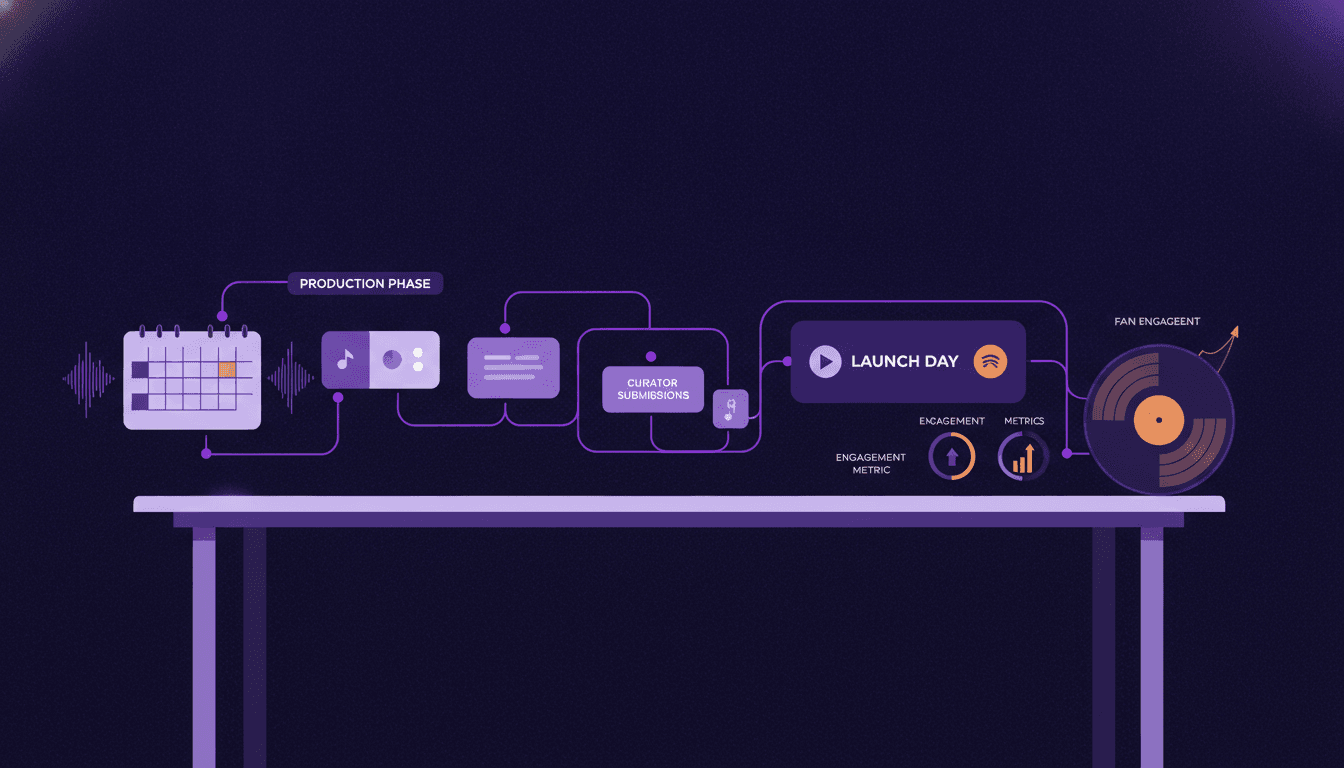
The best releases are not accidents. They follow a predictable timeline that gives every element enough lead time to land properly. Here is the week-by-week breakdown.
Week 8 to 6: Production and Mastering
Finalize your masters, song sequencing (for EPs and albums), and any features or collaborations. This is also when you lock in your release date. Pick a Friday: that is the global new music day across all major streaming platforms, and it gives you a full tracking week in chart calculations. If your date lands in December or January, it sits next to a fixed seasonal moment, so read what to post around Spotify Wrapped before you commit.
Key tasks during this phase:
- Complete final mixes and masters with your engineer
- Decide on track order for multi-track releases
- Confirm all credits, splits, and publishing registrations
- Choose your lead single if releasing an EP or album
- Register songs with your PRO (ASCAP, BMI, SESAC, or equivalent)
Week 5 to 4: Distribution and Metadata
Upload your release to your distributor at least 3 to 4 weeks before the target date. This buffer gives platforms time to process your submission and makes you eligible for editorial playlist consideration.
During upload, get your metadata right the first time:
- Song titles, artist names, and featured artist credits must be consistent across all platforms
- Genre and subgenre tags should be specific (not just "Pop" but "Indie Pop" or "Bedroom Pop")
- ISRC codes are assigned automatically by most distributors but double-check they are unique per track
- Write a compelling "pitch to editors" note if your distributor supports Spotify for Artists pitching
Submit your Spotify for Artists editorial pitch during this window. Spotify requires pitches at least 7 days before release, but 3 to 4 weeks gives editorial teams more time to review. Include the story behind the track, genre references, mood descriptors, and any press or social proof you have.
Week 3 to 2: Marketing Assets and Playlist Pitching
This is when your visual and promotional materials come together. You need all of the following ready before you start any public promotion:
- Cover art (3000x3000px minimum for most distributors)
- Promotional photos and press shots
- Social media graphics in platform-specific dimensions
- A 15 to 30 second teaser clip for Reels, TikTok, and Shorts
- An updated electronic press kit with new release info
Start pitching independent playlist curators during this window. Editorial playlists get pitched through your distributor, but independent curators often accept direct outreach. Focus on curators whose playlists match your genre and have engaged followings, not just large follower counts.
Music24 reads millions of public playlists and charts every day, so you can see which playlists added songs like yours this week, how fast they grow and who curates them. That data helps you identify the curators worth pitching before you spend time on outreach that goes nowhere.
Week 1: Final Push and Pre-Save Campaigns
The last 7 days are about converting awareness into action. Launch your pre-save campaign if you have not already. Pre-saves automatically add your track to a listener's library on release day, which sends a strong signal to the algorithm.
Action items for the final week:
- Share daily countdown content on social platforms
- Send an email blast to your subscriber list with the pre-save link
- Reach out to blogs and media outlets with your press release
- Confirm all playlist pitches have been submitted
- Brief any collaborators, featured artists, or partners on their promo responsibilities
- Schedule release-day social posts so nothing is left to last-minute scrambling
Release Day: What to Do When Your Music Drops
Release day is not the finish line. It is the starting gun.
Your first 24 to 72 hours set the trajectory for the entire release cycle. Streaming algorithms evaluate early engagement to decide whether to push your track to more listeners through algorithmic playlists like Discover Weekly and Release Radar.
Here is your release day playbook:
- Post across all social channels within the first hour of release. Link directly to your music on multiple platforms using a smart link service.
- Engage with every comment, share, and message you receive. The algorithm tracks engagement velocity, not just total numbers.
- Go live on Instagram or TikTok to talk about the release. Live content gets priority in feeds and creates real-time connection with your audience.
- Text, DM, or email your closest supporters and ask them to save the track (not just stream it). Saves carry more weight than passive plays.
- Monitor your Spotify for Artists and Apple Music for Artists dashboards throughout the day. Watch for playlist adds, geographic hotspots, and listener demographics.
Post-Release Strategy: The First 30 Days
Most artists stop promoting after the first week. That is a mistake. The first 30 days after release are when algorithmic momentum either builds or dies.
Week 1 focuses on maximizing streams, saves, and social engagement. Share user-generated content, repost fan reactions, and keep the conversation alive.
Weeks 2 and 3 shift to secondary content. Release a music video, a behind-the-scenes clip, an acoustic version, or a remix. Each piece of secondary content gives you a new reason to push listeners back to the original track.
Week 4 is evaluation time. Pull your analytics and assess what worked. Which playlists drove the most streams? Where did your listeners come from geographically? What social content converted best? These insights shape your next release strategy.
Track your listener behavior through playlist data to understand which audiences stuck around after the initial push and which dropped off.
Single vs. EP vs. Album: Which Release Format Is Right for You?
Choosing the right format depends on your goals, your catalog size, and where you are in your career. Here is a comparison to help you decide.
| Format | Best For | Typical Timeline | Pros | Cons |
|---|---|---|---|---|
| Single | Building momentum, testing new sounds, staying visible | 4 to 6 weeks prep | Low cost, fast turnaround, algorithm-friendly | Limited revenue per release, no deep listening experience |
| EP (4 to 6 tracks) | Establishing a sound, bridging gaps between albums | 8 to 12 weeks prep | Showcases range, qualifies for more playlist types, manageable production scope | Less press coverage than an album, can feel incomplete if not cohesive |
| Album (8+ tracks) | Major statements, touring support, label milestones | 3 to 6 months prep | Maximum press and media coverage, deep fan engagement, higher streaming revenue potential | Expensive to produce, long timeline, harder to maintain attention across all tracks |
For most independent artists in 2026, a rolling single strategy works best. Release a new single every 6 to 8 weeks, building a catalog that feeds algorithmic recommendations. Once you have 3 to 4 strong singles, bundle them into an EP or album with bonus tracks to create a bigger release moment.
How to Use Data Analytics to Measure Your Release Performance
Raw stream counts tell you how many people pressed play. They do not tell you if those listeners cared. The metrics that matter for evaluating a release go deeper.
Save rate: the percentage of listeners who save your track to their library. A save rate above 5% on Spotify signals strong listener intent. Below 2% means your track is getting skipped or forgotten.
Listener-to-fan conversion: how many first-time listeners come back for a second play within 7 days. This metric is not available on all platforms, but you can approximate it through Spotify for Artists' "listeners vs. streams" ratio.
Playlist add velocity: how quickly your track gets added to user-generated and editorial playlists in the first 14 days. Fast growth here indicates organic discovery momentum.
Geographic concentration: where your listeners are located. A release that performs well in 2 or 3 specific markets is a signal to invest in touring, targeted ads, or regional playlist pitching in those areas.
Music24 reads millions of public playlists and charts every day and shows which playlists add songs like yours, which tracks and artists are gaining playlists fastest in a genre, and the countries where that genre grows.
Common Release Strategy Mistakes and How to Avoid Them
Releasing on a Monday or mid-week. Friday is the global new music day. Releasing on any other day means you lose a full tracking week and miss Release Radar placements.
Skipping the pre-save campaign. Pre-saves are free engagement signals. Every pre-save converts to an automatic stream on release day, boosting your first-day numbers.
Pitching playlists too late. Spotify editorial pitches need at least 7 days' lead time. Independent curator outreach should start 2 to 3 weeks early. Last-minute pitches rarely land.
Ignoring metadata. Misspelled artist names, wrong genre tags, and missing credits hurt discoverability and create headaches with royalty collection.
Stopping promotion after week one. The algorithm does not stop evaluating your track after 7 days. Consistent engagement over 30 days gives your release the best chance of landing on algorithmic playlists.
Not analyzing results. Every release teaches you something. Skip the analysis and you repeat the same mistakes. Study your data, adjust your approach, and apply those lessons to the next release. Check out our guide on how to detect music trends early to sharpen your analytical skills.
FAQ
How far in advance should I plan a music release?
A minimum of 8 weeks for a single. EPs need 8 to 12 weeks, and albums should have 3 to 6 months of planning. The biggest bottleneck is usually distribution and editorial pitching, which requires 3 to 4 weeks of lead time before your release date.
What day of the week should I release music?
Friday. It is the global new music day across Spotify, Apple Music, Amazon Music, and other streaming platforms. Releasing on Friday gives you a full tracking week for chart eligibility and ensures your track appears in Release Radar and New Music Friday playlists.
How many singles should I release before an album?
Two to four singles typically work best. Each single builds your audience, tests different sounds, and generates streaming data you can analyze before committing to a full album sequence. Space them 6 to 8 weeks apart to maintain consistent visibility.
Do pre-save campaigns actually work?
Yes. Pre-saves convert to automatic plays on release day, which boosts your first-day stream count and sends a strong signal to streaming algorithms. Even a few hundred pre-saves can meaningfully affect your first-week performance, especially for independent artists.
How do I know if my release strategy is working?
Track four key metrics: save rate (aim for above 5%), listener return rate (repeat plays within 7 days), playlist add velocity in the first two weeks, and geographic listener concentration. If these numbers grow with each release, your strategy is working. If they plateau, revisit your pre-release promotion and playlist pitching approach.
Should I use a distributor or go direct to streaming platforms?
Use a distributor. Direct uploads are only available on a few platforms and limit your reach. Distributors like DistroKid, TuneCore, CD Baby, and AWAL handle multi-platform delivery, metadata formatting, and Spotify for Artists access. Choose based on pricing model (per-release vs. annual subscription) and whether you need additional services like sync licensing or publishing administration.
How important is cover art for a release?
Very. Cover art is the first visual impression of your music. It appears in playlists, search results, social shares, and smart speaker displays. Invest in professional artwork that reflects your brand and stands out at small thumbnail sizes. Avoid generic stock imagery or cluttered designs.
Releasing music soon? Start free with Music24: 7 days of the Pro plan, no card, then a Free plan for as long as you like.
Get your music heard. Grow the fans who stay.
Add a song. music24 makes the posts and the videos, plans your release and publishes it on every channel. Free for 7 days on the Pro plan, no card.