How to track listener behavior with private playlists
Discover how to track listener behavior using private playlist data to identify emerging artists 4-6 weeks earlier and improve A&R accuracy by up to 35%.

Identifying authentic listener preferences before trends hit public charts remains one of the most difficult challenges for A&R executives and artist managers. Traditional metrics like streaming counts and social media engagement arrive too late, after hype cycles have already begun. Private playlist analysis reveals authentic listener behavior by examining personal, non-public collections that capture unfiltered preferences and early trends before public charts. This guide walks you through the preparation, execution, and verification methods needed to leverage private playlist data for discovering emerging talent and tracking genuine listener behavior patterns.
Table of Contents
- Key takeaways
- Understanding private playlist data and its importance
- Preparing to track listener behavior: tools, metrics, and data sources
- Executing advanced listener behavior tracking using private playlist analysis
- Verifying and optimizing listener behavior insights for A&R success
- Enhance your music scouting with Music24
- FAQ
Key Takeaways
| Point | Details |
|---|---|
| Private playlist insights | Analyzing private playlists reveals authentic listener preferences and early trends that public data often misses. |
| Key metrics matter | Tracking metrics such as addition velocity and skip rates sharpens talent scouting and reduces reliance on late stage popularity. |
| Private and public data | Integrating private and public playlist signals provides the most accurate view of emerging artists. |
| Responsible analytics | Platforms should anonymize user data and audit bias to protect privacy and ensure fair trend detection. |
Understanding private playlist data and its importance
Private playlists are personal music collections that users create for themselves without sharing publicly. Unlike public playlists or algorithmic recommendations, these collections represent unfiltered listening preferences free from social signaling or platform manipulation. When you analyze private vs public playlists, the difference in authenticity becomes immediately clear.
Public playlists often reflect what listeners want others to see rather than what they genuinely enjoy. Users curate public collections to project specific identities or gain followers. Algorithmic recommendations, while personalized, still operate within platform business objectives that prioritize engagement metrics over pure discovery. Private playlists eliminate these distortions entirely.
The limitations of relying solely on public data create blind spots in talent scouting. By the time an artist appears on popular public playlists or trending charts, multiple labels have already noticed them. The competitive advantage disappears. Private playlist data shifts the timeline backward, revealing listener adoption patterns weeks before public visibility emerges.
Ethical considerations matter when working with private data. Platforms providing private playlist analysis music trends must anonymize user information and aggregate data to protect privacy. Regular bias audits ensure that demographic skews in data collection do not distort trend identification. Responsible analytics platforms implement these safeguards as standard practice.
Pro Tip: Focus on private playlist data from diverse geographic regions and age demographics to avoid regional bias in trend detection. A track gaining traction in private playlists across multiple markets signals stronger breakout potential than concentrated regional activity.
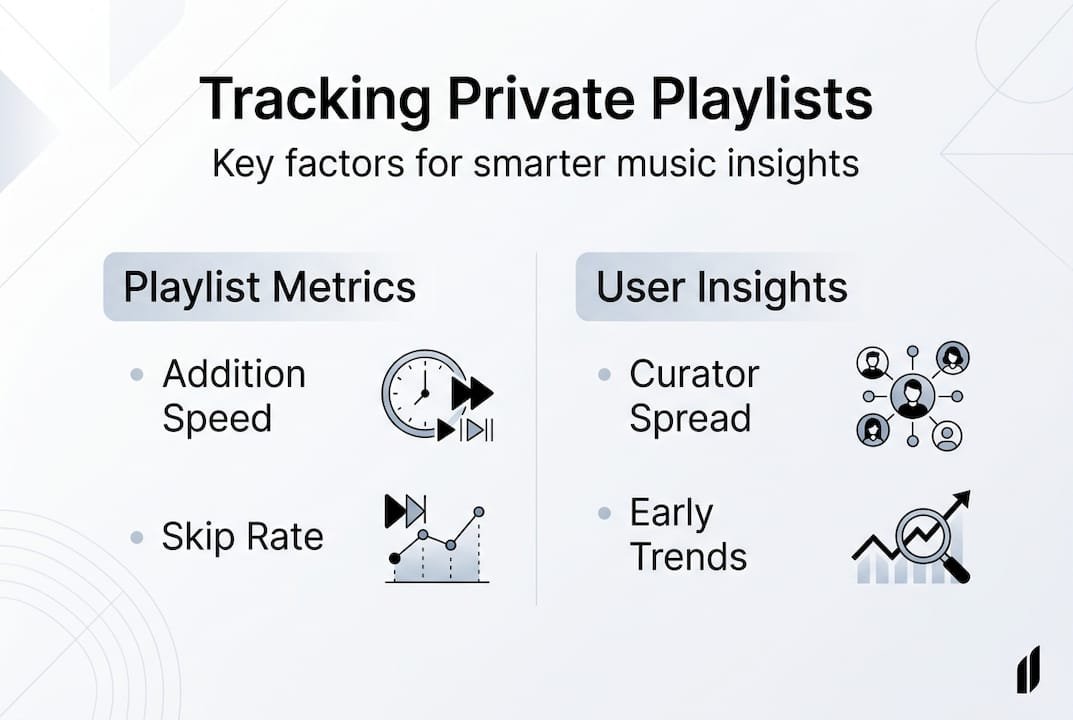
Early identification capabilities represent the primary value proposition. When private data shows an artist appearing in hundreds of new playlists weekly with low skip rates, you are witnessing authentic discovery in action. This signal arrives before streaming counts spike, before social media buzz builds, and before competing labels take notice. For A&R teams, this timing advantage translates directly into better deal terms and stronger artist relationships.
Preparing to track listener behavior: tools, metrics, and data sources
Accessing true private playlist data presents immediate challenges. Direct access to true private Spotify playlists is restricted; industry uses aggregated and anonymized data from platforms or APIs for public playlists. Music professionals must work with specialized analytics platforms that have established data partnerships or use sophisticated aggregation methods.
Tools like Music24, Viberate, PlaylistSupply, Playlist Pilot provide analytics on playlists, tracking placements, followers, growth, bot detection for A&R scouting. Each platform offers different strengths. Music24 specializes in private playlist insights and early trend detection. Viberate excels at influencer identification across platforms. PlaylistSupply focuses on playlist curator contact information. Playlist Pilot emphasizes campaign tracking for artists already gaining traction.
Selecting the right metrics determines analysis quality. Addition velocity measures how quickly a track gets added to new playlists over time. A song appearing in 50 new private playlists this week versus 20 last week shows accelerating interest. Skip rates indicate whether listeners actually enjoy tracks they have added. High addition velocity with low skip rates signals genuine appeal rather than curiosity adds.

Curator centrality identifies influential playlist creators whose additions predict broader trends. When high-centrality curators add a track, their followers and connected curators often follow within days. This network effect amplifies discovery patterns. Geographic distribution reveals whether interest concentrates in one market or spreads across regions, helping predict scalability.
| Metric Type | What It Measures | Why It Matters |
|---|---|---|
| Addition Velocity | Rate of playlist adds over time | Identifies momentum and trending tracks |
| Skip Rate | Percentage of skips within 30 seconds | Validates genuine listener engagement |
| Curator Centrality | Influence level of playlist creators | Predicts trend amplification potential |
| Geographic Spread | Regional distribution of adds | Assesses market scalability |
| Retention Rate | Percentage of adds that remain after 2 weeks | Distinguishes lasting appeal from novelty |
Comparing capabilities between public and private playlist analytics clarifies strategic value. Public playlist tools track follower counts, playlist placement, and curator contact information effectively. These metrics help with promotional campaigns and playlist pitching. Private playlist analytics reveal adoption patterns, authentic engagement, and early trend signals that public data cannot capture. The private playlist analysis guide explains how combining both approaches creates comprehensive intelligence.
Aggregated and anonymized datasets support meaningful insights while protecting user privacy. Platforms collect data from millions of playlists, strip identifying information, and analyze patterns at scale. You receive trend signals and artist metrics without accessing individual user data. This aggregation method provides statistically significant insights while maintaining ethical standards.
Pro Tip: Establish baseline metrics for your target genres before analyzing individual tracks. Understanding typical addition velocity and skip rates for similar artists helps you recognize when a new track significantly outperforms category averages.
Executing advanced listener behavior tracking using private playlist analysis
Implementing systematic private playlist analysis requires a structured methodology. Key methodologies include tracking playlist addition velocity, curator centrality and influence, skip rates, genre blending, geographic micro-trends, and emotion recognition from lyrics. Follow this execution framework for consistent results.
-
Establish your monitoring parameters. Define target genres, geographic markets, and artist profiles you want to track. Set minimum thresholds for addition velocity and skip rates that signal meaningful trends. Configure alerts for when tracks exceed baseline metrics.
-
Collect baseline data across your focus areas. Spend two weeks gathering data on typical playlist behavior in your target categories. Calculate average addition velocity, skip rates, and retention rates for established artists in similar genres. These benchmarks help you recognize outlier performance.
-
Implement curator influence scoring. Identify playlist creators whose additions consistently predict broader trends. Track their centrality scores and connection networks. When these high-influence curators add new tracks, flag them for immediate review regardless of current popularity.
-
Monitor addition velocity patterns daily. Check for tracks showing week-over-week acceleration in playlist adds. A track jumping from 30 new adds per day to 80 new adds per day indicates growing momentum. Sustained acceleration over multiple weeks signals strong trend potential.
-
Analyze skip rate and retention data weekly. High addition velocity means nothing if listeners immediately skip tracks. Review skip rates for all flagged tracks. Prioritize artists showing both accelerating additions and below-average skip rates. Check retention rates after two weeks to confirm lasting appeal.
-
Map geographic distribution patterns. Examine where playlist additions concentrate geographically. Tracks gaining traction across multiple markets simultaneously show stronger breakout potential than regional phenomena. Use the analyze listener behavior with private playlist data framework to interpret geographic patterns.
-
Detect genre blending and micro-trends. Notice when tracks appear in playlists spanning multiple genres. This cross-genre appeal often predicts mainstream breakthrough potential. Track emerging micro-genres by identifying clusters of playlists featuring similar sonic characteristics before genre labels solidify.
-
Apply emotion recognition for lyrical insight. Use sentiment analysis tools to categorize tracks by emotional content. Compare emotional profiles of rising tracks against established hits. Shifts in popular emotional themes can signal broader cultural trends affecting multiple artists.
Pro Tip: Create custom dashboards tracking your top 20 high-potential tracks simultaneously. Update metrics daily and review the full dashboard weekly. This systematic approach prevents you from missing momentum shifts while avoiding information overload.
| Analysis Stage | Key Actions | Success Indicators |
|---|---|---|
| Setup | Define parameters, set thresholds, configure alerts | Clear benchmarks established |
| Data Collection | Gather baseline metrics, identify curator networks | Statistically significant sample size |
| Monitoring | Track velocity, skip rates, retention daily | Early trend signals detected |
| Validation | Cross-reference geographic spread, genre patterns | Multiple confirming indicators present |
| Action | Prioritize high-potential artists for outreach | Competitive timing advantage achieved |
The spot rising artists private playlists methodology emphasizes pattern recognition over single-metric analysis. No individual metric tells the complete story. Addition velocity might spike due to a viral moment that fades quickly. Low skip rates on a track with minimal additions indicate quality but not momentum. Combine multiple signals to build conviction before committing resources.
Timing your analysis cadence appropriately prevents both missed opportunities and false alarms. Daily monitoring catches momentum shifts early. Weekly deep dives validate trends and filter noise. Monthly reviews identify longer-term pattern changes in listener behavior across genres and markets. This multi-timeframe approach balances responsiveness with analytical rigor.
Verifying and optimizing listener behavior insights for A&R success
Validating findings separates actionable intelligence from misleading signals. Common mistakes in playlist data analysis create false positives that waste scouting resources. Bot activity represents the most significant data quality threat. Fake playlists created by bots inflate addition counts without reflecting genuine listener interest. Public playlists risk bot activity; private data requires AI detection for authenticity.
Implement bot detection protocols before analyzing any playlist data. Examine playlist creation patterns for suspicious regularity. Real users create playlists sporadically with varied track selections. Bots generate playlists on predictable schedules with formulaic content. Check curator profiles for authentic listening history. Accounts created recently with thousands of playlists but minimal listening activity likely represent bot operations.
Data cleansing improves analysis accuracy significantly. Remove outlier playlists that skew metrics, such as massive collections with thousands of tracks added simultaneously. Filter playlists that show no skip rate data, indicating the curator never actually listens. Exclude playlists with suspicious geographic patterns, like identical track selections appearing in hundreds of playlists from the same city within hours.
Integrating private with public playlist data creates the most reliable insights. Private vs public playlists serve different analytical purposes that complement each other. Private data reveals early adoption and authentic engagement. Public data validates trends and measures promotional effectiveness. When both data sources align, confidence in artist potential increases dramatically.
Validation techniques for trend detection include cross-referencing multiple data sources. Check whether tracks showing strong private playlist momentum also demonstrate growing search volume, social media mentions, or radio spins. Trends supported by multiple independent signals prove more reliable than isolated metrics. Interview playlist curators directly when possible to understand their discovery process and verify authentic interest.
Private data detects emerging artists 4-6 weeks before public charts, improving A&R decision accuracy by up to 35%.
Achieving these accuracy gains requires disciplined methodology and continuous optimization. Track your prediction success rate by documenting which artists you flagged based on private playlist data and monitoring their subsequent commercial performance. Calculate what percentage achieved label deals, significant streaming growth, or chart success within six months. Use this feedback loop to refine your thresholds and analysis criteria.
Common pitfalls to avoid include:
- Overweighting single exceptional metrics while ignoring contradictory signals
- Failing to account for seasonal listening pattern variations
- Ignoring genre-specific norms when setting performance thresholds
- Neglecting to update baseline metrics as market conditions evolve
- Chasing momentum after public visibility has already emerged
The private playlist analytics workflow emphasizes systematic documentation and continuous improvement. Maintain detailed records of your analysis process, decision criteria, and outcomes. Review quarterly to identify which signal combinations proved most predictive. Adjust your methodology based on empirical results rather than intuition.
Optimization extends beyond individual artist evaluation to portfolio strategy. Analyze your successful signings to identify common patterns in their early playlist data. Did they all show similar addition velocity curves? Did they share geographic distribution characteristics? Understanding your hit pattern helps you recognize similar profiles faster in future analysis.
Collaboration amplifies analytical capabilities. Share anonymized findings with trusted industry colleagues to validate your trend observations. When multiple A&R teams independently identify the same emerging artist through private playlist analysis, conviction increases. Build networks with playlist curators, music supervisors, and regional tastemakers who provide qualitative context for quantitative signals.
Enhance your music scouting with Music24
Tracking authentic listener behavior through private playlist data transforms how you identify emerging talent and spot trends before competitors. Music24 provides the specialized analytics platform built specifically for this challenge. Our proprietary access to anonymized private playlist data from millions of user collections reveals adoption patterns weeks before public charts reflect them.
The platform integrates addition velocity tracking, curator influence scoring, skip rate analysis, and geographic trend mapping into unified dashboards designed for A&R workflows. You gain the competitive timing advantage that separates successful signings from missed opportunities. Music24 combines private and public playlist insights with predictive analytics that improve scouting accuracy by up to 35%. Explore how Music24 can optimize your talent identification process and help you discover the next breakthrough artist before anyone else notices.
FAQ
How can private playlist data overcome bot-related distortions?
AI-driven bot detection algorithms analyze playlist creation patterns, curator behavior, and listening history to identify and filter artificial activity. Public playlists risk bot activity; private data requires AI detection for authenticity. Filtering bots ensures insights reflect genuine listener behavior rather than manipulation schemes. Regular audits maintain data quality as bot tactics evolve.
What key metrics should I prioritize when tracking listener behavior?
Focus on addition velocity, skip rates, and curator centrality as your primary metrics. Key methodologies include tracking playlist addition velocity, curator centrality, skip rates. Addition velocity measures song adoption speed and momentum. Skip rates indicate whether listeners genuinely engage with tracks they have added. Curator centrality reflects playlist influencer impact and predicts trend amplification potential across connected networks.
How much earlier can private playlist analysis detect emerging artists compared to public charts?
Private data detects emerging artists 4-6 weeks before public charts, improving A&R decision accuracy by up to 35%. This timing advantage allows you to approach artists before bidding wars begin and negotiate better deal terms. The accuracy improvement comes from identifying authentic listener adoption patterns rather than reacting to lagging public metrics. Scouting earlier in the discovery cycle provides competitive advantage in talent acquisition.
Can private playlist analysis work effectively for niche genres with smaller audiences?
Yes, private playlist analysis often works better for niche genres because authentic fan communities drive discovery through personal recommendations rather than algorithmic promotion. Smaller audiences create clearer signals when addition velocity accelerates, since organic growth stands out more dramatically. Adjust your baseline thresholds to reflect realistic scale for the genre rather than comparing niche artists to mainstream benchmarks.
How do I balance quantitative playlist metrics with qualitative artistic judgment?
Use playlist data to identify which artists deserve your attention, then apply artistic judgment to evaluate signing potential. Metrics reveal momentum and listener engagement but cannot assess artistic vision, work ethic, or long-term development potential. Think of private playlist analysis as an efficient filtering mechanism that surfaces high-potential artists for deeper qualitative evaluation rather than a replacement for A&R expertise.
Recommended
- How to Analyze Listener Behavior with Private Playlist Data - Blog - Music24.com
- Private Playlist Analytics: Transforming A&R Discovery - Blog - Music24.com
- Private Playlist Monitoring Workflow: Unlocking Early Music Trends - Blog - Music24.com
- Why Track Private Playlists for Early Artist Discovery - Blog - Music24.com
Get your music heard. Skip the content grind.
Add a song. Music24 makes the posts and the videos, plans your release and publishes it on every channel. Free for 7 days on the Pro plan, no card.