
Most A&R teams overlook the fact that over 60 percent of music discovery now happens through playlist engagement rather than traditional radio. For american record labels and global industry decision makers, understanding how private and public playlists shape listener behavior has become mission-critical. This overview breaks down how analyzing playlist patterns can unlock early indicators of emerging artists and pinpoint truly influential trends long before they hit mainstream charts.
Table of Contents
- Defining Private and Public Playlists
- Key Differences: Privacy and Visibility
- Playlist Data and Music Discovery Patterns
- Why Private Playlists Reveal Emerging Trends
- Leveraging Private Playlist Insights for A&R
Key Takeaways
| Point | Details |
|---|---|
| Understanding Playlist Types | Private playlists reveal genuine listener preferences, while public playlists reflect social signaling and broader trends. |
| Value of Private Playlists | Analyzing private playlists allows A&R professionals to detect early musical trends before they enter the mainstream. |
| Data Insights and Privacy | Advanced analytical techniques can uncover meaningful insights from private playlists without compromising user privacy. |
| Driving Talent Discovery | Insights from private playlist data can reshape talent scouting strategies by revealing emerging artists with authentic listener traction. |
Defining Private and Public Playlists
In the music industry, understanding the nuanced differences between private and public playlists represents a critical analytical frontier for A&R professionals. Public playlist attributes reveal more than just musical preferences - they expose intricate social connections and listener behaviors that can predict emerging trends.
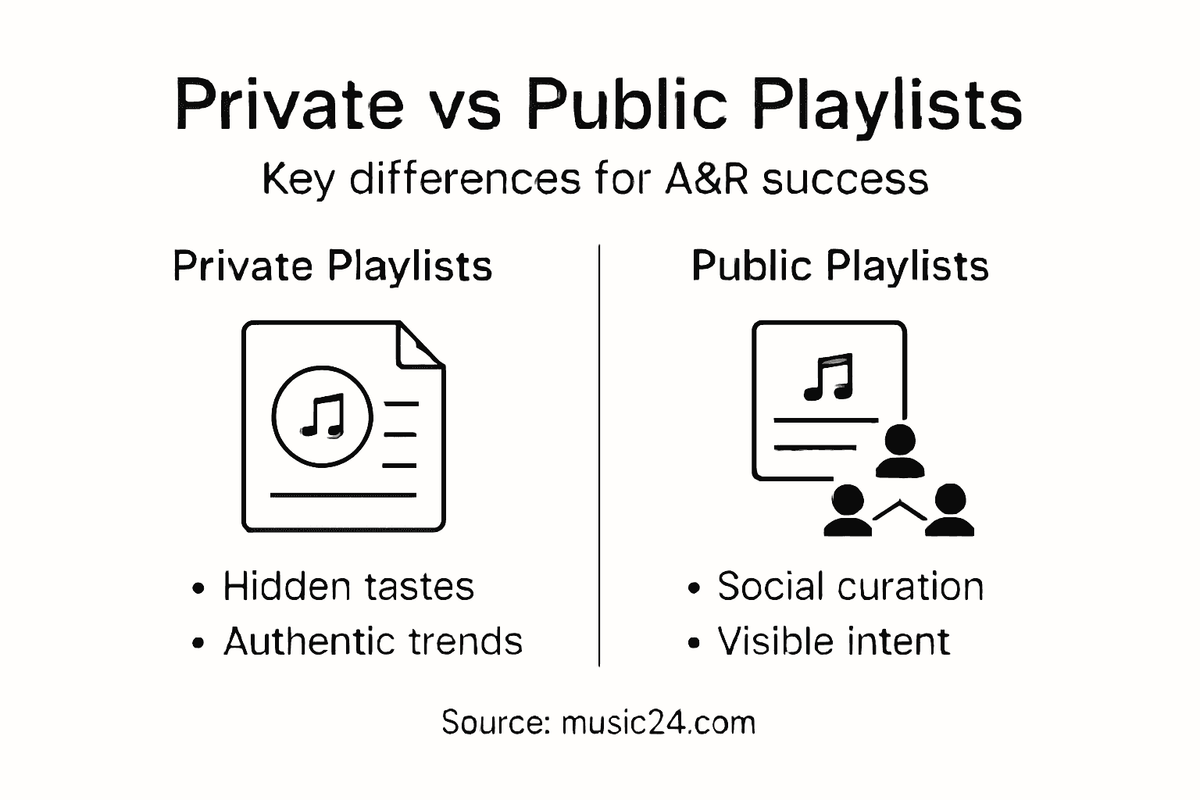
Private playlists, by contrast, offer a deeper, more intimate glimpse into individual music consumption patterns. While public playlists serve as curated expressions of musical identity shared with broader audiences, private playlists represent personal soundtracks crafted exclusively for individual enjoyment. These collections remain hidden from public view, containing experimental tracks, guilty pleasures, and deeply personal musical selections that listeners might not want to broadcast.
The key distinction lies in visibility and intent. Public playlists function as social artifacts - carefully constructed narratives that listeners use to communicate taste and personal brand. Private playlists, conversely, operate as personal sanctuaries where music exploration happens without external judgment or performative considerations. For A&R executives, understanding this divide becomes crucial in decoding authentic listener preferences beyond surface-level trends.
Pro tip: Treat private playlist data as your secret weapon for discovering genuine, unfiltered musical preferences that public metrics cannot reveal.
Here's a concise comparison of private and public playlists from an A&R analytics perspective:
| Aspect | Private Playlists | Public Playlists |
|---|---|---|
| Visibility | Accessible only to the creator | Visible to all users |
| User Motivation | Driven by personal exploration | Shaped by social signaling |
| Data Insights | Reveal authentic preferences, niche picks | Offer broader trend and popularity cues |
| A&R Value | Early trend detection, genuine tastes | Measuring artist reach and popularity |
Key Differences: Privacy and Visibility
A&R professionals must recognize the fundamental distinctions between private and public playlists through the lens of data visibility and user intent. Music data privacy transforms how executives understand listener behavior, revealing nuanced insights beyond traditional metrics.
Private playlists create a unique digital space where listeners curate music without external pressure or performative considerations. Unlike public playlists that serve as social statements, these personal collections represent unfiltered musical preferences. They capture experimental genre blending, niche artist discoveries, and deeply personal soundtracks that listeners might hesitate to broadcast publicly.

Visibility becomes the critical differentiator between these playlist types. Public playlists function as carefully constructed musical personas - meticulously arranged to communicate taste, cultural alignment, and social identity. In contrast, private playlists operate as intimate musical diaries, free from the constraints of peer perception or algorithmic recommendations. For A&R executives, understanding this distinction means accessing more authentic listener preferences that traditional streaming metrics cannot capture.
Pro tip: Develop advanced analytical techniques that can ethically decode private playlist patterns without compromising user privacy, giving you a competitive edge in artist discovery.
Playlist Data and Music Discovery Patterns
Playlist data represents a complex ecosystem of musical exploration, where listener behavior patterns reveal intricate insights into music consumption and discovery mechanisms. A&R professionals must understand that playlist data transcends simple track listings, functioning as dynamic maps of musical preferences and listener psychology.
Streaming platforms generate multiple playlist categories that dramatically influence music discovery. Algorithmic playlists leverage machine learning to recommend tracks based on historical listening patterns, while human-curated playlists introduce serendipitous musical connections. These different playlist types create unique pathways for artists to reach potential fans, with each category offering distinct advantages for music industry professionals seeking emerging talent.
The nuanced layers of playlist data uncover profound insights into listener motivation. Context-driven playlists reflect specific moods, activities, or emotional states, while genre-exploration playlists demonstrate a listener's willingness to venture beyond familiar musical territories. For A&R executives, decoding these subtle variations becomes crucial in understanding how music truly spreads and gains momentum across listener communities.
Pro tip: Develop sophisticated analytical frameworks that can interpret playlist data beyond surface-level metrics, focusing on contextual listening behaviors and emergent musical connections.
Summary of playlist types and their influence on artist discovery:
| Playlist Type | Curation Method | Impact on Music Discovery |
|---|---|---|
| Algorithmic | Software-based | Recommends tracks via data patterns |
| Human-curated | Editor or user-driven | Introduces unique, serendipitous finds |
| Context-driven | Mood/activity themed | Matches music to listener situations |
| Genre-exploration | Cross-genre focus | Encourages diverse taste exploration |
Why Private Playlists Reveal Emerging Trends
Private playlists serve as underground laboratories of musical innovation, where listeners experiment with sounds free from social judgment or algorithmic influence. Private playlists shape trends in ways traditional music analytics cannot capture, offering A&R professionals unprecedented insights into authentic listener preferences.
Unlike public playlists designed for external consumption, private collections represent raw, unfiltered musical exploration. These personal soundtracks capture nascent genre intersections, early adopter behaviors, and sonic experiments that have not yet registered on mainstream radar. A&R executives who can decode these hidden musical narratives gain a significant competitive advantage in identifying breakthrough artists before they become commercially visible.
The true power of private playlists lies in their authenticity. Listeners curate these collections without performative constraints, selecting tracks that genuinely resonate with their musical identity. This means private playlists become early warning systems for emerging musical trends, revealing stylistic shifts, cross-genre pollination, and underground artistic movements long before they emerge in public streaming data or chart rankings.
Pro tip: Develop sophisticated data parsing techniques that can extract meaningful patterns from private playlist metadata while maintaining strict user privacy protections.
Leveraging Private Playlist Insights for A&R
A&R professionals can transform their talent discovery strategies by tracking private playlist data with unprecedented precision. These hidden musical repositories offer a direct window into listener authenticity, revealing emerging artist potential far beyond traditional streaming metrics.
Private playlist analysis requires sophisticated computational approaches that respect user privacy while extracting meaningful musical trend signals. By developing advanced machine learning algorithms capable of detecting subtle pattern shifts, A&R teams can identify micro-genre innovations, early listener adoption curves, and underground artistic movements before they become mainstream phenomena. These insights become predictive tools for understanding which emerging artists have genuine listener momentum.
The strategic value of private playlist insights extends beyond simple artist identification. These collections represent unfiltered musical ecosystems where listeners experiment without social performance constraints. Cross-referencing private playlist data can uncover complex listener behaviors - revealing how niche artists gain organic traction, how genre boundaries blur, and how musical innovation truly propagates across listener communities. For forward-thinking A&R executives, this represents a radical reimagining of talent scouting.
Pro tip: Develop ethical data parsing frameworks that can extract meaningful playlist insights while maintaining rigorous user privacy standards and consent protocols.
Unlock the Power of Private Playlists for True A&R Breakthroughs
Understanding the crucial difference between private and public playlists reveals a hidden challenge faced by A&R professionals: gaining access to authentic listener preferences beyond surface-level trends. This article highlights how private playlists act as intimate musical diaries showcasing unfiltered tastes and early genre shifts that public metrics miss. If you are seeking to detect genuine emerging trends, niche artist momentum, and cross-genre innovations before they hit mainstream awareness, you need more than traditional analytics.
Music24.com specializes in solving this exact problem. By analyzing millions of anonymized private playlists, our platform reveals the real patterns behind music discovery and listener behavior. We empower record labels, artist managers, and A&R teams with predictive insights into rising artists and micro-trends that public playlists simply cannot uncover. Gain a competitive edge in talent scouting by leveraging exclusive access to private playlist data and sophisticated analytic tools.
Ready to transform your A&R strategy using the hidden signals in private playlists?
Explore how Music24.com helps you decode unfiltered listener tastes and discover breakthrough artists earlier. Unlock exclusive early trend insights and develop targeted approaches with our advanced music analytics solutions. Visit Music24.com today and take the next step toward music discovery success.
Frequently Asked Questions
What are the main differences between private and public playlists?
Public playlists are visible to all users and often reflect social identity and curation, whereas private playlists are accessible only to the creator and represent personal musical preferences without external judgment.
How can private playlists be used to identify emerging music trends?
Private playlists provide insight into unfiltered musical exploration, capturing early adopter behaviors and unique genre intersections that may not yet be visible in public metrics.
What insights can A&R professionals gain from analyzing private playlist data?
A&R professionals can uncover genuine listener preferences, identify micro-genre innovations, and recognize underground movements, which are key for discovering breakthrough artists before they hit mainstream popularity.
Why is data privacy important in analyzing private playlists?
Data privacy ensures that the personal listening habits of users are respected while allowing A&R teams to derive meaningful trends and insights without compromising user trust.

