Step-by-step curator influence analysis guide for pros
Master curator influence analysis with this step-by-step guide for music professionals. Learn to identify tastemakers early using private playlist data and network metrics.

Identifying influential playlist curators before they break into mainstream recognition remains one of the most challenging tasks for A&R executives and music marketers. While public streaming charts offer delayed snapshots of popularity, private playlist data reveals authentic early discovery patterns that predict trends weeks ahead. This guide provides a structured framework to analyze curator influence using private playlist analytics, enabling you to spot emerging tastemakers, validate their impact through network analysis, and leverage these insights for smarter talent scouting and campaign targeting decisions.
Table of Contents
- Key takeaways
- Understanding the problem: Why analyzing curator influence matters
- Preparation: Gathering data and understanding key metrics for curator influence
- Execution: Step-by-step process for curator influence analysis
- Verification and troubleshooting: avoiding common pitfalls and validating findings
- Where Music24 fits
- Frequently asked questions
Key Takeaways
| Point | Details |
|---|---|
| Stepwise framework | A structured step by step approach guides how to collect data, measure metrics, and validate curator influence. |
| Private playlist signals | Private playlists reveal early discovery patterns that precede public trends and help forecast momentum. |
| Network centrality insights | Network analysis identifies core curators by their connections and influence across multiple playlists. |
| AI plus human validation | Combine AI signals with human cultural context to verify influence before acting on it. |
| Authenticity checks | Guard against bot driven metrics and confirm sustainable influence through multiple signals. |
Understanding the problem: Why analyzing curator influence matters
Playlist curators shape listener behavior and artist discovery in ways that traditional radio never could. Curated playlists drive 70% of streams and improve A&R productivity by up to 40% when teams track curator influence systematically. Yet most industry professionals still rely on public playlist data that arrives weeks after trends emerge, missing critical windows for signing talent or launching campaigns.
Public playlists suffer from promotional bias and lag time. Major editorial playlists reflect decisions made weeks earlier, while algorithmic playlists respond to existing momentum rather than predicting it. This creates a reactive cycle where labels chase artists after competitors have already moved. Private playlists break this cycle by capturing genuine listener preferences before promotional machinery kicks in.
The advantages of private playlist analytics workflow extend beyond timing. Private collections reveal how real listeners organize music, which curators they trust, and which emerging artists earn saves rather than skips. These behavioral signals predict streaming success more accurately than follower counts or social metrics.
Early insight into curator activity transforms A&R decisions. When you identify a curator adding multiple tracks from an unsigned artist, you're witnessing organic discovery before management teams or competing labels notice. This intelligence allows proactive outreach, better negotiation positioning, and strategic campaign planning around natural momentum.
Common obstacles complicate curator analysis:
- Bot-inflated follower counts create false signals of influence
- Niche curators with small but highly engaged audiences get overlooked
- Cross-platform curator activity remains fragmented and hard to track
- Viral spikes mask sustainable curator influence patterns
- Public data sources lack depth on listener retention and engagement quality
"The curators who break artists aren't always the ones with the biggest follower counts. They're the ones whose audiences actually listen, save, and share consistently over time."
Addressing these challenges requires systematic analysis that separates authentic influence from vanity metrics, combines quantitative data with qualitative cultural understanding, and validates findings across multiple signals before making business decisions.
Preparation: Gathering data and understanding key metrics for curator influence
Successful curator analysis starts with comprehensive data collection across private and public playlist sources. Private playlists provide the earliest signals of curator taste and listener behavior, while public playlists offer context for reach and mainstream impact. Combining both datasets creates a complete picture of curator influence trajectories.
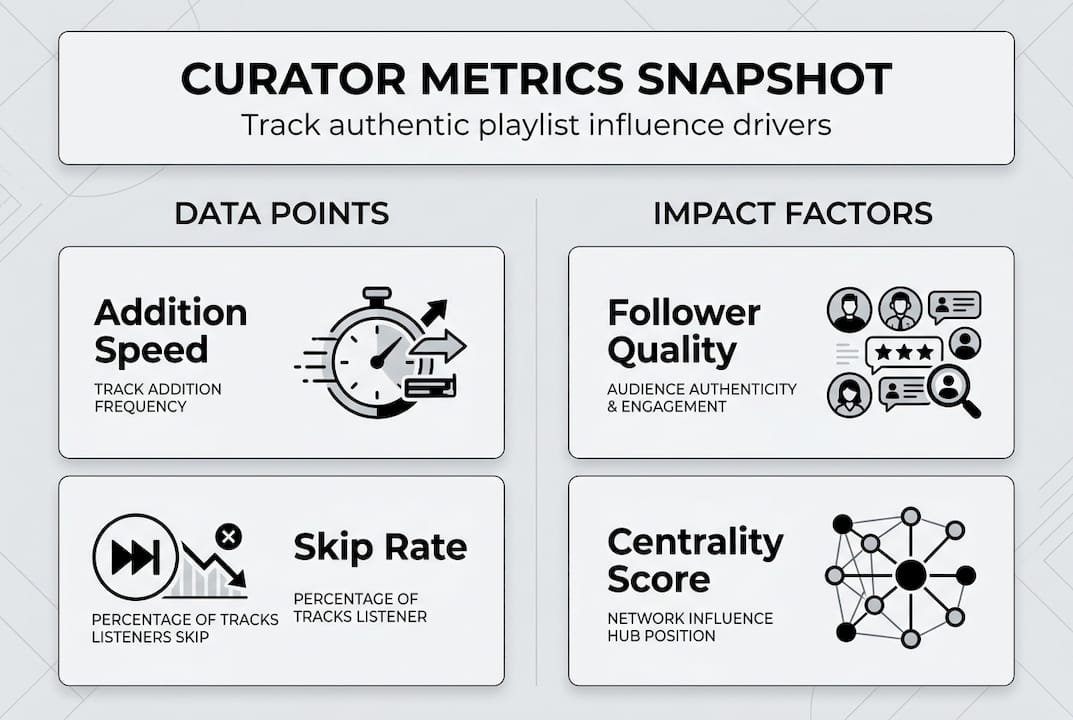
Critical metrics to track include:
- Addition velocity: how quickly curators add new tracks after release
- Skip and retention rates: whether listeners engage beyond the first 30 seconds
- Save rates: percentage of listeners adding tracks to their own collections
- Playlist longevity: how long tracks remain in active rotation
- Cross-playlist placement: how many other curators add the same tracks
Key metrics include playlist addition velocity, skip/retention rates, and curator network centrality. These measurements reveal not just what curators add, but how their audiences respond and whether influence extends beyond initial placement.
Use the A&R music analytics metrics scorecard to distinguish playlist additions from listening depth and assess source concentration.

Understanding curator types helps target analysis effectively. Editorial curators at streaming platforms wield massive reach but move slowly through approval processes. Independent curators operate faster with more flexibility but vary widely in audience quality. Niche curators serve specific genres or demographics with highly engaged listeners who trust their taste implicitly.
| Curator type | Average followers | Addition speed | Audience engagement |
|---|---|---|---|
| Editorial platform | 500K-5M | 2-4 weeks | Medium (passive listening) |
| Independent influencer | 50K-500K | 1-7 days | High (active discovery) |
| Niche specialist | 5K-50K | Same day | Very high (loyal community) |
| Emerging tastemaker | 1K-10K | Same day | Extremely high (early adopters) |
Follower quality matters more than quantity. Playlists with over 1,000 followers yield 34% algorithmic boost, but only when those followers actively engage. Retention metrics separate real audiences from bot networks. Look for consistent listening patterns, geographic diversity, and engagement rates above platform averages.
Verification steps ensure data authenticity before analysis. Check follower growth patterns for sudden spikes that indicate purchased followers. Review historical playlist updates to confirm consistent curation activity. Cross-reference curator profiles across platforms to validate identity and influence scope. Examine listener demographics to ensure alignment with target markets.
Benchmarking typical metric thresholds provides context for evaluation. Save rates above 5% indicate exceptional audience engagement. Skip rates below 25% suggest strong track-to-playlist fit. Addition velocity within 48 hours of release signals active discovery behavior. These benchmarks vary by genre and market, so establish baselines specific to your focus areas.
Pro Tip: Build a curator database tracking metrics over time rather than relying on single snapshots. Influence patterns emerge through consistent behavior, not isolated placement decisions. Historical data reveals which curators consistently break artists versus those who follow trends.
Integrating data from predict music hits with private playlist analytics workflows ensures comprehensive preparation. Combine playlist metrics with listener behavior data, geographic trends, and genre evolution patterns. This multidimensional approach identifies curators whose influence extends beyond individual playlists into broader cultural movements.
Access to private playlist analysis guide resources accelerates preparation by providing frameworks for data collection, metric calculation, and quality verification. Standardized processes reduce analysis time while improving accuracy and consistency across team members.
Execution: Step-by-step process for curator influence analysis
Executing curator influence analysis requires systematic progression through identification, measurement, network mapping, prioritization, monitoring, and interpretation phases. Stepwise approach improves A&R productivity up to 40% by identifying key curators, analyzing metrics, mapping networks, leveraging AI, and monitoring emerging artist placements.
-
Identify target curators by filtering for genre relevance, geographic market alignment, and curator type matching your objectives. Start with curators who have added artists similar to your focus, then expand to adjacent genres and emerging categories. Use platform search tools, third-party databases, and social listening to build comprehensive curator lists.
-
Analyze engagement metrics for each curator's playlists, focusing on save rates, skip patterns, and listener retention beyond initial plays. Calculate average engagement across multiple playlists to identify consistent performance versus one-hit wonders. Compare metrics against genre benchmarks to assess relative influence strength.
-
Map curator networks using playlist overlaps and shared audience demographics. Network analysis metrics like degree, betweenness, eigenvector centrality identify bridge curators who connect niche communities to mainstream audiences. Degree centrality measures direct connections, betweenness reveals gatekeepers between communities, and eigenvector centrality identifies curators connected to other influential curators.
-
Use AI tools to prioritize curators based on weighted influence scores combining engagement metrics, network position, and historical track record. Machine learning models process thousands of data points faster than manual analysis while identifying patterns humans might miss. Set threshold scores for high-priority outreach versus monitoring-only curators.
-
Monitor emerging artist placements across prioritized curator playlists to spot talent before mainstream recognition. Track which unsigned or newly signed artists appear repeatedly in high-influence curator collections. Cross-reference placement timing to identify curators who discover artists earliest versus those who follow initial momentum.
-
Interpret influence patterns by connecting curator behavior to downstream outcomes like streaming growth, chart performance, and social engagement. Validate whether curator placements correlate with artist success metrics. Identify which curator types drive which outcomes, from viral moments to sustained career building.
| Analysis approach | Time investment | Data depth | Scalability | Best for |
|---|---|---|---|---|
| Manual review | High (20+ hours/week) | Deep contextual understanding | Low (10-20 curators) | Niche genres, cultural nuance |
| AI-enhanced | Medium (5-10 hours/week) | Broad pattern recognition | High (100+ curators) | Large catalogs, trend detection |
| Hybrid model | Medium (8-12 hours/week) | Balanced depth and breadth | Medium (50+ curators) | Most professional applications |
Pro Tip: Schedule weekly curator audits rather than sporadic deep dives. Consistent monitoring catches influence shifts early, while irregular analysis misses critical timing windows for artist outreach and campaign launches.
Applying findings to A&R and marketing decisions requires translating data insights into actionable strategies. When high-influence curators repeatedly add an unsigned artist, prioritize scouting and negotiation. When curator networks show genre blending patterns, adjust marketing positioning to reach cross-genre audiences. When placement timing analysis reveals optimal release windows, schedule launches accordingly.
Integrating playlist data interpretation steps frameworks ensures systematic application of insights. Document decision rationales, track outcome correlations, and refine prioritization criteria based on results. This feedback loop continuously improves analysis accuracy and business impact.
Leveraging private playlist insights trends alongside curator analysis provides market context that enhances interpretation. Understanding broader listening pattern shifts helps distinguish curator influence from general trend momentum, improving attribution accuracy for business decisions.
Verification and troubleshooting: avoiding common pitfalls and validating findings
Validating curator influence insights prevents costly mistakes from bot-inflated data, niche curator oversight, and stale public information. Common pitfalls undermine analysis accuracy when teams rush from data collection to business decisions without verification steps.
Bot-inflated playlists create false signals of influence through purchased followers, fake engagement, and automated playlist additions. These artificial metrics waste resources on curators with zero real impact. Identify bot activity by checking follower growth patterns for sudden spikes, examining engagement rates for suspiciously high or low percentages, and reviewing listener profiles for duplicate patterns or inactive accounts.
Niche curator oversight occurs when analysis focuses exclusively on high-follower-count playlists while missing specialized curators with small but highly engaged audiences. These overlooked tastemakers often break artists in specific communities before mainstream recognition. Prevent this by setting multiple influence thresholds based on engagement quality rather than follower quantity alone, and by actively searching emerging curator categories rather than relying only on established names.
Over-reliance on public data introduces lag time that erodes competitive advantage. By the time curator influence appears in public metrics, multiple competitors have already acted on the same intelligence. Balance public data with private playlist signals that reveal curator behavior weeks earlier, providing actionable insights while opportunities remain open.
Validation checks ensure authentic insights:
- Analyze retention rates to confirm listeners engage beyond initial plays
- Verify follower quality through demographic diversity and activity patterns
- Cross-reference placements across multiple curators to validate trend authenticity
- Track historical curator performance to distinguish consistent influence from viral flukes
- Compare AI-generated priorities against human cultural assessment for alignment
Validate authenticity via retention rates, follower verification, and cautious interpretation to avoid false positives from viral spikes. Single placement events rarely indicate sustainable curator influence, while repeated patterns across time and multiple artists signal genuine tastemaker status.
When a seasonal placement drives a spike, assess Halloween music streaming trends against an exposure log before extending promotional spend.
Combining AI-driven data analysis with human curation and cultural intuition addresses the limitations of purely algorithmic approaches. AI excels at processing large datasets, identifying statistical patterns, and prioritizing based on quantitative metrics. Human judgment understands cultural context, recognizes emerging movements before data accumulates, and interprets nuanced signals that algorithms miss.
Ethical considerations and transparency matter for sustainable industry relationships. Respect curator privacy when analyzing private playlist data through anonymization and aggregate analysis rather than individual tracking. Disclose data sources and methodologies when sharing insights with stakeholders. Avoid manipulative practices that exploit curator trust or artificially inflate metrics.
Best practices to interpret data and avoid false positives include setting minimum sample sizes before drawing conclusions, requiring multiple confirming signals before high-confidence decisions, and maintaining skepticism toward outlier results until validated. Document assumptions and limitations in analysis to prevent overconfidence in uncertain insights.
"The most reliable curator insights come from triangulating multiple data sources, combining quantitative metrics with qualitative cultural understanding, and validating patterns over time rather than reacting to single data points."
Verifying across multiple data sources increases confidence by reducing dependence on any single platform or metric. When private playlist signals align with emerging social engagement, geographic streaming patterns, and curator network activity, confidence in trend authenticity rises substantially. Contradictory signals warrant deeper investigation before business decisions.
Integrating music trend prediction tips enhances verification processes by providing additional context for curator behavior interpretation. Understanding broader market dynamics helps distinguish curator-driven trends from platform algorithm changes or external cultural events.
Where Music24 fits
Music24 reads millions of public playlists and charts every day. Its public data shows which playlists add songs like the ones you work with, which tracks and artists are gaining playlists fastest in a genre, and the countries where that genre grows. Follow the artists, tracks and playlists you care about and get an email when they move.
Start free with Music24: 7 days of the Pro plan, no card, then a Free plan for as long as you like.
Frequently asked questions
What does curator network centrality mean and why is it important?
Curator network centrality measures a curator's position and influence within the broader ecosystem of playlist creators and listeners. Higher centrality scores indicate curators who serve as hubs connecting multiple communities, bridges between niche and mainstream audiences, or gatekeepers controlling access to specific listener segments. These metrics identify which curators drive trend diffusion most effectively, making them priority targets for artist placement and partnership strategies.
How can private playlists predict music trends earlier than public charts?
Private playlists reflect genuine early listener preferences without promotional bias or label influence, capturing organic discovery behavior as it happens. These collections lead public charts by 4 to 6 weeks because they represent personal taste decisions made before artists gain mainstream recognition or playlist editorial consideration. By analyzing patterns across millions of private playlists, platforms identify emerging artists and genre trends while opportunities for strategic action remain open.
What are common pitfalls to avoid in curator influence analysis?
Beware of bot-inflated playlists that create false signals through purchased followers and fake engagement metrics. Over-reliance on public data introduces lag time that erodes competitive advantage and misses early trend signals. Validate curator authenticity via retention rates, follower quality checks, and cross-platform verification. Combine AI-driven analysis with human cultural intuition to avoid false positives from viral spikes or algorithmic anomalies that don't reflect sustainable influence.
Why combine AI with human intuition in curator analysis?
AI handles large-scale data processing and pattern recognition efficiently, analyzing thousands of curators and millions of data points faster than manual review. Human intuition understands cultural context, emerging movements, and nuanced signals that raw data misses, such as subcultural significance or regional taste shifts. Together they improve accuracy by balancing quantitative rigor with qualitative cultural relevance, reducing both false positives from statistical noise and false negatives from overlooking emerging trends before data accumulates.
Recommended
Get your music heard. Grow the fans who stay.
Add a song. Music24 makes the posts and the videos, plans your release and publishes it on every channel. Free for 7 days on the Pro plan, no card.