
Spotting tomorrow’s headliners before they break into the mainstream is a challenge every data-driven A&R executive faces. As music discovery increasingly moves into private curation on streaming platforms, the ability to securely access and analyze private playlist data becomes a competitive edge. By combining robust authentication protocols with advanced analytics, you can harness insights from private playlists and identify emerging artists and micro-trends that shape future market hits.
Table of Contents
- Step 1: Set Up Private Playlist Data Access
- Step 2: Analyze Genre and Geographic Micro-Trends
- Step 3: Identify Influential Playlist Curators
- Step 4: Detect Early Artist Discovery Patterns
- Step 5: Validate Predictions with Outcome Metrics
Quick Summary
| Main Insight | Explanation |
|---|---|
| 1. Establish Secure Data Access | Securely authenticate private playlist metadata while prioritizing user privacy and consent for analytics purposes. |
| 2. Monitor Genre and Geographic Trends | Analyze emerging listener preferences by tracking shifts in genre and geographic music consumption patterns. |
| 3. Identify Key Playlist Curators | Focus on influential curators who predict trends and select tracks that could become mainstream hits. |
| 4. Track Artist Discovery Patterns | Analyze metrics indicating artist growth potential, including streaming behaviors and social media momentum. |
| 5. Systematically Validate Predictions | Measure prediction accuracy against real-world metrics to refine forecasting models and improve reliability. |
Step 1: Set Up Private Playlist Data Access
To predict music hits using private playlist analytics, you must first establish secure data access protocols. This involves understanding how to retrieve and authenticate playlist metadata while maintaining user privacy. Music metadata APIs provide the technical infrastructure needed to extract valuable insights from private playlist collections.
Accessing private playlist data requires carefully navigating authentication frameworks. Spotify and other streaming platforms mandate user consent and specific API permissions before allowing analytics professionals to retrieve playlist information. You will need to generate unique developer credentials, request appropriate scopes for data retrieval, and implement robust token management strategies. Each platform has distinct requirements for private playlist authentication, so understanding their specific protocols is crucial.
The process involves registering your analytics application, obtaining client credentials, and implementing secure OAuth workflows that protect user data while enabling meaningful research. Your authentication strategy must balance comprehensive data access with stringent privacy protections.
Pro Tip: Always design your data retrieval methods with user consent and data protection as the primary considerations, implementing granular permission controls that give playlist creators ultimate control over their musical information.
Here's a comparison of common authentication requirements across major music streaming platforms:
| Platform | Required Credentials | Permission Scopes | Unique Security Feature |
|---|---|---|---|
| Spotify | Client ID & Secret | Playlist-read-private | Consent-driven OAuth workflow |
| Apple Music | MusicKit Token | User-library-read | Token-based authentication |
| YouTube Music | API Key & OAuth | Playlist & channel data | Two-factor access validation |
Step 2: Analyze Genre and Geographic Micro-Trends
Understanding music hit prediction requires deep insights into genre and geographic micro-trends that reveal emerging listener preferences. Neurophysiological data analysis helps identify subtle patterns of music popularity across diverse cultural landscapes, enabling more precise predictive modeling.

To effectively analyze these micro-trends, you will need to aggregate data from multiple streaming platforms, examining playlist compositions, listener demographics, and regional genre preferences. This involves collecting comprehensive metadata that tracks song interactions across different geographic regions. Advanced analytics techniques allow you to map music popularity shifts by examining how specific genres gain traction in different cultural contexts. Pay special attention to emerging markets where musical trends can develop rapidly and unexpectedly.
Your analysis should focus on granular data points such as playlist inclusion rates, geographic streaming volumes, and cross-genre collaboration patterns. Look for emerging artists who demonstrate consistent growth across multiple regions and genres, as these indicators often signal potential breakout success.
Pro Tip: Develop a dynamic tracking system that continuously monitors genre transitions and geographic music consumption patterns, allowing you to detect trend shifts in real time.
Step 3: Identify Influential Playlist Curators
Identifying influential playlist curators is a critical strategy for predicting music hits before they emerge in mainstream charts. Neural network analysis reveals that certain curators consistently demonstrate predictive power in music trend detection, making them key targets for your research.
To effectively map curator influence, you need to analyze multiple dimensions of their playlist performance. Track metrics such as follower count, playlist update frequency, genre diversity, and the historical success rate of songs they add to their collections. Look for curators who demonstrate consistent ability to select tracks that later become mainstream hits. Some curators specialize in specific genres or regional markets, so develop nuanced tracking strategies that account for these specialized influencers. Comprehensive music metadata can help you cross reference curator selections with broader music trend databases.
Pay special attention to curators who exhibit early adoption patterns across multiple platforms. These tastemakers often have networks that span streaming services, social media, and local music scenes. Their playlist selections frequently represent emerging listener preferences before they become widely recognized.
Pro Tip: Create a dynamic scoring system that weights curator influence based on their historical track record of identifying breakthrough artists.
Step 4: Detect Early Artist Discovery Patterns
Detecting early artist discovery patterns requires a sophisticated approach to analyzing emerging musical talent before they become mainstream hits. Machine learning techniques provide powerful tools for tracking artist trajectories and predicting potential breakout success.
To effectively map artist discovery, you need to develop a comprehensive tracking methodology that goes beyond traditional metrics. Analyze acoustic features, metadata, and streaming behaviors that indicate an artist's potential for growth. Emerging artist trajectory analysis reveals specific patterns such as consistent playlist additions, rapid listener engagement growth, and cross genre appeal. Pay close attention to artists who demonstrate unique sonic signatures or innovative musical approaches that distinguish them from established performers.
Your analysis should incorporate multiple data points including playlist inclusion rates, listener engagement metrics, social media momentum, and geographic streaming patterns. Look for artists who show exponential growth in listener interaction rather than linear progression. Track how quickly an artist moves from niche playlists to broader audience collections, as this often signals impending mainstream breakthrough.
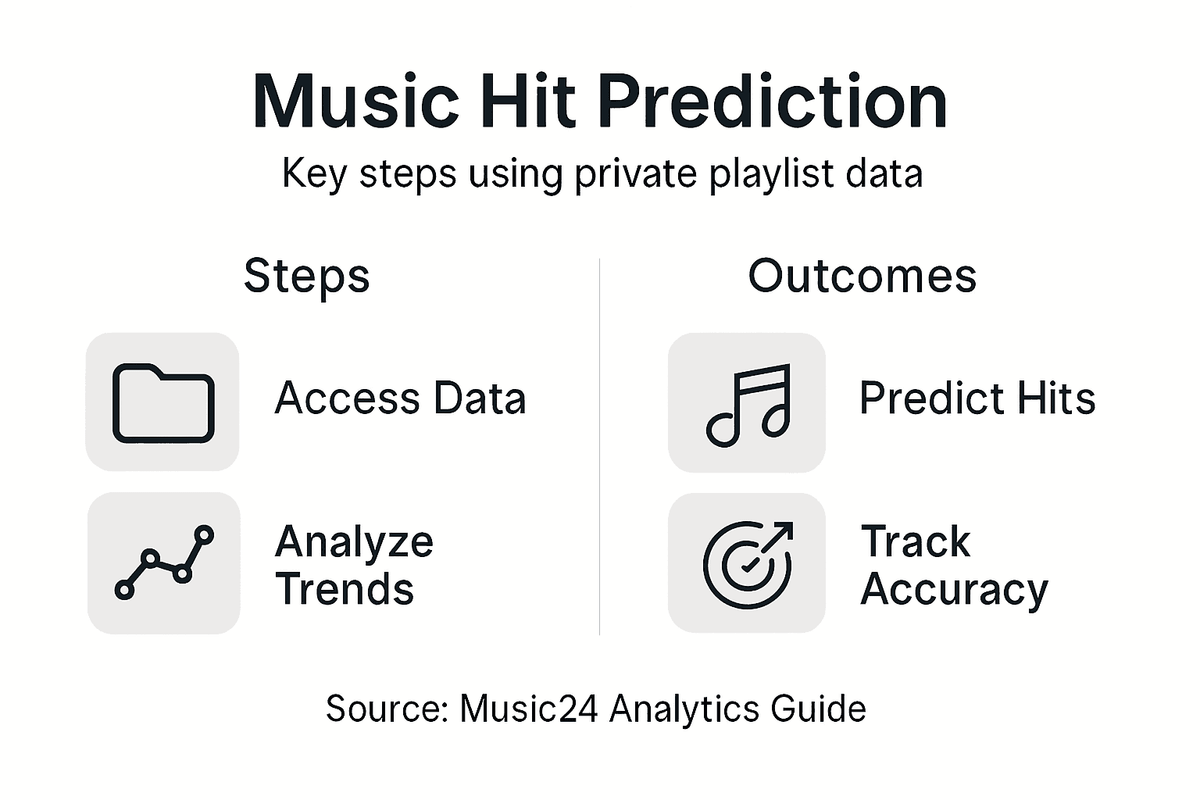
Pro Tip: Develop a predictive scoring system that weights multiple discovery indicators to create a comprehensive artist potential index.
Step 5: Validate Predictions with Outcome Metrics
Validating your music hit predictions requires a systematic approach to measuring predictive accuracy across multiple performance indicators. Comprehensive prediction frameworks offer robust methodologies for comparing forecasted potential against real world musical success metrics.
To effectively validate your predictions, establish a multi dimensional evaluation strategy that encompasses various outcome metrics. Track critical indicators such as chart rank progression, streaming volume, playlist inclusion rates, and listener engagement trajectories. Machine learning validation techniques enable you to quantify prediction accuracy by comparing your forecasted artist potential against actual market performance. Develop a scoring mechanism that weights different metrics based on their reliability and predictive significance.
Create a temporal tracking system that monitors predicted artists over extended periods. Calculate precision rates by comparing initial predictions with subsequent market outcomes. Pay special attention to artists who demonstrate consistent growth patterns that align with your initial forecasts, as these validate the robustness of your predictive model. Regularly recalibrate your algorithms based on performance discrepancies to improve future prediction accuracy.
Pro Tip: Implement a rolling validation window that continuously compares prediction models against emerging market data to maintain predictive precision.
To clarify, here is a summary of essential metrics for validating music hit predictions:
| Metric | Measures | Predictive Value |
|---|---|---|
| Chart Rank Progression | Changes in chart position | Gauges market breakout |
| Streaming Volume | Total streams over time | Indicates listener engagement |
| Playlist Inclusion Rate | Frequency in new playlists | Reflects momentum and discovery |
| Listener Engagement | Active interactions per song | Validates sustained popularity |
Unlock the Future of Music Hit Prediction with Music24
The article highlights the challenge of securely accessing private playlist data and making sense of complex trends like genre shifts, curator influence, and early artist discovery. If you want to move beyond public streaming metrics and truly tap into the pulse of emerging music trends, it all starts with reliable, privacy-conscious data analytics. Music24 understands the critical need to combine private playlist insights with powerful predictive tools to help you identify breakout artists and uncover geographic and genre micro-trends before anyone else.
With Music24 you gain
- Access to anonymized private playlist analytics that respect user privacy
- Real-time tracking of influential playlist curators and early artist growth patterns
- Comprehensive insights that validate predictions with actual market outcomes
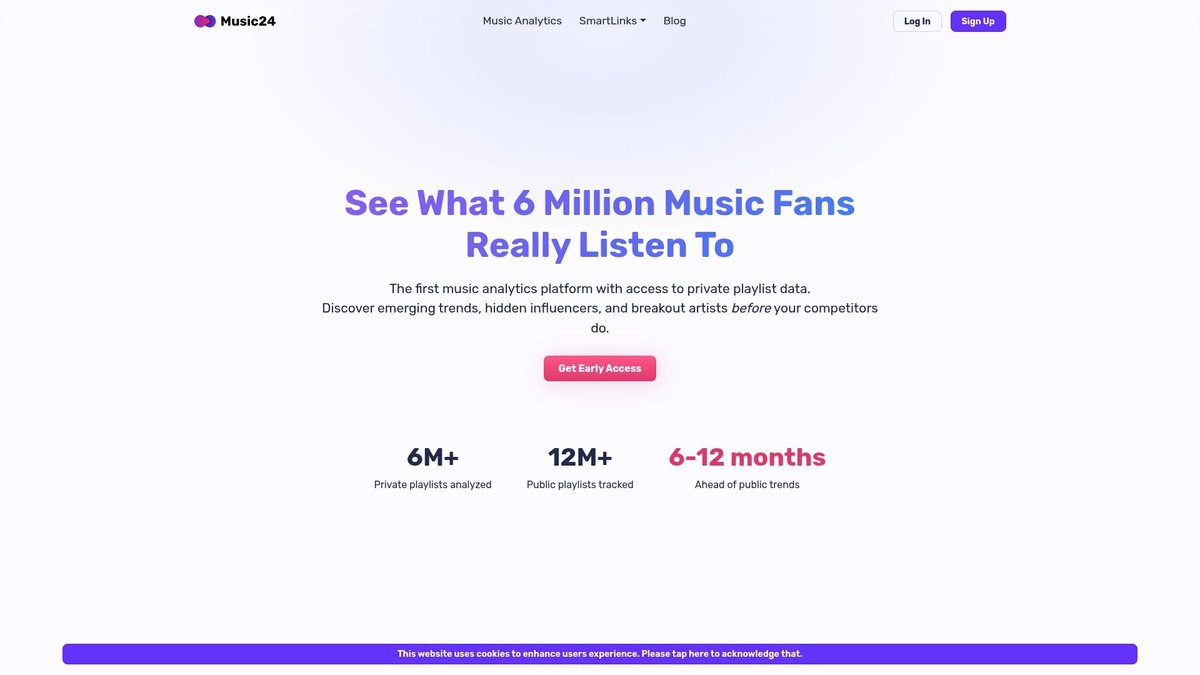
Ready to stay ahead in the fast-moving music industry and turn private playlist data into actionable intelligence Visit Music24 today and discover how our advanced analytics platform transforms private data into your competitive edge Start making data-driven decisions with confidence and spot the next big music hits before the rest of the world does by learning more at Music24 now
Frequently Asked Questions
How can I set up private playlist data access for music prediction?
To set up private playlist data access, first, register your analytics application to obtain developer credentials. Next, implement secure OAuth workflows to authenticate and retrieve playlist metadata while ensuring user privacy.
What types of analytics should I perform to identify music genre trends?
To identify music genre trends, analyze playlist compositions, listener demographics, and regional preferences. Focus on collecting data on playlist inclusion rates and streaming volumes to spot emerging musical patterns.
How do I find influential playlist curators for predicting music hits?
To find influential playlist curators, track their playlist performance metrics such as follower count and update frequency. Identify curators who consistently select tracks that later become mainstream hits, focusing on those with a proven track record.
What metrics should I use to validate my music hit predictions?
You should use metrics like chart rank progression, streaming volume, and listener engagement to validate your predictions. Establish a scoring mechanism that weighs these indicators based on their reliability and predictive significance.
How can I detect emerging artist patterns effectively?
To detect emerging artist patterns, analyze acoustic features and streaming behaviors that indicate an artist's growth potential. Use a comprehensive tracking methodology to monitor how quickly artists move from niche playlists to mainstream collections.
What is the best way to implement a rolling validation window for my predictions?
To implement a rolling validation window, continuously compare your prediction models against emerging market data over set periods. Regularly recalibrate your algorithms based on performance discrepancies to enhance future prediction accuracy.
Recommended
- How to Forecast Music Trends 2025: Pro Methods Unveiled - Blog - Music24.com
- Understanding Private Playlist Data Explained - Blog - Music24.com
- Workflow for Music Marketer Insights Using Private Playlists - Blog - Music24.com
- Why Track Private Playlists for Early Artist Discovery - Blog - Music24.com

