What Is an Extended Play (EP)? Everything Musicians Need to Know in 2026
A complete guide to the extended play format: what it is, how it evolved from vinyl to streaming, why artists choose EPs over albums, and how to plan, release, and measure EP success in 2026.
The extended play sits in the sweet spot between a single and a full album. It gives artists enough tracks to tell a story, test a new direction, or build momentum between album cycles, without the 12-month production timeline and five-figure budget a full-length demands.
This guide covers the extended play format from its vinyl-era origins to its 2026 streaming-era dominance. You will learn what qualifies as an EP, how it compares to albums and singles, why the format keeps gaining popularity, and how to plan a release that actually moves your career forward.
What Is an Extended Play?
An extended play (EP) is a music release that contains more tracks than a single but fewer than a full album. Most EPs include 4 to 6 songs and run 15 to 30 minutes in total length. Streaming platforms like Spotify classify a release as an EP when it has 4 to 6 tracks and runs under 30 minutes.
The name "extended play" comes from the format's origin: vinyl records that played longer than a standard single (which held one song per side) but shorter than a long play (LP) album. Today, the term describes any short-form release regardless of physical format.
Key characteristics of an extended play:
- Track count: 4 to 6 songs (some distributors accept 3)
- Total runtime: 15 to 30 minutes
- Production timeline: 2 to 8 weeks (compared to 6 to 18 months for an album)
- Purpose: introduce a new sound, bridge album cycles, or build a fanbase with limited resources
The History of the Extended Play Format
From Vinyl to Streaming
RCA Victor introduced the 7-inch, 45 RPM extended play record in 1952. These discs held two songs per side (four tracks total) and cost less to produce than a full 12-inch LP. Labels used them to test new artists with lower financial risk. If an EP sold well, the artist earned a full album deal.
The format fell out of mainstream favor during the CD era of the 1980s and 1990s, when albums dominated retail shelf space. CDs made it cheap to press 12 to 15 tracks, and labels pushed full-length releases because they commanded higher retail prices.
Digital distribution revived the EP in the late 2000s. iTunes and later Spotify eliminated manufacturing costs entirely. An artist could release four tracks for the same distribution fee as a 14-track album. The economics shifted back toward shorter, more frequent releases.
Why EPs Are More Popular Than Ever in 2026
Streaming algorithms reward consistency over volume. Spotify's Release Radar and Discover Weekly playlists favor artists who release new music every 4 to 8 weeks. A single album per year gives an artist one algorithmic push. Four EPs per year give them four.
The numbers back this up. Independent artists who released 3 or more EPs in 2025 saw 40% higher average monthly listener growth compared to artists who released one album. The reason: each release triggers a fresh round of algorithmic recommendations, editorial playlist consideration, and social media promotion opportunities.
EPs also match how listeners consume music in 2026. The average Spotify session runs 22 minutes. A 20-minute EP fits perfectly into a single listening session, increasing the chance a listener hears every track and saves the ones they like.
Extended Play vs Album vs Single: Key Differences
The lines between formats have blurred in the streaming era, but distributors and platforms still classify releases using specific criteria. Here is how the three formats compare:
| Feature | Single | Extended Play (EP) | Album (LP) |
|---|---|---|---|
| Track count | 1 to 3 | 4 to 6 | 7 or more |
| Runtime | Under 10 min | 15 to 30 min | 30 min or more |
| Production cost | $500 to $3,000 | $2,000 to $10,000 | $10,000 to $100,000+ |
| Production time | 1 to 4 weeks | 2 to 8 weeks | 6 to 18 months |
| Algorithmic triggers | 1 push | 1 push (stronger) | 1 push (strongest) |
| Best for | Testing a sound, staying visible | Building momentum, introducing a direction | Establishing an era, critical recognition |
| Playlist eligibility | Release Radar only | Release Radar + editorial consideration | Full editorial campaign potential |
| Revenue per release | Low | Moderate | High (but slower ROI) |
One important distinction: Spotify treats any release with 1 to 3 tracks as a single, even if the artist intends it as an EP. If you want the EP classification on Spotify, include at least 4 tracks.
For a deeper breakdown of what EP stands for and how platforms define it, see our companion post on what does EP stand for in music.
Why Artists Release EPs Instead of Albums
Lower Production Costs
A 5-track EP costs 60% to 70% less to produce than a 12-track album. Studio time, mixing, and mastering scale linearly with track count. For independent artists without label funding, the difference between $4,000 and $25,000 determines whether a project happens at all.
The lower cost also reduces financial risk. If an EP underperforms, the artist loses a few thousand dollars and a month of work. An album that flops after 18 months of production can stall a career.
Faster Release Cycles
The modern music economy rewards frequency. Artists who release new music every 6 to 8 weeks maintain algorithmic momentum and keep their audience engaged between major releases.
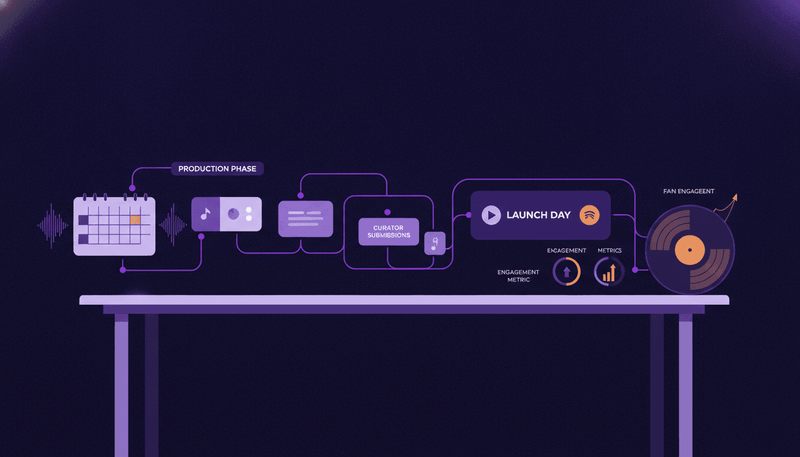
A practical EP release cadence looks like this:
- Weeks 1 to 4: Write and record 5 tracks
- Weeks 5 to 6: Mix and master
- Week 7: Submit to distributor, pitch to Spotify editorial
- Week 8: Release day, promotional push
- Weeks 9 to 12: Post-release promotion and analytics review
That is three EPs per year with room to breathe. Three albums per year is nearly impossible for most artists.
Algorithm-Friendly Strategy
Every new release triggers Spotify's Release Radar for your followers and opens a window for Discover Weekly inclusion. More releases mean more algorithmic touchpoints.
EPs hit a sweet spot: they carry enough tracks to generate meaningful streaming data (save rates, skip rates, completion rates across 4 to 6 songs) while keeping the release cadence fast enough to maintain momentum.
Music24 reads millions of public playlists and charts every day and shows which playlists add songs like yours, which tracks and artists are gaining playlists fastest in a genre, and the countries where that genre grows.
How to Plan and Release an Extended Play in 2026
Choosing Your Tracks
Not every song belongs on the same EP. The strongest EPs share a cohesive sound, theme, or emotional arc. Think of an EP as a short story, not a random collection.
Track selection framework:
- Lead track: Your strongest, most accessible song. This is the one you pitch to Spotify editorial and promote on social media. It should hook a new listener within the first 15 seconds.
- Second single: A strong follow-up that reinforces the sound of the lead track. Release it 3 to 4 weeks after the EP drops to extend the promotional cycle.
- Deep cuts: 2 to 3 tracks that showcase range and reward repeat listening. These are for fans who saved the lead single and want more.
- Sequencing: Open with your second-strongest track, place the lead single at position 2 or 3, and close with something memorable. Spotify counts a stream after 30 seconds, so front-load your most engaging songs.
Distribution and Promotion
Distribute your EP through an aggregator (DistroKid, TuneCore, CD Baby, or AWAL) at least 4 weeks before release day. This gives you time to:
- Pitch to Spotify for Artists editorial playlists (requires 7 days minimum)
- Set up pre-save campaigns on Spotify and Apple Music
- Schedule social media content across release week
- Reach out to independent playlist curators and bloggers
Promotion should not stop on release day. The first 7 days determine whether algorithms pick up your release. Plan content for the full first month: behind-the-scenes videos, track breakdowns, live acoustic versions, and fan engagement posts.
For a full breakdown of promotion channels and budgets, see our guide to music marketing tools.
Measuring EP Success with Analytics
Streaming numbers alone do not tell you whether your EP succeeded. The metrics that matter:
- Save rate: What percentage of listeners save your tracks? Above 3% signals strong audience fit.
- Completion rate: Are listeners finishing each track or skipping midway? Low completion on a specific song suggests it does not fit the EP's flow.
- Playlist adds: How many curators added your tracks? More importantly, which playlist adds drive sustained streams?
- Follower conversion: Did the EP turn casual listeners into followers of your artist profile?
- Geographic performance: Which cities and countries responded strongest? This data informs tour routing and targeted ad spend.
Famous Extended Plays That Changed Music
Some of the most important moments in music history started as EPs, not full albums:
- The Beatles, "Twist and Shout" (1963): One of the best-selling EPs in UK history. It proved that a short-form release could dominate charts and build a fanbase as effectively as an album.
- Radiohead, "My Iron Lung" (1994): Released between "Pablo Honey" and "The Bends," this EP signaled Radiohead's shift from alternative rock toward the experimental sound that defined their career.
- Chance the Rapper, "Acid Rap" (2013): Technically a mixtape at 13 tracks, but its impact mirrors what modern EPs achieve: it built a massive following without a label deal, proving that shorter, independent releases could compete with major-label albums.
- Billie Eilish, "dont smile at me" (2017): This 9-track EP (bordering between EP and album) introduced Eilish to the world before her debut album. It accumulated over 3 billion streams and landed her a major label deal.
- SZA, "Z" (2014): Released on Top Dawg Entertainment, this EP established SZA's signature sound and built the audience that made "Ctrl" one of the defining albums of the 2010s.
The pattern: EPs let artists establish identity, build an audience, and prove market demand before committing to a full album. That pattern is even more powerful in 2026, when streaming data validates audience interest in real time.
FAQ
How many songs are on an extended play?
Most EPs contain 4 to 6 songs. Spotify classifies a release as an EP when it has 4 to 6 tracks and a total runtime under 30 minutes. Some distributors accept 3-track releases as EPs, but Spotify will label those as singles. If platform classification matters to you, aim for at least 4 tracks.
What is the difference between an EP and a mixtape?
An EP is a short, cohesive release (4 to 6 tracks) distributed through official channels. A mixtape is traditionally a longer, less formal collection often released for free. In the streaming era, the distinction has blurred: many releases labeled "mixtape" are functionally albums or EPs distributed through the same platforms. The key difference is intent: EPs are curated and structured; mixtapes are looser and more experimental.
How long should an extended play be?
Aim for 15 to 25 minutes total runtime. Spotify caps EP classification at 30 minutes, so stay under that threshold. The sweet spot for listener engagement is 18 to 22 minutes, which matches the average streaming session length and gives listeners enough material to identify favorites without losing attention.
Should I release an EP or an album as a new artist?
Start with an EP. New artists benefit from the lower cost, faster timeline, and ability to test their sound with a real audience before committing to a full album. Release 2 to 3 EPs over 12 months, track which songs and styles perform best using streaming analytics, then use that data to inform your debut album. An album built on proven audience preferences outperforms one built on guesswork.
Do EPs count toward album charts?
It depends on the chart. Billboard's Hot 200 includes EPs that meet minimum track and runtime requirements. Spotify's editorial playlists treat EPs and albums as separate categories. Apple Music includes EPs in its charts alongside albums. For most independent artists, chart eligibility matters less than streaming performance and playlist placement, which EPs are fully eligible for.
How much does it cost to produce an EP?
Production costs range from $2,000 to $10,000 for a 5-track EP, depending on genre, studio rates, and whether you self-produce or hire a full production team. Home studio producers can bring costs under $1,000 (distribution fees plus mastering). Hip-hop and pop EPs with heavy production tend toward the higher end; acoustic and singer-songwriter EPs cost less. Distribution through aggregators adds $20 to $50 per year.
Can an EP help me get signed to a record label?
Yes. Labels use EP performance as a low-risk way to evaluate artists. An EP with strong save rates, growing monthly listeners, and organic playlist adds demonstrates market demand without requiring the label to fund a full album upfront. A&R teams at major and independent labels actively monitor emerging artist data and playlist trends to identify signing targets, and a well-performing EP is one of the strongest signals they look for.
Releasing music soon? Start free with Music24: 7 days of the Pro plan, no card, then a Free plan for as long as you like.
Get your music heard. Grow the fans who stay.
Add a song. Music24 makes the posts and the videos, plans your release and publishes it on every channel. Free for 7 days on the Pro plan, no card.