
Spotting the next breakout artist before they hit the mainstream charts remains one of the most valuable yet elusive skills in the music industry. With over 99,000 new tracks uploaded daily across streaming platforms, A&R teams and artist managers face an overwhelming challenge: how do you identify genuine talent amid this relentless flood of content? Traditional discovery methods centered on radio play and live buzz no longer provide the early advantage they once did. This guide delivers a comprehensive framework combining data analytics, AI tools, and human expertise to master early artist identification in 2026, giving you the competitive edge needed to sign tomorrow's stars today.
Table of Contents
- Preparation: What You Need For Early Artist Identification
- Execution: Step-By-Step Process For Identifying Emerging Artists Early
- Troubleshooting Common Challenges And Mistakes In Early Artist Identification
- Verification: Measuring Success And Refining The Identification Process
- Unlock Your Early Artist Identification Potential With Music24.com
- Frequently Asked Questions
Key takeaways
| Point | Details |
|---|---|
| Hybrid approach wins | Combining AI pre-filtering with human judgment delivers superior prediction accuracy compared to either method alone. |
| Data tools level the field | Affordable analytics platforms starting under $20/month enable indie labels to compete with major label scouting resources. |
| Preparation is foundational | Success requires assembling diverse data sources, selecting the right platforms, and cultivating an analytical mindset. |
| Common pitfalls exist | Over-reliance on metrics can suppress creativity while ignoring context leads to misidentification of true potential. |
| Verification drives improvement | Tracking post-identification outcomes and implementing feedback loops refines your process for sustained accuracy. |
Preparation: what you need for early artist identification
Before diving into talent scouting, you need the right foundation. Early artist identification demands more than gut instinct; it requires systematic access to data, appropriate analytical tools, and a mindset that balances numbers with nuance.
Start by identifying your essential data sources. Your scouting effectiveness depends on aggregating information from multiple channels:
- Streaming platform metrics (Spotify, Apple Music, YouTube Music)
- Social media engagement data (Instagram, TikTok, Twitter)
- Radio airplay tracking and playlist additions
- Live performance indicators (ticket sales, venue capacity trends)
- Music blog coverage and press mentions
- Playlist curator behavior and private listening patterns
Next, select analytics platforms that fit your budget and needs. The landscape has democratized significantly. Data tools democratize access for indie labels and managers, providing affordable analytics like Viberate at $19.90/month. These platforms aggregate streaming data, social metrics, and audience demographics into actionable dashboards. Other options include Chartmetric, Soundcharts, and specialized tools like Music24.com that analyze private playlist behavior for early trend detection.
Cultivating an analytical mindset is equally critical. You're not replacing your industry intuition; you're augmenting it. Train yourself to ask data-driven questions: What engagement rate indicates genuine fan connection versus passive listening? Which geographic markets show disproportionate growth? How does an artist's streaming velocity compare to similar acts at the same career stage?
The accessibility of modern music analytics tools overview means small teams can now compete with major label A&R departments. You no longer need enterprise budgets to access predictive insights. Independent managers and boutique labels can leverage the same data streams that once required dedicated analytics teams.
Pro Tip: Maximize platform trial periods by preparing specific artists or genres to evaluate during your test window. Configure custom alerts and dashboards immediately to assess whether the tool's interface and data granularity match your workflow before committing to a subscription.
Execution: step-by-step process for identifying emerging artists early
With your tools assembled and mindset calibrated, implement this systematic workflow to identify promising artists before mainstream recognition.
Step 1: Aggregate and pre-filter new music uploads using AI to manage volume. Given that 99,000 tracks hit platforms daily, human review of everything is impossible. Deploy AI-powered tools to scan new releases, filtering by genre, geographic origin, initial engagement velocity, and sonic characteristics. Set parameters that align with your roster strategy or client needs. This first pass should reduce your review pool to 1-2% of total uploads.
Step 2: Apply machine learning benchmarks to score artist potential. Tree-based models have demonstrated superior performance in early prediction accuracy. These algorithms evaluate dozens of variables simultaneously: streaming trajectory curves, playlist addition rates, social follower growth patterns, engagement quality metrics, and comparative performance against similar artists. The output is a predictive score indicating breakout probability.
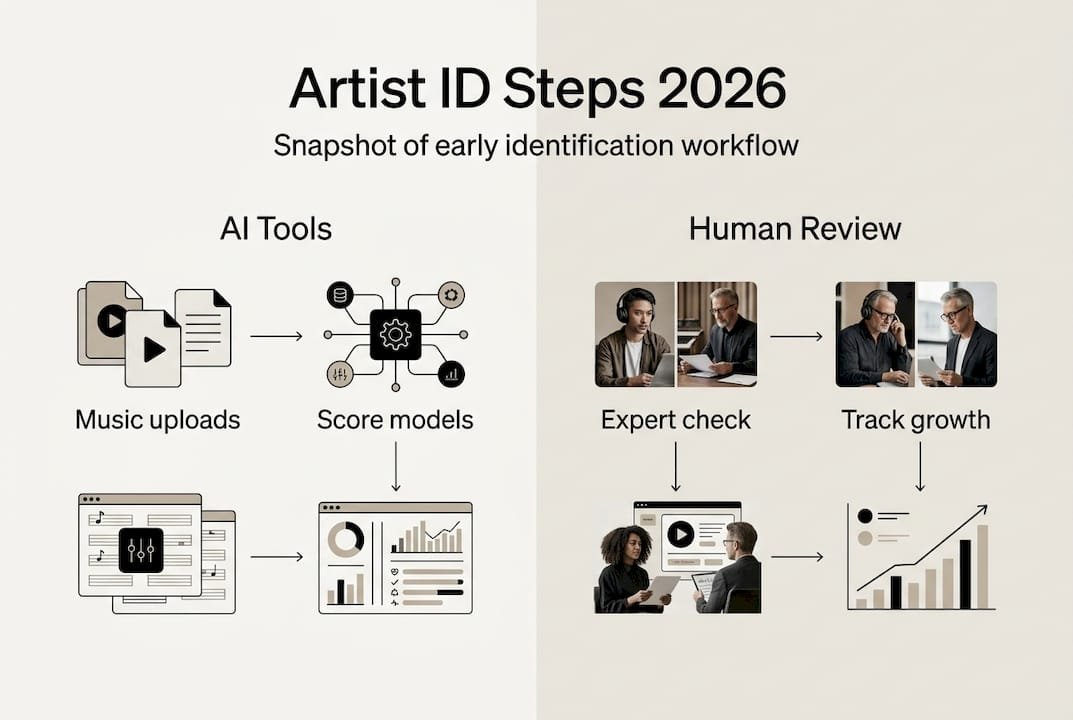
Step 3: Human expert review to evaluate qualitative factors and fit. This is where your expertise becomes irreplaceable. Listen to the music AI has surfaced. Assess artistic uniqueness, vocal quality, production values, lyrical depth, and brand potential. Consider whether the artist's style aligns with current market gaps or emerging trends. Evaluate their social presence for authenticity and fan connection quality. Does their story resonate? Can you envision a sustainable career arc?
Step 4: Continuous monitoring of key metrics for early signals. Once you've identified potential prospects, track them systematically. Watch for inflection points: sudden playlist adds, viral social moments, tour announcements, or press coverage. Set automated alerts for threshold breaches in streams, followers, or engagement rates.
The table below compares three identification approaches:
| Approach | Pros | Cons | Best Use Case | | --- | --- | | AI-only | Processes massive volume, eliminates human bias, identifies pattern anomalies | Misses artistic nuance, can't assess cultural fit, prone to false positives | Initial filtering of large datasets | | Human-only | Recognizes artistic quality, understands cultural context, assesses intangibles | Limited capacity, subject to personal bias, slower process | Final selection decisions | | Hybrid | Combines scale with nuance, reduces bias while preserving insight, optimizes accuracy | Requires tool investment and training, needs process coordination | Complete identification workflow |
Pro Tip: Create a scoring rubric that weights AI predictions and human assessments according to your historical success patterns. If your best signings came from strong social engagement despite modest streaming numbers, adjust your hybrid model to emphasize those signals.
Troubleshooting common challenges and mistakes in early artist identification
Even with robust processes, several pitfalls can undermine your scouting effectiveness. Recognizing and avoiding these mistakes separates successful talent identification from wasted resources.
Common errors include:
- Ignoring artistic uniqueness in favor of metric optimization, leading to signings that lack differentiation
- Neglecting contextual factors like genre-specific growth patterns or regional market dynamics
- Misinterpreting vanity metrics (follower counts) versus engagement quality indicators
- Over-indexing on single viral moments without assessing sustainable audience building
- Failing to account for algorithmic manipulation or artificial inflation of metrics
- Dismissing artists with unconventional trajectories that don't fit standard models
The most insidious challenge is algorithmic pressure risks pushing artists to optimize for metrics over creativity, which can hinder authentic talent development. When artists perceive that data-driven A&R prioritizes certain engagement patterns, they may compromise artistic vision to game algorithms rather than develop genuine fan connections.

Balance quantitative data with qualitative experience by establishing clear decision frameworks. Use data to surface opportunities and validate hypotheses, but reserve final judgment for human assessment of artistic merit and career potential. Create a culture where analytics inform rather than dictate decisions.
An industry veteran explains: "The biggest mistake I see is treating artist identification like stock picking. You're not just predicting numbers; you're investing in human creativity and cultural impact. Data tells you where to look, but your ears and instincts tell you what matters."
Strategies to maintain creativity focus while leveraging analytics:
- Regularly audit your signed artists against your stated artistic values, not just performance metrics
- Include diverse voices in evaluation processes to counter algorithmic homogenization
- Allocate a portion of your roster to high-conviction, data-defying bets
- Engage directly with artists to understand their creative vision before reviewing their numbers
- Monitor best practices for music insights to stay current on evolving methodologies
Pro Tip: Regularly update evaluation criteria to reflect evolving music trends and platforms. What predicted success in 2024 may not apply in 2026 as consumption patterns shift. Quarterly reviews of your scoring models ensure they remain relevant.
Verification: measuring success and refining the identification process
Identifying potential breakout artists is only half the equation. Validating your selections and systematically improving your process ensures long-term competitive advantage.
Outline metrics for monitoring artist trajectory post-identification. Track these key performance indicators over 6, 12, and 24-month windows:
- Monthly streaming growth rates and playlist penetration
- Social media follower acquisition and engagement rate trends
- Live performance metrics including ticket sales velocity and venue capacity progression
- Press coverage quality and quantity
- Sync licensing placements and brand partnership opportunities
- Fan demographic evolution and geographic expansion patterns
Implement feedback loops into your scouting process through these numbered steps:
- Document your initial prediction scores and reasoning for each identified artist.
- Set calendar reminders to review actual performance against predictions at defined intervals.
- Calculate prediction accuracy rates across your entire portfolio of identified artists.
- Analyze false positives (artists who underperformed predictions) and false negatives (missed opportunities) to identify pattern gaps.
- Adjust AI model parameters based on which variables proved most predictive in your specific context.
- Refine human assessment criteria by studying which qualitative factors correlated with actual success.
- Share learnings across your team to elevate collective judgment and calibrate scoring consistency.
The table below compares evaluation methods:
| Method | Focus | Strengths | Limitations | | --- | --- | | Metric-driven | Quantitative KPIs and growth rates | Objective, scalable, easy to track | Misses qualitative factors, can lag cultural shifts | | Combined qualitative | Blends metrics with artistic assessment | Captures nuance, accounts for intangibles | More subjective, harder to systematize | | Hybrid verification | Uses metrics to trigger qualitative reviews | Balances efficiency with depth | Requires more sophisticated process design |
Empirical benchmarks demonstrate superior performance of tree-based machine learning models for early prediction accuracy in artist scouting. However, even the best models require continuous refinement. As streaming platforms adjust their algorithms, social media trends shift, and audience preferences evolve, your identification process must adapt accordingly.
Adjust AI model parameters based on results. If your models consistently over-predict success for artists with high TikTok engagement but modest streaming growth, reduce the weighting of social virality in your scoring algorithm. Conversely, if you're missing artists who break through unconventional channels, expand your data sources to capture those signals.
Refine human assessment criteria similarly. If your team's artistic evaluations skew toward established sounds while breakthrough artists consistently push boundaries, consciously adjust your qualitative frameworks to value innovation more heavily.
Stress continuous improvement to stay ahead as industry and technology evolve. The music business transforms rapidly. Consumption patterns that defined 2024 may be obsolete by 2026. New platforms emerge, genres blend and fracture, and audience behaviors shift. Your early artist identification process must be a living system that learns, adapts, and improves with each cycle. Explore predictive analytics for early breakouts to stay current on emerging methodologies and tools.
Unlock your early artist identification potential with music24.com
You've now explored comprehensive strategies for identifying emerging artists before they break mainstream. From assembling the right data sources and tools to executing hybrid AI-human workflows, troubleshooting common pitfalls, and verifying your predictions, you have a complete framework for competitive advantage in talent scouting.
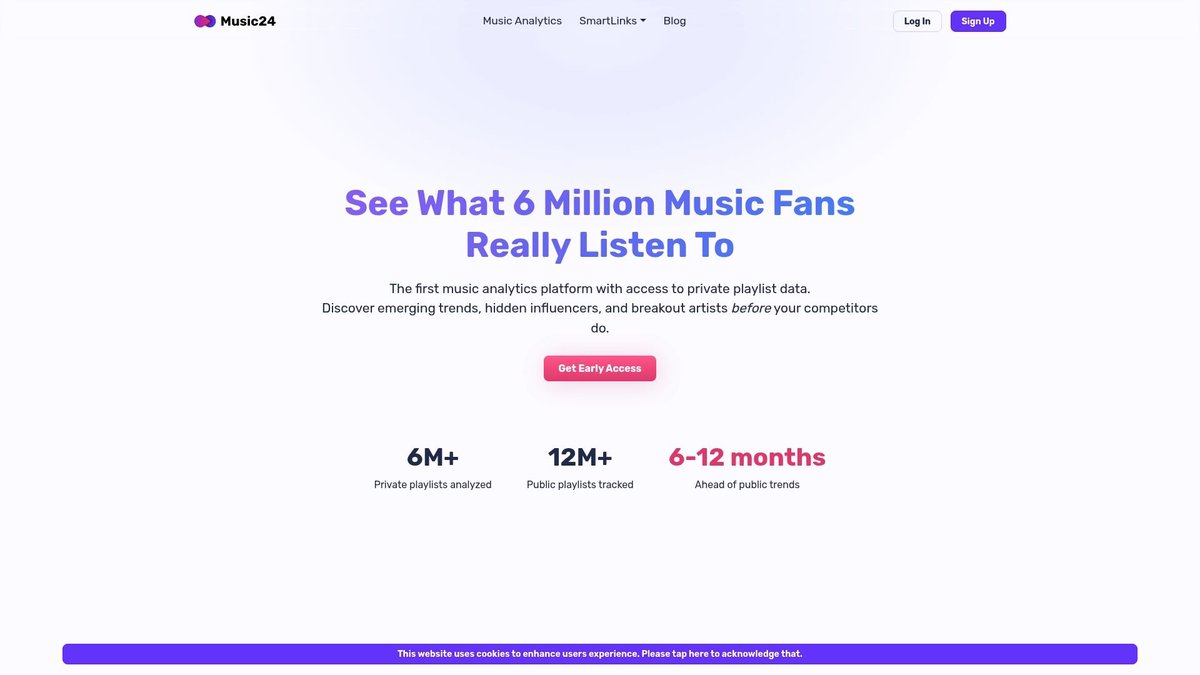
Music24.com takes your capabilities further by providing proprietary access to private playlist data that reveals authentic discovery patterns before they surface in public metrics. While competitors rely on streaming charts and social signals everyone can see, Music24 analyzes millions of anonymized private playlists to detect emerging artists, genre trends, and influential curators ahead of the curve. Explore the Music24 homepage to discover how private playlist intelligence transforms early artist identification. Dive deeper into advanced analytics blog content and expand your understanding through the music industry analytics blog. Transform your scouting process from reactive to predictive, and sign tomorrow's stars today.
Frequently asked questions
What is the early artist identification process?
The early artist identification process combines data analytics with human expertise to spot rising talent before mainstream recognition. It involves aggregating streaming, social, and performance data, applying AI models to filter and score potential, then using human judgment to assess artistic merit and cultural fit. Success depends on systematic workflows that balance quantitative signals with qualitative evaluation.
What tools and skills are required for effective early artist identification?
You need access to music analytics platforms (like Viberate, Chartmetric, or Music24), streaming and social media data sources, and basic data literacy to interpret metrics. Essential skills include understanding engagement rate significance, recognizing growth pattern anomalies, and maintaining strong artistic judgment to evaluate creative potential beyond numbers. Budget-conscious scouts can start with affordable platforms under $20/month.
How are early artist identification outcomes verified and refined?
Verification involves tracking identified artists' actual performance against initial predictions over 6, 12, and 24-month periods. Monitor streaming growth, social engagement, live performance metrics, and press coverage. Implement feedback loops by analyzing prediction accuracy, studying false positives and negatives, then adjusting both AI model parameters and human assessment criteria based on what actually predicted success in your context.
What are the differences between AI-only and hybrid human-AI approaches?
AI-only approaches excel at processing massive volume and identifying statistical patterns but miss artistic nuance, cultural context, and intangible qualities that drive careers. Human-only methods recognize creative merit but can't scale to review thousands of daily releases. Hybrid approaches optimize both: AI filters volume and surfaces statistical anomalies while humans assess artistic quality, authenticity, and strategic fit for final decisions.
How are risks like algorithm-driven bias managed in artist identification?
Manage algorithmic bias by maintaining diverse evaluation teams, allocating roster space to high-conviction bets that defy data patterns, and regularly auditing signed artists against artistic values rather than just metrics. Recognize that algorithms can push artists toward metric optimization over creativity. Use data to inform decisions, not dictate them, and consciously value innovation and uniqueness in your qualitative assessment frameworks.
Recommended
- 6 Key Tips for Identifying Breakout Artists Early - Blog - Music24.com
- Music Trend Analysis: Early Artist Discovery Tactics - Blog - Music24.com
- Emerging Artist Spotting Tips for Private Playlist Analytics - Blog - Music24.com
- Music Insights Best Practices for Early Artist Discovery - Blog - Music24.com

