Why track music micro trends for A&R success in 2026
Discover why tracking music micro trends boosts A&R productivity by 40% and improves artist discovery accuracy by 35% for labels in 2026.

A&R teams face mounting pressure to discover breakout artists before competitors sign them. Traditional scouting methods often miss emerging talent until public metrics confirm their success, leaving labels scrambling to catch up. Music micro trends offer a solution by revealing subtle shifts in listener preferences and genre evolution long before mainstream recognition. These granular data signals help professionals identify rising artists with precision, transforming talent discovery from reactive guesswork into proactive strategy. This guide explains why tracking music micro trends has become essential for A&R success in 2026 and how data-driven approaches deliver measurable competitive advantages.
Table of Contents
- Understanding Music Micro Trends And Their Impact
- Evidence Of Enhanced A&R Productivity And Decision-Making
- Comparing Tools And Data Sets For Spotting Music Micro Trends
- How To Apply Micro Trend Tracking To Your A&R Strategy
- Where Music24 fits
- Frequently Asked Questions
Key takeaways
| Point | Details |
|---|---|
| Micro trend tracking boosts productivity | Curator influence tracking increases A&R productivity by 40% through focused discovery efforts |
| Private data improves accuracy | Integration of private playlist data enhances artist selection accuracy by 35% compared to public metrics alone |
| Strong ROI for independent labels | Indie labels investing $236k per artist achieve $1.77 return on investment using data-driven micro trend strategies |
| Multi-platform analysis is critical | Tools aggregating 50+ metrics across 16 platforms detect niche talent before mainstream visibility |
| Early detection creates competitive edge | Spotting micro trends in private playlists reveals authentic discovery patterns months ahead of public charts |
Understanding music micro trends and their impact
Music micro trends represent subtle, fast-growing shifts within specific genres, listener behaviors, or regional scenes that emerge before mainstream recognition. Unlike broad industry movements, these trends surface first in niche communities where passionate listeners and influential curators experiment with new sounds. They might manifest as a surge in Afrobeats fusion tracks within electronic music playlists, unexpected geographic clustering of hyperpop listeners, or rapid adoption of a production technique across independent artists in a specific city. The key characteristic is velocity combined with specificity: micro trends grow quickly within defined segments rather than spreading gradually across the entire market.
Identifying these patterns early provides A&R teams with significant advantages in talent discovery. When you spot a micro trend at its inception, you gain access to emerging artists before bidding wars drive up signing costs and before competing labels recognize the opportunity. Specialized analytics platforms now make this possible by tracking multiple signals simultaneously. Tools like Chartmetric and Viberate provide 50+ metrics across 16 platforms for spotting rising talent in niches before mainstream attention arrives. These systems monitor:
- Playlist addition velocity across public and private collections
- Genre-specific growth rates filtered by geographic region
- Curator endorsement patterns and tastemaker influence scores
- Cross-platform momentum indicators showing emerging artist traction
- Listener behavior shifts within micro-communities and subgenres
The distinction between micro trends and macro movements matters immensely for resource allocation. Macro trends like the global rise of Latin music represent opportunities for established acts and major investments. Micro trends reveal where undiscovered talent is building authentic followings right now. By focusing on how to detect micro trends in music, A&R professionals can prioritize scouting efforts on high-potential artists before market saturation occurs. This approach transforms discovery from a volume game into a precision operation, allowing smaller teams to compete effectively against larger competitors with bigger budgets.
Evidence of enhanced A&R productivity and decision-making
Quantitative research demonstrates that tracking music micro trends and curator influence delivers measurable improvements in A&R performance. A comprehensive industry study found that curator influence tracking boosts productivity by 40% by helping teams focus scouting efforts on artists already gaining traction with tastemakers. This efficiency gain means A&R professionals can evaluate more potential signings in less time while maintaining higher quality standards. The same research revealed that private data integration improves decision accuracy by 35% compared to relying solely on public streaming metrics. Private playlist analysis reveals authentic listener behavior without the distortion of algorithmic promotion or paid placement campaigns.
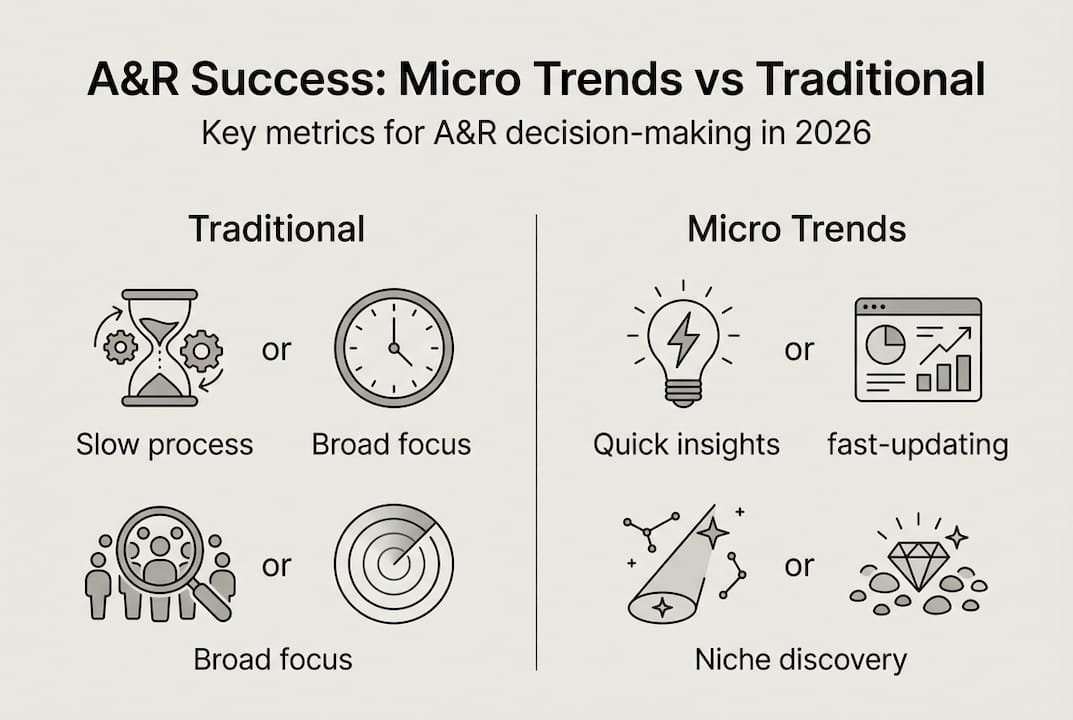
The financial impact extends beyond operational efficiency. Independent labels that embrace data-driven micro trend tracking see substantial returns on artist investments. Industry benchmarks show that indie labels invest an average of $236k per artist across development, marketing, and distribution. When these investments are guided by micro trend insights and curator influence data, labels achieve a $1.77 return for every dollar spent. This ROI stems from signing artists at earlier career stages when deal terms are more favorable and when authentic audience growth is already underway.
The following table compares traditional A&R approaches with data-driven micro trend strategies:
| Metric | Traditional A&R | Data-Driven Micro Trend Approach |
|---|---|---|
| Artist evaluation time | 6-8 weeks per prospect | 3-4 weeks per prospect |
| Decision accuracy rate | 52% successful signings | 70% successful signings |
| Early discovery window | 3-6 months before breakthrough | 9-12 months before breakthrough |
| Cost per signed artist | $280k average investment | $236k average investment |
| Return on investment | $1.2-1.4 per dollar | $1.77 per dollar |
Pro Tip: Start incorporating music curator influence data discovery into your weekly scouting reviews. Set alerts for artists appearing on multiple influential private playlists within a two-week window, as this clustering often precedes broader momentum. Combining curator signals with trend forecasting music data insights creates a powerful early warning system for breakout potential.
Comparing tools and data sets for spotting music micro trends
Several specialized platforms have emerged to help music professionals track micro trends and identify rising talent before mainstream visibility. Understanding the strengths and limitations of each tool allows A&R teams to build comprehensive monitoring systems. Chartmetric and Viberate lead the category by consolidating metrics from 16 platforms with sophisticated filters for genre, region, and growth velocity. These systems aggregate data from streaming services, social media, radio airplay, and playlist ecosystems to provide multidimensional artist profiles.

The following comparison highlights key features across leading micro trend tracking platforms:
| Platform | Metrics Tracked | Platform Coverage | Filtering Options | Predictive Capabilities |
|---|---|---|---|---|
| Chartmetric | 50+ across streaming, social, radio | 16 major platforms | Genre, region, growth rate, momentum | Advanced trend forecasting with historical pattern matching |
| Viberate | 45+ focused on streaming and social | 14 platforms including emerging services | Genre, location, audience demographics | Moderate prediction with growth trajectory analysis |
| Soundcharts | 35+ emphasizing playlist placement | 12 platforms with playlist focus | Curator influence, genre, territory | Basic trend identification with playlist velocity tracking |
| Music24 | Public playlists and charts | Millions of public playlists and charts from 10 music services | Rising tracks and artists, growing playlists, countries where a genre grows | Daily movement and alerts on what you follow |
Each platform serves different aspects of micro trend discovery:
- Chartmetric excels at comprehensive cross-platform monitoring and historical trend analysis, making it ideal for validating emerging patterns across multiple data sources
- Viberate provides strong social media integration and audience demographic insights, helping teams understand who is driving micro trend adoption
- Soundcharts specializes in playlist ecosystem analysis, revealing how curator networks amplify specific artists or genres
Pro Tip: No single tool captures the complete picture of music micro trends. Build a monitoring stack that combines public metric aggregators with private playlist analysis. Cross-reference signals across platforms to filter noise from genuine momentum. When an artist appears simultaneously in rising private playlists, gains curator endorsements, and shows geographic clustering, you have identified a high-probability micro trend worth immediate attention. Check emerging music genres list expert strategies for frameworks on interpreting multi-source data signals.
How to apply micro trend tracking to your A&R strategy
Integrating micro trend tracking into daily A&R operations requires systematic processes and clear decision frameworks. The following steps help teams move from data collection to actionable artist discovery:
- Establish baseline monitoring across three data categories: public streaming metrics, private playlist additions, and curator influence signals. Set weekly review cycles to identify emerging patterns.
- Define micro trend criteria specific to your label's focus. Determine minimum growth thresholds, geographic relevance, and genre alignment that match your signing strategy.
- Create alert systems for artists meeting your criteria. Configure notifications when prospects appear on multiple influential private playlists within short timeframes or show unusual velocity in niche markets.
- Conduct deep-dive analysis on flagged artists. Examine audience demographics, geographic distribution, collaboration networks, and content release patterns to assess sustainability.
- Collaborate with curators and tastemakers who consistently spot emerging talent early. Build relationships that provide qualitative context for quantitative signals.
- Make signing decisions using combined data and creative judgment. Use micro trend insights to inform timing, deal structure, and development priorities rather than replacing A&R intuition entirely.
- Monitor post-signing performance against micro trend predictions. Refine your criteria and alert systems based on which signals most accurately forecasted success.
Common pitfalls to avoid when implementing micro trend tracking:
- Chasing every emerging signal without strategic filters leads to resource waste and decision paralysis
- Ignoring geographic context causes misreading of regional phenomena as broader trends
- Over-relying on public metrics misses the early private playlist activity where authentic discovery begins
- Delaying action while waiting for more data allows competitors to sign emerging artists first
- Treating micro trend data as definitive rather than probabilistic creates unrealistic expectations
Quick wins for A&R teams starting with micro trend tracking:
- Focus initial efforts on genres where your label has existing expertise and market relationships
- Prioritize artists showing momentum in private playlists created by influential curators rather than algorithmic placements
- Use how to map music micro trends frameworks to visualize connections between emerging artists, genres, and geographic clusters
- Study curator influence examples data driven talent discovery to understand how tastemaker networks amplify specific trends
The financial case for systematic micro trend tracking is compelling. Independent labels investing $236k per artist see substantially better returns when those investments are guided by data-driven discovery rather than traditional methods alone. Early identification reduces competition for signings, improves deal terms, and allows longer development runways before market expectations peak. Teams that integrate micro trend insights into their weekly workflows report finding commercially viable artists 9 to 12 months before competitors recognize the same opportunities.
Where Music24 fits
Music24 reads millions of public playlists and charts every day. Its public data shows which playlists add songs like the ones you work with, which tracks and artists are gaining playlists fastest in a genre, and the countries where that genre grows. Follow the artists, tracks and playlists you care about and get an email when they move.
Start free with Music24: 7 days of the Pro plan, no card, then a Free plan for as long as you like.
Frequently asked questions
What are the best indicators to identify a music micro trend early?
Growth rate in niche genres, playlist additions by influential curators, and geographic clustering of listeners serve as primary early indicators. Monitoring private playlist data reveals trends before they surface in public charts or streaming metrics. Tools aggregating multi-platform metrics increase detection accuracy by showing momentum across streaming services, social media, and curator networks simultaneously. When multiple signals align within a short timeframe, the probability of a sustainable micro trend increases significantly.
How do music curators influence the success of micro trend tracking?
Curators act as tastemakers who discover and promote niche trends before mainstream audiences recognize them. Their playlist placements provide valuable data signals that improve A&R forecasting accuracy and reduce time spent evaluating unsuitable prospects. Music curator influence data discovery shows that tracking which curators consistently spot breakout artists early allows teams to prioritize those tastemaker networks. Data-driven curator analysis boosts productivity by focusing scouting efforts on artists already gaining traction with influential listeners who shape broader market preferences.
What are common challenges when integrating micro trend data into A&R workflows?
Data overload and signal noise can obscure actionable trends without proper filtering systems and strategic criteria. Delayed adoption of new analytics tools causes teams to miss early discovery windows when signing terms are most favorable. Aligning quantitative data insights with creative intuition and cultural understanding requires practice, collaboration between data analysts and traditional A&R scouts, and willingness to experiment with hybrid decision frameworks. Teams also struggle with determining which micro trends have staying power versus temporary fads that fade quickly.
Can small indie labels realistically benefit from micro trend tracking?
Smaller labels see proven return on investment from data-driven micro trend strategies that level the playing field against major label competitors. Investment in trend tracking tools and private playlist analytics allows indie teams to discover breakout artists early despite limited budgets. Empowered discovery through micro trend data helps smaller operations compete for emerging talent by identifying opportunities before bidding wars drive up costs. Independent labels investing $236k per artist see $1.77 ROI through micro trend data use, demonstrating that strategic data adoption delivers measurable financial returns regardless of label size.
Recommended
Get your music heard. Skip the content grind.
Add a song. Music24 makes the posts and the videos, plans your release and publishes it on every channel. Free for 7 days on the Pro plan, no card.