Music Industry Analytics Trends 2025: Shaping A&R Strategy
Music industry analytics trends 2025 revealed: Learn about private playlist data, early artist discovery, and next-gen A&R insights for record labels.

Identifying tomorrow’s headline act is tougher than ever as the global volume of music releases skyrockets. For A&R executives, understanding how analytics decode listener behavior is now essential. Data-driven decision-making has become fundamental in managing new artist discovery, transforming intuition into actionable insights. This article highlights how private playlist data and predictive metrics empower talent scouting, providing the tools you need to spot genuine trends and make smarter signing decisions.
Table of Contents
- Defining Music Industry Analytics in 2025
- Private Playlist Data and Predictive Metrics
- Early Artist Discovery and Trend Detection
- Leveraging Genre Blending and Micro-Trends
- Risks, Limitations, and Ethical Considerations
Key Takeaways
| Point | Details |
|---|---|
| Data-Driven Decision-Making | The music industry increasingly relies on sophisticated analytics to identify and nurture talent, blending creativity with technology. |
| Emerging Analytical Techniques | Key trends such as private playlist data and predictive metrics are transforming artist discovery and market strategies. |
| Ethical Considerations | The rise of data analytics brings risks like algorithmic bias and privacy concerns, highlighting the need for transparent practices. |
| Investment in Analytics | Labels should invest in comprehensive analytics platforms to track micro-trends and enhance audience engagement effectively. |
Defining Music Industry Analytics in 2025
Music industry analytics in 2025 represents a sophisticated ecosystem of data-driven insights that transform how record labels, artist managers, and streaming platforms identify, develop, and monetize musical talent. At its core, these analytics leverage advanced technological capabilities to decode complex listener behaviors, predict emerging trends, and make strategic decisions with unprecedented precision.
The landscape of music analytics has dramatically evolved, driven by three primary technological shifts:
- Advanced Machine Learning Algorithms: Capable of analyzing millions of playlist interactions
- Real-Time Data Processing: Enabling instant trend recognition across global markets
- Predictive Modeling: Forecasting artist potential before traditional metrics emerge
According to the IFPI Global Music Report 2025, data-driven decision-making has become fundamental in managing the massive global influx of new music releases. The report highlights how analytics now integrate creativity with digital innovation, transforming artist development from an intuitive art to a strategic science.
Key components of modern music industry analytics include:
- Private Playlist Data Analysis
- Geographic Listening Trend Mapping
- Cross-Genre Audience Behavior Tracking
- Influencer Curator Impact Assessment
- Predictive Artist Discovery Modeling
The technological infrastructure supporting these analytics demands robust data management. As outlined in the UK Government's Music 2025 report, improving data efficiency and interoperability represents a critical challenge for the industry, requiring sophisticated metadata standards and digital integration strategies.
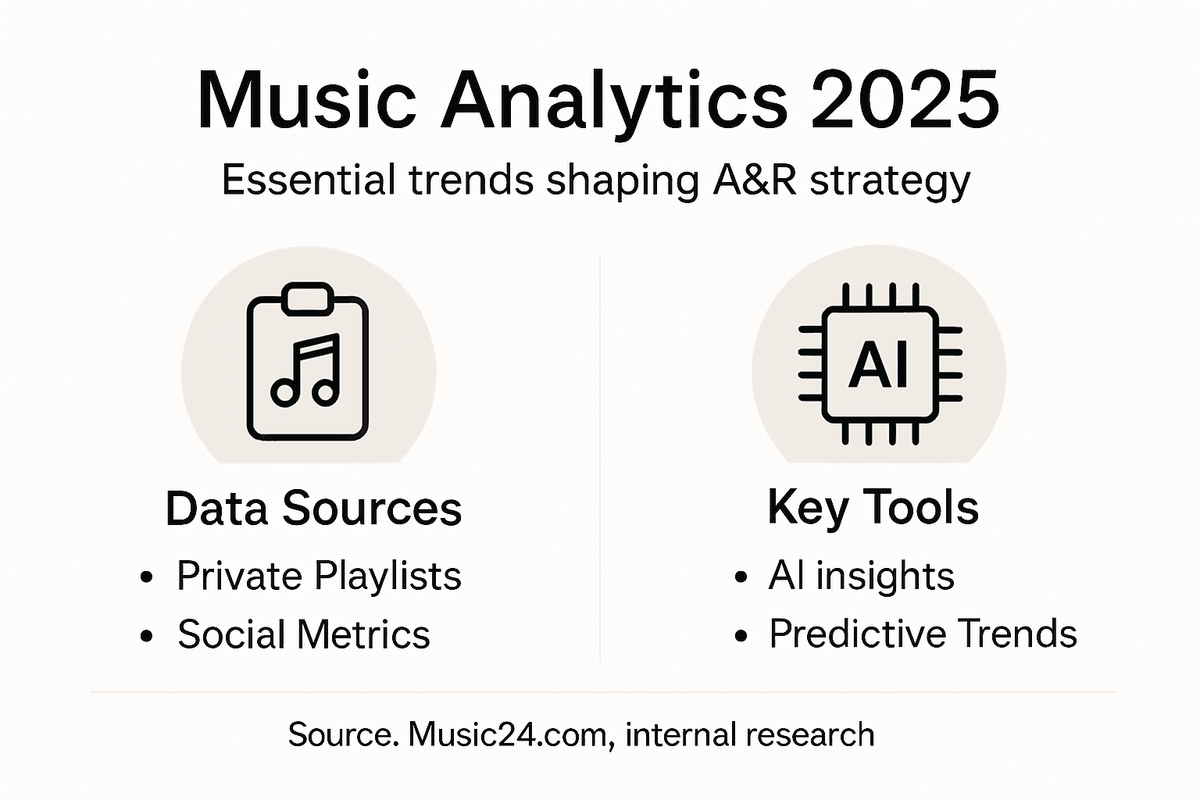
Here's a comparison of key analytics technologies and their impact on the music industry:
| Technology | Main Function | Business Impact | Example Use |
|---|---|---|---|
| Machine Learning Algorithms | Analyze playlist interactions | Improved trend prediction | Early hit forecasting |
| Real-Time Data Processing | Provides instant insights | Faster marketing decisions | Immediate trend alerts |
| Predictive Modeling | Forecast artist potential | Better talent investment | Signing emerging artists |
Pro tip: Invest in comprehensive analytics platforms that offer multi-dimensional insights beyond traditional streaming numbers, focusing on granular audience engagement metrics.
Private Playlist Data and Predictive Metrics
Private playlist data represents the next frontier of music industry analytics, offering unprecedented insights into listener behavior that traditional public metrics cannot capture. Unlike public streaming charts, private playlist data reveals nuanced user preferences, genre crossovers, and emerging artist discoveries before they become mainstream trends.
The emerging landscape of predictive metrics includes several critical components:
- Listener Segmentation: Granular audience categorization based on complex listening patterns
- Micro-Genre Tracking: Identifying nascent musical sub-genres before commercial recognition
- Algorithmic Trend Prediction: Machine learning models forecasting potential hit trajectories
- Curator Influence Mapping: Analyzing how playlist creators shape musical consumption
Big data applications in music enterprises demonstrate how private playlist analytics can revolutionize marketing and artist development strategies. These advanced analytical approaches enable record labels to identify promising artists early, predict genre trends, and design hyper-targeted marketing campaigns with remarkable precision.
The technical infrastructure behind these predictive metrics involves sophisticated data processing techniques:
- Multi-dimensional listener profile creation
- Real-time playlist interaction tracking
- Cross-platform behavioral analysis
- Predictive modeling using machine learning algorithms
- Continuous refinement of recommendation engines
Private playlist data transforms music discovery from a subjective art to a data-driven science, offering unprecedented insights into listener behavior and emerging trends.
Pro tip: Develop comprehensive listener persona models that integrate private playlist data with demographic and behavioral analytics for more accurate artist development strategies.
Early Artist Discovery and Trend Detection
The landscape of artist discovery is undergoing a radical transformation, driven by sophisticated data analytics that enable record labels to identify and nurture talent with unprecedented precision. Traditional A&R methods of relying on gut instinct and industry connections are being systematically replaced by data-driven approaches that leverage advanced predictive modeling and comprehensive digital behavior tracking.
Key components of modern early artist discovery strategies include:
- Algorithmic Trend Mapping: Detecting emerging musical patterns across multiple platforms
- Social Media Sentiment Analysis: Measuring audience engagement and potential viral potential
- Streaming Platform Anomaly Detection: Identifying unexpected listener spikes
- Cross-Platform Popularity Indicators: Tracking artist momentum across different digital ecosystems
Big data analytics in music enterprises significantly advances early artist discovery by aggregating vast social and streaming data to detect emerging trends. These sophisticated systems use predictive modeling to assess future popularity and trend viability, providing record labels with actionable insights for signing and promoting new artists in a globally connected market.
The technical infrastructure supporting early artist discovery involves several sophisticated approaches:
- Multi-source data aggregation
- Machine learning trend prediction
- Real-time performance metric tracking
- Comparative artist trajectory analysis
- Predictive potential scoring
Early artist discovery has transformed from an art of intuition to a precise science of data interpretation, enabling unprecedented accuracy in talent identification.
Pro tip: Develop a comprehensive data integration framework that combines streaming metrics, social media engagement, and demographic listener data for more nuanced artist potential assessment.
Leveraging Genre Blending and Micro-Trends
The music industry is experiencing a revolutionary transformation driven by genre hybridization and intricate micro-trends that challenge traditional musical categorizations. Artists are increasingly breaking down established genre boundaries, creating innovative soundscapes that defy conventional classification and capture listeners' imagination across diverse musical ecosystems.
Key characteristics of contemporary genre blending include:
- Cross-Cultural Fusion: Merging musical styles from different global traditions
- Digital-Native Experimentation: Leveraging technology to create unprecedented sonic experiences
- Algorithmic Genre Mapping: Using data analytics to identify emerging musical intersections
- Listener-Driven Innovation: Allowing audience preferences to shape musical evolution
Global music trend research reveals how genre blending profoundly influences listener engagement and popularity patterns. These micro-trends emerge from complex cross-genre experimentation, shaped by nuanced cultural and regional factors that challenge traditional A&R strategies.
The strategic approaches for leveraging genre blending involve multiple sophisticated techniques:
- Comprehensive cross-genre trend monitoring
- Predictive audience preference modeling
- Dynamic artist development frameworks
- Adaptive marketing strategies
- Continuous micro-trend identification
Genre boundaries are no longer rigid walls but fluid membranes where musical creativity flows and transforms, creating unprecedented artistic possibilities.
Pro tip: Invest in advanced analytics platforms that can dynamically track genre hybridization and emerging musical micro-trends across multiple global markets.
Risks, Limitations, and Ethical Considerations
The proliferation of data-driven analytics in the music industry presents a complex landscape of potential risks and ethical challenges that demand careful navigation. While technological capabilities offer unprecedented insights, they simultaneously introduce significant concerns about algorithmic bias, privacy intrusion, and the potential commodification of artistic expression.
Critical ethical challenges in music industry analytics include:
- Algorithmic Bias: Potential systematic discrimination against underrepresented artists
- Privacy Concerns: Unauthorized data collection and user behavior tracking
- Creative Authenticity: Risk of reducing artistic innovation to mathematical predictions
- Representation Inequity: Potential reinforcement of existing industry power structures
Big data analytics in music enterprises highlight significant risks including algorithmic bias that favors commercially successful artists and potential exploitation of user data. These challenges emphasize the critical need for transparency, equitable representation, and balanced data usage to preserve musical diversity and artistic integrity.
Key limitations of current music analytics approaches involve:
- Incomplete representation of artistic complexity
- Over-reliance on quantitative metrics
- Limited understanding of cultural nuance
- Potential suppression of experimental music
- Risk of homogenizing musical creativity
Ethical data analytics must balance technological capability with human creativity, ensuring that technological insights complement rather than replace artistic intuition.
Pro tip: Implement robust ethical frameworks that prioritize artist diversity, data transparency, and algorithmic fairness in your analytics strategies.
The following table summarizes ethical concerns and potential solutions for music industry analytics:
| Ethical Concern | Impact on Industry | Potential Solution |
|---|---|---|
| Algorithmic Bias | Limits diversity | Regular audits and bias checks |
| Privacy Intrusion | Erodes listener trust | Transparent data policies |
| Creative Homogenization | Reduces innovation | Balanced analytics and creativity |
Where Music24 fits
Music24 reads millions of public playlists and charts every day. Its public data shows which playlists add songs like the ones you work with, which tracks and artists are gaining playlists fastest in a genre, and the countries where that genre grows. Follow the artists, tracks and playlists you care about and get an email when they move.
Start free with Music24: 7 days of the Pro plan, no card, then a Free plan for as long as you like.
Frequently Asked Questions
What are the key components of music industry analytics in 2025?
The key components include private playlist data analysis, geographic listening trend mapping, cross-genre audience behavior tracking, influencer curator impact assessment, and predictive artist discovery modeling.
How do advanced machine learning algorithms impact artist discovery?
Advanced machine learning algorithms analyze millions of playlist interactions to improve trend prediction and early artist identification, allowing record labels to make informed decisions based on data.
What ethical considerations should the music industry keep in mind when using data analytics?
Key ethical considerations include algorithmic bias, privacy concerns, the risk of creative homogenization, and ensuring equitable representation of diverse artists in data analysis and decision-making processes.
How does private playlist data differ from traditional streaming metrics?
Private playlist data offers deeper insights into listener preferences and behaviors that are not available through traditional streaming metrics, allowing for better identification of emerging trends and nurturing of new talent.
Recommended
Get your music heard. Grow the fans who stay.
Add a song. Music24 makes the posts and the videos, plans your release and publishes it on every channel. Free for 7 days on the Pro plan, no card.