
Spotting the next breakout talent often feels more unpredictable than ever for A&R executives. The complexity of musical evolution across global streaming platforms means conventional scouting rarely keeps pace with today's fast-moving trends. By using advanced private playlist data, you gain an edge in recognizing emerging artists and shifting genre dynamics ahead of mainstream adoption. This article explores how cutting-edge predictive analytics and nuanced playlist analysis deliver actionable insights for confident decision-making.
Table of Contents
- Defining Music Trend Analysis and Its Scope
- Types of Playlist Data and Key Differences
- Detecting Emerging Artists and Genre Shifts
- Analyzing Curator Influence on Discovery Patterns
- Risks, Misconceptions, and Data Quality Issues
Key Takeaways
| Point | Details |
|---|---|
| Music Trend Analysis | This data-driven approach uncovers patterns in musical preferences, revealing how styles transform globally. |
| Diverse Playlist Types | Understanding the different playlist categories enhances insights into listener behaviors and musical discovery. |
| Emerging Artist Detection | Utilizing advanced analytics helps identify breakthrough artists and genre shifts before they become mainstream. |
| Data Quality Challenges | Awareness of risks like data incompleteness and biases is crucial for effective trend interpretation and decision-making. |
Defining Music Trend Analysis and Its Scope
Music trend analysis represents a sophisticated, data-driven approach to understanding the complex dynamics of musical evolution, consumption, and cultural impact. By leveraging advanced computational techniques, this methodology goes far beyond traditional music research to provide nuanced insights into how musical styles transform across global landscapes.
At its core, music trend analysis involves systematically examining large datasets to uncover patterns and shifts in musical preferences, styles, and audience behaviors. Empirical music analysis techniques combine computational models with psychological and cultural insights, enabling researchers to decode the intricate fingerprints of musical innovation.
Key components of comprehensive music trend analysis include:
- Statistical Data Collection: Gathering massive datasets from streaming platforms, social media, and listener interactions
- Machine Learning Algorithms: Using advanced computational techniques to identify emerging patterns
- Genre and Style Mapping: Tracking stylistic transformations across different musical categories
- Cultural Context Analysis: Understanding how global events and societal changes influence musical trends
Music trend analysis isn't just about numbers—it's about understanding the heartbeat of cultural expression through data.
The scope of music trend analysis has dramatically expanded with technological advancements. Spotify data analysis demonstrates how complex computational methods can reveal intricate relationships between listener behaviors, artist innovations, and broader cultural movements.
Pro tip: Focus on collecting diverse data sources and maintaining flexible analytical frameworks to capture the most nuanced musical trend insights.
Types of Playlist Data and Key Differences
Playlist data represents a complex ecosystem of musical consumption patterns, encompassing multiple distinct categories that provide unique insights into listener behaviors and musical preferences. Understanding these various playlist types is crucial for music industry professionals seeking to decode the intricate landscape of music discovery and audience engagement.
Playlist Categories emerge through different user interactions and creation methods, each offering distinct analytical perspectives. Playlist coherence research highlights the nuanced differences between these playlist types, revealing how they represent diverse listener intentions and musical experiences.
Key playlist data types include:
- User-Generated Playlists: Personal collections reflecting individual taste and mood
- Collaborative Playlists: Shared collections created by multiple users with collective input
- Algorithmic Playlists: Machine-curated collections based on listening history and preferences
- Editorial Playlists: Professionally curated collections by streaming platforms
- Genre-Specific Playlists: Themed collections focusing on particular musical styles
Not all playlists are created equal - each type carries unique structural and contextual characteristics that reveal deeper insights about musical consumption.
The structural variations between playlist types significantly impact their analytical value. Collaborative playlists, for instance, demonstrate more complex track relationships and diverse musical selections compared to individual user-generated collections. These nuanced differences provide rich data points for understanding evolving listener preferences and musical discovery patterns.

Here's a quick comparison of playlist types and their analytical value:
| Playlist Type | Data Complexity | Impact on Trend Analysis |
|---|---|---|
| User-Generated | Simple, individual patterns | Reveals personal taste shifts |
| Collaborative | Diverse, multi-user data | Highlights collective musical discovery |
| Algorithmic | Dynamic, pattern-based | Predicts streaming-driven trends |
| Editorial | Curated, expert choices | Amplifies influential tracks and artists |
| Genre-Specific | Focused, theme-oriented | Maps style evolution over time |
Pro tip: Analyze multiple playlist types simultaneously to develop a comprehensive understanding of listener behaviors and emerging musical trends.
Detecting Emerging Artists and Genre Shifts
Detecting emerging artists and tracking genre transformations requires sophisticated analytical approaches that go beyond traditional music discovery methods. Music industry professionals must leverage advanced data analysis techniques to identify breakthrough talents and emerging musical trends before they become mainstream phenomena.
Listener profile analytics offer powerful predictive models for recognizing artists on the cusp of significant breakthroughs. These advanced frameworks enable professionals to identify musical trendsetters and understand the complex dynamics of early artist adoption and genre evolution.
Key strategies for detecting emerging artists and genre shifts include:
- Early Listener Mapping: Track initial fan bases and listener engagement patterns
- Cross-Genre Analysis: Identify artists blending multiple musical styles
- Algorithmic Trend Detection: Use machine learning to predict emerging musical patterns
- Playlist Penetration Tracking: Monitor artist presence across diverse playlist types
- Geographical Trend Monitoring: Analyze regional musical innovation hotspots
Not all musical innovations happen simultaneously - true breakthroughs emerge through complex listener interactions and subtle cultural shifts.
Genre Dynamics continue to evolve in fascinating ways. Streaming platforms mediate genre identities by reshaping how musical styles are discovered, consumed, and understood. Contemporary music increasingly blends traditional genre boundaries, creating more fluid and dynamic artistic expressions.
Pro tip: Develop a multidimensional tracking approach that combines algorithmic insights with human curation to capture the most nuanced emerging artist trends.
Analyzing Curator Influence on Discovery Patterns
Music curation represents a sophisticated art form that fundamentally transforms how listeners discover and engage with new musical content. Curators serve as critical intermediaries between artists and audiences, wielding significant power in shaping musical consumption patterns and emerging trends across global streaming platforms.
Music streaming platforms mediate musical discovery by strategically positioning curators as gatekeepers who control visibility and listener exposure. These influential tastemakers leverage algorithmic and human-driven selection processes to guide audience preferences and artist recognition.
Key dimensions of curator influence include:
- Playlist Construction: Carefully selecting tracks that create narrative and emotional journeys
- Genre Boundary Manipulation: Challenging traditional musical categorizations
- Emerging Artist Promotion: Identifying and amplifying lesser-known talents
- Listening Experience Design: Crafting cohesive musical narratives
- Cultural Trend Interpretation: Translating broader musical movements into curated experiences
Curators are not just selectors - they are musical storytellers who interpret and shape cultural soundscapes.
Recommendation Frameworks continue to evolve, with neural-based curator recommendation systems increasingly personalizing music discovery. These advanced approaches analyze user preferences, curator styles, and intricate listening patterns to create more nuanced musical journeys.
Pro tip: Develop a comprehensive curator tracking methodology that combines algorithmic insights with qualitative analysis of musical narrative construction.
Risks, Misconceptions, and Data Quality Issues
Musical trend analysis requires sophisticated understanding of potential data limitations and inherent analytical risks. While powerful data-driven insights can transform music industry decision-making, professionals must navigate complex challenges that can undermine the reliability and effectiveness of their analytical approaches.
Music data management challenges reveal critical risks that can significantly distort trend interpretations. These challenges range from structural data incompleteness to systematic biases embedded within collection methodologies, demanding rigorous validation and nuanced interpretation.
Key risks and misconceptions in music trend analysis include:
- Data Incompleteness: Partial datasets providing incomplete musical consumption insights
- Platform-Specific Distortions: Algorithmic biases skewing trend representations
- Sampling Limitations: Overrepresentation of certain demographic groups
- Correlation vs. Causation Errors: Misinterpreting statistical relationships
- Selection Bias: Unintentional exclusion of diverse musical perspectives
Not all data tells a true story - critical analysis requires understanding both what the data reveals and what it conceals.
Trend Interpretation Challenges demand sophisticated analytical frameworks. Music trend analysis risks emphasize the importance of multi-source triangulation, combining quantitative metrics with qualitative contextual understanding to mitigate potential misinterpretations.
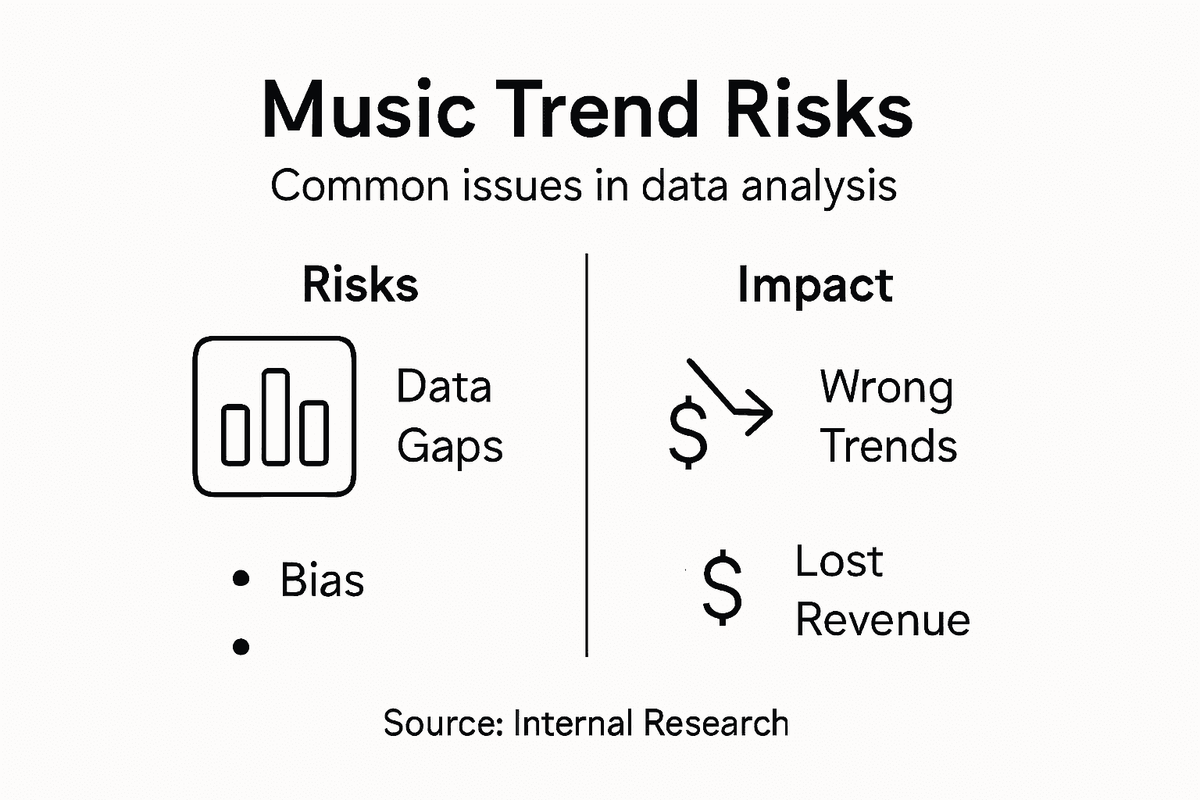
Consider these key risks in music trend analysis and their business consequences:
| Risk Type | Typical Cause | Business Impact |
|---|---|---|
| Data Incompleteness | Limited sources | Misguided marketing decisions |
| Platform Bias | Algorithmic preferences | Skewed audience targeting |
| Sampling Error | Demographic gaps | Missed emerging segments |
| False Correlation | Overreliance on stats | Ineffective promotional campaigns |
| Selection Bias | Narrow dataset focus | Underrepresentation of artists/styles |
Pro tip: Develop a systematic data validation protocol that includes cross-referencing multiple sources and consistently questioning underlying assumptions in your trend analysis.
Unlock Early Music Insights with Advanced Playlist Data Analysis
The challenge of detecting emerging artists and understanding subtle genre shifts demands more than typical public data sources. This article highlights critical pain points such as data incompleteness, platform-specific biases, and the need for multidimensional tracking approaches to capture authentic music discovery patterns. At Music24.com, we specialize in analyzing anonymized private playlists that reveal hidden trends well before they surface on public charts or social media. Our platform empowers music professionals to overcome common pitfalls like sampling limitations and false correlations by providing deep insights into listener behavior, curator influence, and geographic micro-trends.

Discover how you can gain a competitive edge by leveraging proprietary private playlist data that unlocks early artist breakthroughs and genre evolution. Visit Music24.com today to experience predictive analytics designed specifically for record labels, artist managers, and A&R teams. Take control of your music trend analysis and start uncovering the next wave of musical innovation now.
Frequently Asked Questions
What is music trend analysis?
Music trend analysis is a data-driven methodology that examines large datasets to uncover patterns and shifts in musical styles, preferences, and audience behaviors over time.
How do researchers collect music trend data?
Researchers gather data from streaming platforms, social media, and listener interactions to create extensive datasets for analysis, allowing them to understand evolving musical preferences.
What roles do machine learning algorithms play in music trend analysis?
Machine learning algorithms are used to identify emerging patterns in musical data, helping researchers and industry professionals predict trends and understand shifts in audience engagement.
Why is it important to analyze different types of playlists?
Analyzing different types of playlists provides insights into various listener intentions and musical experiences, allowing music professionals to understand consumption patterns and discover new trends effectively.
Recommended
- Music Trend Analysis: Early Artist Discovery Tactics - Blog - Music24.com
- 7 Essential Music Industry Insights List for Spotting Trends - Blog - Music24.com
- Music Trend Spotting Checklist for Industry Pros - Blog - Music24.com
- 7 Micro-Trend Examples in Music Every A&R Should Know - Blog - Music24.com

