Complete Guide to Effective Music Trend Monitoring
Explore effective music trend monitoring with private playlist data, key methods, influential curators, and predictive analytics in this comprehensive guide.

More than 90 percent of american music professionals say that spotting emerging trends early can make or break a career in the industry. Staying ahead of the curve is not just about tracking streaming numbers or following viral hits. With music tastes shifting faster than ever before, understanding effective trend monitoring gives you the edge to anticipate what listeners want next and position yourself for success.
Table of Contents
- Defining Effective Music Trend Monitoring
- Types of Trend Monitoring Methods Used
- Role of Private Playlist Data Insights
- Identifying Influential Curators and Micro-Trends
- Predictive Analytics for Early Artist Discovery
- Common Challenges and Mistakes to Avoid
Key Takeaways
| Point | Details |
|---|---|
| Effective monitoring leverages data | Systematic tracking and analysis of music trends require a mix of quantitative data and qualitative insights to understand audience preferences. |
| Advanced algorithms enhance accuracy | Tools like LSTM-RPA provide unprecedented forecasting capabilities by combining historical data with current trends. |
| Private playlist analysis reveals depth | Analyzing private playlists offers unique insights into genuine listener behavior and emerging trends that public metrics may miss. |
| Context is key to understanding trends | Recognizing cultural and demographic factors is essential for accurately interpreting listener engagement and predicting future patterns. |
Defining Effective Music Trend Monitoring
Effective music trend monitoring is a strategic process of systematically tracking, analyzing, and predicting emerging patterns in music consumption, artist popularity, and listener behavior. At its core, this approach involves leveraging data-driven insights to understand how musical preferences evolve across different demographics, genres, and platforms.
Advanced trend monitoring goes beyond surface-level metrics by examining complex listening dynamics that reveal deeper audience engagement signals. Researchers utilizing advanced algorithms like LSTM-RPA have demonstrated the potential to forecast music popularity with unprecedented accuracy by combining historical data with predictive modeling. These sophisticated techniques allow music industry professionals to identify nascent trends before they become mainstream, providing a critical competitive advantage.
The key components of effective music trend monitoring include:
- Real-time Data Collection: Capturing listening patterns across multiple streaming platforms
- Algorithmic Analysis: Using machine learning to detect subtle shifts in musical preferences
- Contextual Understanding: Interpreting trends within broader cultural and demographic contexts
- Predictive Modeling: Developing forecasts about emerging artists and genre transformations
Professional trend monitoring requires a multifaceted approach that synthesizes quantitative data with qualitative insights. Tracking music trend patterns demands not just technological tools, but a nuanced understanding of cultural dynamics and listener psychology. By combining sophisticated data analysis with deep musical intelligence, industry professionals can anticipate shifts, discover breakthrough talent, and develop strategies that align with evolving audience preferences.
Types of Trend Monitoring Methods Used
Music trend monitoring encompasses diverse methodological approaches that enable industry professionals to capture and analyze evolving musical landscapes. Each method offers unique insights into listener behavior, artist emergence, and genre transformations, ranging from quantitative data analysis to sophisticated algorithmic techniques.
Advanced monitoring methods now leverage complex analytical frameworks. Feature extraction techniques have emerged as powerful tools for understanding musical trends, with researchers developing innovative approaches like topological network analysis and machine learning algorithms. These sophisticated methods allow for nuanced classification and prediction of musical genres and listener preferences by examining intricate patterns beyond traditional metrics.
Key trend monitoring methods include:
- Streaming Platform Analysis: Tracking real-time listening patterns across digital platforms
- Algorithmic Genre Classification: Utilizing machine learning to categorize and predict musical styles
- Social Media Sentiment Tracking: Measuring audience engagement and emotional responses
- Network Topology Analysis: Examining complex relationships between musical elements and listener behaviors
The most effective trend monitoring integrates multiple methodological approaches. Cutting-edge research demonstrates that comprehensive trend analysis requires synthesizing quantitative data with qualitative insights, creating a holistic understanding of musical evolution. By combining technological sophistication with deep cultural intelligence, music industry professionals can unlock predictive capabilities that reveal emerging trends before they become mainstream phenomena.
Role of Private Playlist Data Insights
Private playlist data represents a groundbreaking frontier in music trend analysis, offering unprecedented insights into listener behavior that traditional public metrics cannot capture. These personal, curated collections reveal authentic musical preferences and discovery patterns that exist beyond mainstream charts and algorithmic recommendations.

Understanding private playlist dynamics has become crucial for music industry professionals seeking genuine listener engagement signals. Researchers have demonstrated that private playlists contain nuanced information about emerging musical trends, including subtle shifts in genre preferences, mood correlations, and listener demographic insights. By analyzing features like song danceability and emotional positivity, experts can decode complex listener preferences that traditional metrics overlook.
Key insights derived from private playlist data include:
- Authentic Discovery Patterns: Tracking how listeners genuinely discover and integrate new music
- Emotional Context Analysis: Understanding the mood and psychological drivers behind music selection
- Micro-Genre Exploration: Identifying emerging subgenres and cross-genre blending trends
- Early Talent Detection: Spotting rising artists before they hit mainstream platforms
The most sophisticated trend monitoring approaches now integrate private playlist analysis as a critical component. Advanced predictive algorithms utilize these rich, anonymized datasets to forecast music popularity with remarkable accuracy, transforming how industry professionals understand and anticipate listener preferences. By combining technological innovation with deep cultural intelligence, music industry experts can unlock predictive capabilities that reveal emerging trends long before they become mainstream phenomena.
Identifying Influential Curators and Micro-Trends
Identifying influential music curators and emerging micro-trends requires sophisticated analytical approaches that go beyond traditional tracking methods. These sophisticated strategies involve complex data analysis, pattern recognition, and understanding the nuanced ecosystem of musical discovery and taste-making.
Advanced multi-algorithm analysis has transformed how industry professionals detect emerging musical influencers and nascent genre transformations. Researchers have developed innovative frameworks that integrate knowledge relations and style correlations, enabling a deeper understanding of how musical trends propagate through interconnected curator networks. These methodologies allow for precise mapping of influence patterns and subtle genre mutations that traditional metrics might overlook.
Key strategies for identifying influential curators and micro-trends include:
- Network Topology Analysis: Mapping connections between playlist creators and their musical selections
- Genre Correlation Tracking: Identifying emerging cross-genre blending and stylistic innovations
- Influence Propagation Mapping: Understanding how musical trends spread through curator networks
- Algorithmic Trend Detection: Using machine learning to predict emerging musical patterns
The most sophisticated trend monitoring approaches recognize that musical influence is a complex, dynamic ecosystem. By combining technological innovation with deep cultural intelligence, music industry professionals can decode the intricate relationships between curators, listeners, and emerging musical styles. This holistic approach transforms trend monitoring from a reactive process into a predictive science, enabling early identification of breakthrough artists and transformative musical movements.
Predictive Analytics for Early Artist Discovery
Predictive analytics has revolutionized the music industry's approach to discovering emerging talent, transforming traditional artist identification methods into a sophisticated, data-driven science. By leveraging advanced algorithmic techniques, music professionals can now anticipate breakthrough artists with unprecedented precision and insight.
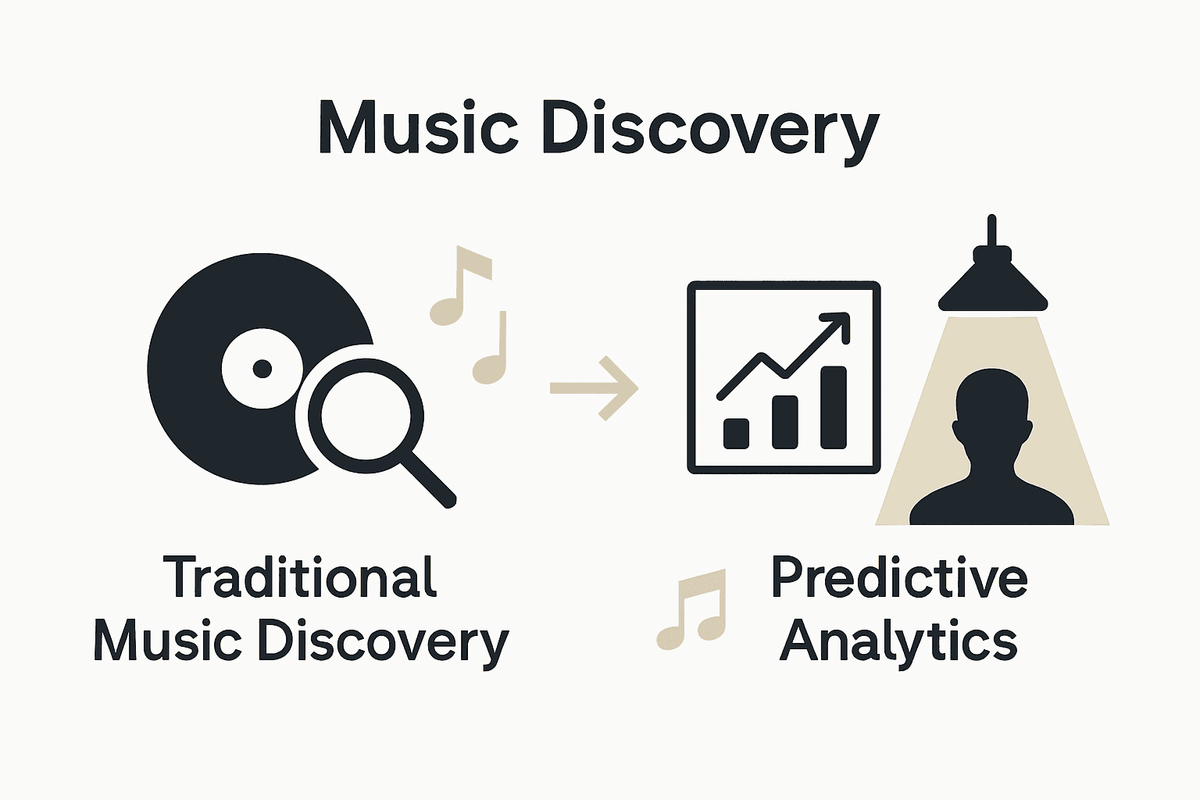
Innovative machine learning algorithms have dramatically enhanced early artist discovery capabilities. Advanced predictive models like the LSTM-RPA algorithm demonstrate remarkable potential by integrating historical listening data with current trend analysis, enabling professionals to forecast artist potential before mainstream recognition. These sophisticated approaches go beyond traditional metrics, analyzing complex patterns of listener engagement, genre evolution, and musical innovation.
Key components of predictive artist discovery include:
- Historical Performance Analysis: Examining past listener interactions and streaming patterns
- Algorithmic Genre Classification: Mapping musical style correlations and emerging trends
- Network Influence Tracking: Measuring artist momentum across playlist and curator networks
- Machine Learning Prediction: Using advanced models to forecast artist breakthrough potential
The most effective predictive analytics strategies recognize that artist discovery is a complex, multidimensional process. By synthesizing technological sophistication with deep cultural understanding, music industry professionals can transform early talent identification from an intuitive art into a precise, data-driven science. This approach enables unprecedented insights into emerging musical talent, providing a critical competitive advantage in an increasingly dynamic and competitive industry landscape.
Common Challenges and Mistakes to Avoid
Music trend monitoring presents complex challenges that can derail even the most sophisticated analytical efforts. Professionals must navigate a nuanced landscape of data interpretation, technological limitations, and evolving listener behaviors that can easily lead to misguided conclusions and ineffective strategies.
Advanced feature extraction methods are critical for avoiding common pitfalls in trend analysis. Researchers have identified significant challenges in musical trend monitoring, particularly around data limitations and algorithmic bias. The most prevalent mistakes stem from oversimplifying complex musical ecosystems, relying too heavily on surface-level metrics, and failing to account for the dynamic nature of listener preferences.
Key challenges and potential mistakes include:
- Data Scarcity: Insufficient or non-representative sample sizes
- Algorithmic Bias: Overreliance on limited machine learning models
- Contextual Blindness: Ignoring cultural and demographic nuances
- Overfitting: Creating predictive models that fail to generalize beyond specific datasets
- Static Methodology: Using rigid analytical approaches in a constantly evolving musical landscape
Successful trend monitoring demands a holistic approach that balances technological sophistication with deep cultural intelligence. Music industry professionals must remain adaptable, continuously refining their analytical methods and maintaining a nuanced understanding of the complex ecosystem of musical discovery and listener behavior. The most effective strategies recognize that trend monitoring is an art as much as a science, requiring continuous learning, critical thinking, and a willingness to challenge existing assumptions.
Where Music24 fits
Music24 reads millions of public playlists and charts every day. Its public data shows which playlists add songs like the ones you work with, which tracks and artists are gaining playlists fastest in a genre, and the countries where that genre grows. Follow the artists, tracks and playlists you care about and get an email when they move.
Start free with Music24: 7 days of the Pro plan, no card, then a Free plan for as long as you like.
Frequently Asked Questions
What is music trend monitoring?
Music trend monitoring is the strategic process of tracking, analyzing, and predicting emerging patterns in music consumption, artist popularity, and listener behavior across different demographics, genres, and platforms.
What methods are used for music trend monitoring?
Key methods include streaming platform analysis, algorithmic genre classification, social media sentiment tracking, and network topology analysis. These approaches help capture evolving musical landscapes and listener behaviors.
How does private playlist data enhance music trend analysis?
Private playlist data provides insights into genuine listener preferences and discovery patterns, revealing emotional and contextual factors that traditional metrics may overlook, which aids in understanding emerging trends.
What are common challenges in music trend monitoring?
Common challenges include data scarcity, algorithmic bias, contextual blindness, overfitting models, and using static methodologies that fail to adapt to the evolving musical landscape.
Recommended
Get your music heard. Skip the content grind.
Add a song. Music24 makes the posts and the videos, plans your release and publishes it on every channel. Free for 7 days on the Pro plan, no card.