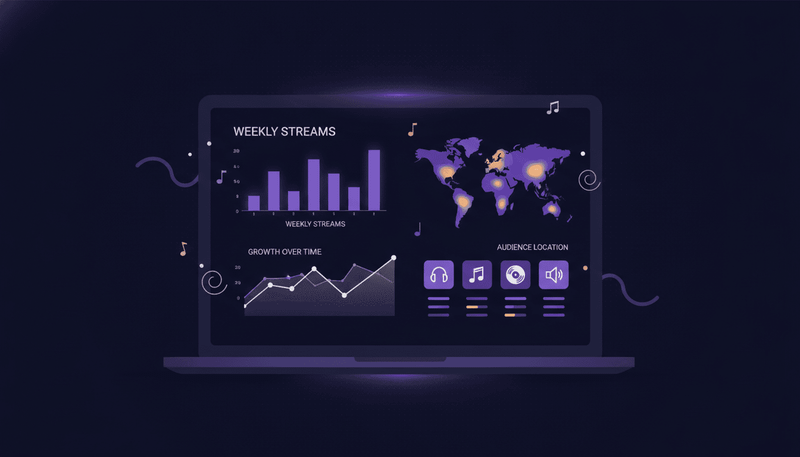
Benefits of Music Data Analysis for Industry Leaders
Music data analysis unlocks early artist discovery, predicts trends, and empowers data-driven decisions for labels, A&Rs, and marketers worldwide.

Over ninety percent of American music industry executives now rely on data analysis to identify new talent and guide marketing strategies. As listeners gravitate to streaming platforms and personalized playlists, understanding how music data is collected and decoded matters more than ever. This guide uncovers the real processes behind music data analysis, showing how experts turn raw audio and listener habits into powerful insights that shape the future of music.
Table of Contents
- Understanding Music Data Analysis Process
- Key Data Sources: Private Vs. Public Playlists
- Emerging Trends And Early Artist Discovery
- Optimizing Marketing And A&R Strategies
- Risks, Limitations, And Ethical Concerns
Key Takeaways
| Point | Details |
|---|---|
| Data Analysis Enhancements | Music data analysis transforms raw musical data into strategic insights, aiding decision-making in the music ecosystem. |
| Playlist Insights | Public and private playlists provide distinct perspectives on listener behavior, with private playlists offering deeper, more genuine insights. |
| Artist Discovery Techniques | Advanced data analytics facilitate early identification of emerging talent, significantly ahead of traditional methods. |
| Ethical Considerations | Professionals in music data analysis must prioritize user privacy and prevent biases while leveraging data-driven insights. |
Understanding Music Data Analysis Process
Music data analysis represents a sophisticated computational approach to deciphering complex musical information. Industry professionals leverage advanced techniques to transform raw musical data into strategic insights, enabling more informed decision making across the music ecosystem.
The process typically involves multiple sophisticated stages, starting with comprehensive music data collection. Researchers utilize specialized algorithms to extract meaningful patterns from diverse sources like streaming platforms, private playlists, and user interaction metrics. By analyzing elements such as tempo, chord progression, listener engagement, and genre crossovers, analysts can uncover nuanced trends that traditional metrics might overlook.
Key components of music data analysis include:
- Audio Feature Extraction: Capturing technical characteristics of musical recordings
- Listener Behavior Tracking: Monitoring how audiences interact with different musical content
- Predictive Modeling: Using historical data to forecast emerging artist popularity
- Genre and Style Classification: Identifying subtle musical taxonomy and emerging hybrid styles
Implementing robust music analytics workflows requires sophisticated computational techniques. Researchers draw from interdisciplinary approaches combining musicology, computer science, and statistical modeling to develop precise analytical frameworks. These methodologies transform complex musical datasets into actionable strategic intelligence for record labels, artist managers, and music industry professionals seeking competitive advantages in talent discovery and audience engagement.
Key Data Sources: Private vs. Public Playlists
Playlist data sources represent critical information channels for music industry professionals, offering unique insights into listener behavior and musical preferences. The landscape of playlist data is complex, with significant distinctions between public and private collections that can dramatically impact strategic decision making.

Public playlists provide visible, aggregate information about musical trends. Researchers have discovered that these platforms reveal intricate connections between user demographics and musical preferences. Public playlists allow analysts to observe broad listener patterns, genre interactions, and mainstream musical movements that are easily trackable and quantifiable.
Private playlist data, by contrast, offers a more nuanced and authentic perspective. These collections represent deeply personal musical selections that are not curated for public consumption. Key characteristics include:
- Unfiltered musical preferences
- More genuine listener behavior
- Less performative music selection
- Deeper insights into personal taste
Understanding private playlist data requires sophisticated analytical approaches that respect user privacy while extracting meaningful insights. Industry leaders recognize that these personal collections represent the most genuine representation of musical consumption, offering predictive capabilities that traditional public metrics cannot match. By synthesizing both public and private playlist information, music professionals can develop more comprehensive strategies for artist development, marketing, and audience engagement.
Emerging Trends and Early Artist Discovery
Music trend identification has become a critical strategic advantage for industry professionals seeking to discover breakthrough talent before mainstream recognition. Big data analysis in music enterprises has transformed traditional talent scouting approaches, enabling more precise and predictive methods of artist evaluation.
The process of early artist discovery involves complex multi-dimensional analysis that goes far beyond traditional metrics. Advanced cross-modal retrieval methodologies now allow researchers to integrate multiple data sources, creating comprehensive profiles of emerging musical talent. These techniques examine nuanced signals like listener engagement, playlist inclusion rates, genre-blending characteristics, and underground community interactions.
Key strategies for emerging trend detection include:
- Monitoring micro-genre emergence
- Tracking cross-platform listener migration
- Analyzing playlist inclusion dynamics
- Identifying viral content propagation patterns
Music trend spotting techniques have evolved to become sophisticated predictive tools. Industry leaders now rely on granular data analysis that captures subtle shifts in listener preferences, enabling them to identify potential breakout artists weeks or even months before traditional discovery mechanisms. By synthesizing complex behavioral data, music professionals can make more informed decisions about artist development, marketing strategies, and talent investment.
Optimizing Marketing and A&R Strategies
Music industry transformation has accelerated dramatically through advanced data analytics, fundamentally reshaping how artists are discovered, developed, and marketed. Big data analysis has revolutionized traditional profit models by providing unprecedented insights into user behavior and market dynamics.

The integration of sophisticated data strategies enables unprecedented precision in artist and repertoire (A&R) decision making. Deep learning approaches for music representation now allow professionals to extract nuanced insights from complex musical datasets, creating more targeted and effective marketing strategies.
Key optimization strategies include:
- Predictive audience segmentation
- Personalized artist recommendation systems
- Micro-targeted marketing campaigns
- Real-time performance tracking
Music marketing analytics have evolved from broad demographic approaches to hyper-specific, data-driven methodologies. By leveraging advanced computational techniques, industry professionals can now predict listener preferences, identify emerging talent, and develop marketing strategies with remarkable accuracy. This data-centric approach transforms traditional intuition-based decision making into a precise, measurable science of musical talent development and audience engagement.
Risks, Limitations, and Ethical Concerns
Music data analysis presents complex ethical challenges that extend far beyond technological capabilities. Research demonstrates the potential for inferring personal information from seemingly innocuous playlist data, raising significant privacy concerns about user data protection and consent.
The intricate landscape of music data analytics requires careful navigation of potential misinterpretation risks. Professionals must recognize that raw data does not always translate directly into meaningful insights, and algorithmic approaches can introduce unintentional biases or oversimplifications of complex musical experiences. Data sonification techniques highlight the nuanced challenges of accurately representing musical information, underscoring the importance of maintaining contextual integrity.
Key ethical considerations include:
- Protecting user privacy and anonymity
- Preventing unauthorized personal data inference
- Maintaining transparency in data collection methods
- Establishing clear consent frameworks
- Mitigating potential algorithmic biases
Industry leaders must implement rigorous ethical guidelines that prioritize individual rights while leveraging data-driven insights. This requires developing sophisticated anonymization techniques, establishing clear opt-out mechanisms, and creating robust governance structures that respect user autonomy. By proactively addressing these challenges, music data analytics can evolve into a responsible, transparent field that balances technological innovation with fundamental privacy protections.
Where Music24 fits
Music24 reads millions of public playlists and charts every day. Its public data shows which playlists add songs like the ones you work with, which tracks and artists are gaining playlists fastest in a genre, and the countries where that genre grows. Follow the artists, tracks and playlists you care about and get an email when they move.
Start free with Music24: 7 days of the Pro plan, no card, then a Free plan for as long as you like.
Frequently Asked Questions
What are the key benefits of music data analysis for industry leaders?
Music data analysis provides insights into listener behavior, identifies emerging trends, and enhances marketing strategies, enabling industry leaders to make informed decisions about artist development and audience engagement.
How can music data analysis improve artist discovery?
By utilizing predictive modeling and tracking listener engagement across various platforms, music data analysis helps identify potential breakout artists before they gain mainstream recognition, allowing for early investment.
What types of data are typically analyzed in music data analysis?
Key data types include audio features such as tempo and chord progression, listener behavior metrics, public and private playlist data, and broader trends in genre interactions and audience preferences.
What ethical considerations are associated with music data analysis?
Music data analysis involves ethical challenges such as user privacy protection, the prevention of unauthorized data inference, and the need for transparency in data collection methods, making it essential for industry leaders to establish responsible practices.
Recommended
Get your music heard. Grow the fans who stay.
Add a song. Music24 makes the posts and the videos, plans your release and publishes it on every channel. Free for 7 days on the Pro plan, no card.