
Spotting the next breakout artist before the rest of the industry is getting harder, especially when everyone can access the same streaming charts and public playlist data. For A&R professionals, understanding the distinct roles of public and private music data goes beyond confirming what is already popular. Private playlist insights let you tap into authentic listener behavior, revealing where and when new trends are taking root. This article walks through how harnessing private data offers you a competitive edge in discovering emerging talent and understanding real audience shifts.
Table of Contents
- Types Of Music Data: Public Vs. Private
- How Private Playlist Data Reveals Trends
- Use Cases For A&R And Label Professionals
- Risks, Legal Concerns, And Data Ethics
Key Takeaways
| Point | Details |
|---|---|
| Distinction Between Data Types | Understand the difference between public and private music data: public data confirms trends while private data reveals early emerging trends and listener behavior. |
| Leverage Private Playlists | Focus on private playlists to identify talent and market preferences before they become apparent in public charts, gaining a competitive edge. |
| Monitor Geographic Trends | Use private playlist signals to map geographic trends, enabling targeted marketing and artist development strategies based on regional adoption patterns. |
| Ethical Considerations | Ensure compliance with data privacy laws and maintain ethical standards in data usage, protecting listener trust while leveraging insights for artist development. |
...
Types of Music Data: Public vs. Private
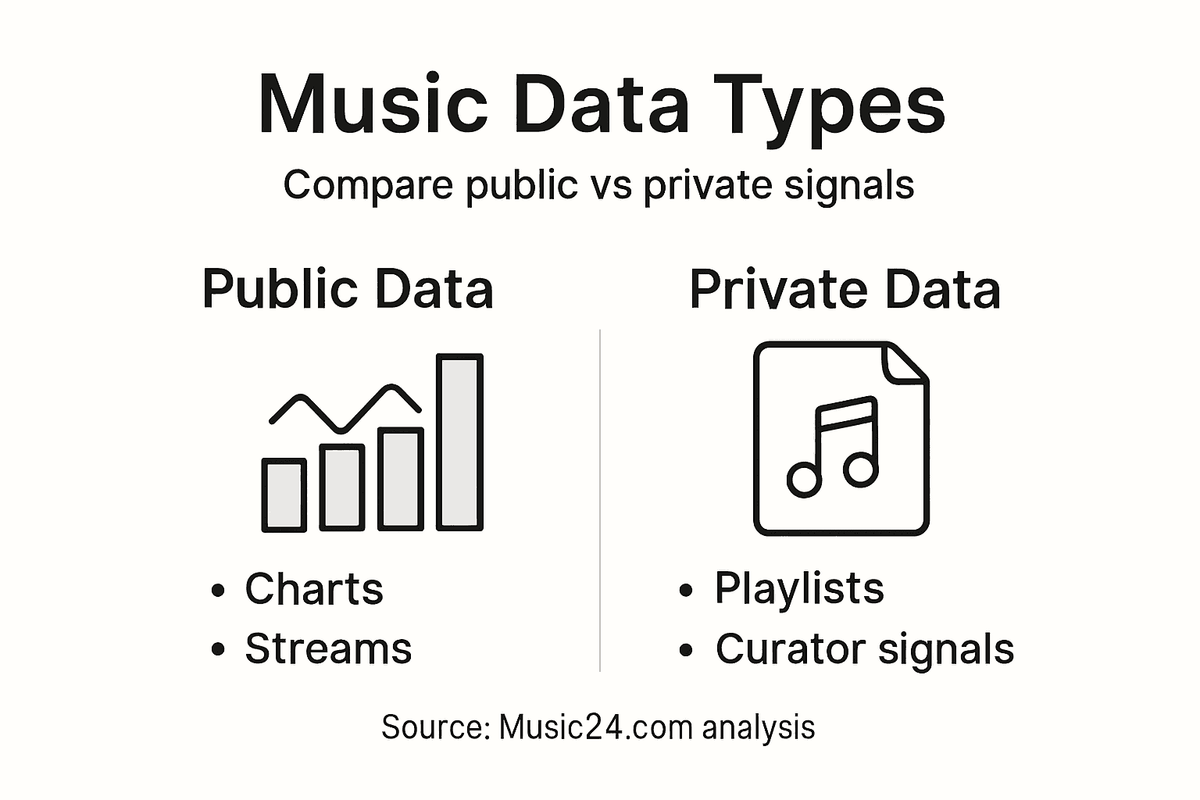
As an A&R professional, you already know that not all data carries the same weight. The distinction between public and private music data fundamentally shapes your ability to spot emerging talent before your competitors do. Public data is the information everyone sees: artist names, release dates, track durations, genre classifications, and publicly visible streaming numbers on major platforms. This metadata is openly accessible, standardized, and frankly, already digested by every label hunting for the next breakout act. Private data, by contrast, lives in the spaces most people cannot reach. It encompasses performance metrics within closed listener collections, unpublished playlist additions, purchasing patterns, and proprietary listener behavior tracked through private playlists. The critical insight here is that public metadata describes factual information while private metadata often contains the competitive advantage you need.
Why does this distinction matter to your A&R strategy? Public streaming charts tell you what already won. They confirm trends after millions have already discovered them. By the time a track climbs Spotify's global Top 50, the momentum is visible to every label on Earth. Private playlists, however, capture authentic curation and early adoption patterns. When an independent playlist curator with 50,000 followers adds an unknown artist to their private collection before any public playlist pickup, that signal precedes the mainstream. You see the interest forming. You witness listener behavior at the moment it happens, not weeks after algorithms have already validated it. This temporal advantage transforms how you evaluate emerging artists and geographic trends. A song gaining traction in private playlists across Canada three weeks before appearing on public charts gives you time to build a strategy, negotiate with the artist, and position your label ahead of the rush.
The data accessibility challenge cuts both ways. Public data is easy to access but low signal. Everyone has it. Private data is harder to capture but extraordinarily valuable because it reveals authentic, unrestricted listener choices. Private playlists show what people actually listen to when no algorithm nudges them and no social pressure influences their curation. That authenticity is gold for identifying micro trends, understanding niche genre blending, and discovering which emerging artists resonate with real listeners before market saturation. The legal and competitive boundaries protecting private data exist precisely because this information drives significant business decisions.
Here's a quick comparison of public vs. private music data for A&R purposes:
| Aspect | Public Data | Private Data |
|---|---|---|
| Accessibility | Open to all users | Restricted, proprietary access |
| Data Examples | Track metadata, visible streams | Curated additions, listener behavior |
| Business Value | Confirms existing trends | Reveals early emerging trends |
| Competitive Edge | Minimal, shared by all | High, gives advance market insights |
| Authenticity | Influenced by algorithms | Reflects real, organic choices |
Pro tip: Focus your early stage artist evaluation on private playlist signals in your target geographic markets at least 30 to 45 days before expecting those trends to surface on public charts, giving your label maximum lead time for artist development and marketing planning.
How Private Playlist Data Reveals Trends
Private playlists operate as unfiltered windows into listener psychology. Unlike public playlists shaped by social performance and algorithmic promotion, private collections represent pure curation. An A&R professional monitoring these spaces sees exactly what real listeners are collecting, organizing, and returning to repeatedly. This authenticity is the foundation of trend detection. When thousands of listeners across different demographics independently add an obscure indie rock track to their private collections within a compressed timeframe, that pattern signals emerging momentum before any algorithm amplifies it. The music hasn't hit mainstream platforms yet. Critics haven't written about it. But the signal is unmistakable because it emerges from uncontaminated listener behavior.

The power of private playlist data extends beyond simple volume metrics. Research demonstrates that playlist content reveals user attributes including demographics and personality traits, enabling precise audience segmentation. For your A&R strategy, this means you can identify not just which tracks are gaining traction, but exactly who is adding them and what that tells you about market potential. A track gaining momentum among listeners aged 18 to 25 in urban centers versus one building traction among listeners aged 35 to 50 in suburban markets represents fundamentally different trend trajectories. One might indicate viral social potential; the other suggests resilient, streaming playlist potential. Private playlists reveal these micro segmentations before public metrics can surface them. You see genre blending patterns emerging. You identify regional preferences that contradict national trends. You spot the exact moment a niche subgenre begins crossing into adjacent listener communities.
The temporal advantage compounds when you layer private playlist data across multiple geographic markets simultaneously. A track gaining private playlist additions across Toronto, Vancouver, and Montreal three weeks before similar activity appears in American markets signals Canadian cultural leadership in that moment. That advance knowledge lets you position the artist regionally before national competition intensifies. You can negotiate terms, secure premiere placements, and build artist credibility through strategic market entry. Private playlists also reveal curator influence networks that public metrics obscure entirely. When specific independent curators add emerging artists to their private collections consistently, and their subsequent public playlist picks validate those early choices, you've identified reliable talent scouts operating ahead of major label algorithms. Building relationships with these curators becomes a data driven decision rather than a gamble.
Pro tip: Cross reference private playlist adoption patterns across at least three geographic markets and track the 45 to 60 day lag time between private playlist momentum and public chart appearance to calibrate your timing for artist outreach and development decisions.
Use Cases for A&R and Label Professionals
Your A&R workflow depends on making fast, accurate decisions with incomplete information. Private playlist data transforms that equation. The most immediate use case is early artist identification. Instead of waiting for tracks to accumulate millions of streams across major playlists, you identify emerging artists at the moment their music enters private collections at scale. This means you're competing with fewer labels for negotiating rights and positioning. An artist gaining 50,000 private playlist adds in their home country before securing major label support represents an untapped opportunity. You move first. You build the relationship when the artist still has leverage to demand favorable terms rather than taking whatever offer arrives after a bidding war.
A second critical application is geographic trend mapping. A&R professionals rely on streaming services for artist discovery, but private playlist data lets you see regional adoption patterns before public charts reflect them. You identify which European markets are adopting Australian trap producers, which Asian listeners are gravitating toward Brazilian funk, which South American audiences embrace Nordic synth pop. This intelligence enables targeted marketing strategies, regional artist partnerships, and global release sequencing that maximizes momentum across specific markets. You don't waste promotional budget pushing a track nationally when the data shows concentrated adoption in three specific regions. You concentrate resources there first, build regional credibility, then expand.
The third use case involves curator relationship development. Private playlist data reveals which independent curators consistently identify emerging talent before mainstream validation. These curators become your early warning system and credibility builders. When a trusted curator adds an artist to their private collection repeatedly across multiple releases, and their subsequent public playlist picks drive streaming momentum, you've identified a reliable talent scout. Building strategic relationships with these curators becomes a data-driven priority rather than random outreach. You can offer these curators exclusive preview access, artist interview opportunities, or playlist collaboration deals that benefit both parties.
Finally, private playlist signals inform artist development strategy and marketing timing. Track which emerging artists are gaining private playlist momentum in specific listener demographics and geographic regions. Use that data to personalize development strategies. An artist gaining traction among 24 to 35 year old listeners in urban centers needs different positioning and marketing than one gaining momentum among 18 to 24 year olds in suburban communities. Private playlists reveal exactly who is adopting each artist, allowing you to tailor everything from cover art to collaboration partnerships to social media strategy around actual listener behavior rather than assumptions.
The table below summarizes key use cases for private playlist data in A&R strategy:
| Use Case | Key Benefit | Example Application |
|---|---|---|
| Early Artist Identification | Spot talent before mainstream awareness | Negotiate with rising artists first |
| Geographic Trend Mapping | Target marketing by region | Focus campaigns on high-adoption areas |
| Curator Relationship Building | Leverage trusted talent scouts | Collaborate with influential curators |
| Artist Development Timing | Align rollouts with trend peaks | Launch promos in optimal windows |
Pro tip: Monitor private playlist adoption patterns for your roster artists weekly and identify the three to four month window before expected public chart appearance to time product rollouts, feature collaborations, and promotional campaigns for maximum impact.
Risks, Legal Concerns, and Data Ethics
The competitive advantage of private playlist data comes with serious responsibilities. As an A&R professional leveraging this intelligence, you operate at the intersection of innovation and regulation. The primary legal framework governing your data practices is GDPR compliance if you're working with European listeners, but similar regulations exist globally. Data protection in the music industry requires explicit consent from individuals, transparency about data collection, minimization of data usage, and respect for individual rights. This means that accessing and analyzing private playlist data demands clear contractual agreements with data providers, documented consent mechanisms, and ironclad security protocols. Failing to maintain these standards exposes your label to substantial penalties and reputational damage. Regulators aren't tolerant of data mishandling in the music space. The fines are real.
Beyond legal compliance sits a deeper ethical concern: listener privacy and trust. Private playlists represent deeply personal musical taste. When listeners create these collections, they do so with the assumption of privacy. Using that data to target them with marketing, influence their listening through algorithmic recommendations, or profile them for demographic exploitation violates the implicit trust they've placed in the platform. Ethical data practices mean being transparent about how private playlist signals inform your artist development and marketing decisions. It means respecting boundaries. You can identify that a listener demographic gravitates toward a specific emerging artist without harvesting their individual listening history to create invasive advertising profiles. The distinction matters because short term competitive gains built on privacy violations create long term industry backlash that harms everyone.
A third risk involves bias amplification. Private playlist data, while authentic, reflects existing listener preferences and can embed societal biases. If private playlists predominantly feature artists from certain demographics or geographic regions, relying solely on private playlist signals for artist discovery can systematically disadvantage emerging talent from underrepresented communities. You must actively counter this bias by supplementing private playlist analysis with intentional human curation and diverse sourcing strategies. The data reveals patterns, but it doesn't reveal what's missing. An artist not appearing in private playlists might be phenomenal; they might simply operate outside the communities where private playlist adoption is concentrated.
Finally, AI and music present ethical questions about creativity and copyright that impact how you use data insights. Generative AI trained on existing music without artist consent, algorithmic systems that replace human curation, and automated decision making in artist development all raise questions about authenticity and fair compensation. Using private playlist data to make artist development decisions is legitimate. Using it to automate artist selection without human judgment, or to train systems that generate derivative works without consent, crosses ethical lines. Your responsibility extends beyond compliance to stewardship.
Pro tip: Establish a data ethics review process within your A&R team that documents how private playlist signals inform artist decisions, maintains transparent consent records with data providers, and includes quarterly audits for demographic bias in your artist acquisition patterns.
Unlock Hidden Music Trends Before Your Competition
Discovering emerging artists and untapped markets early is critical in today’s fast-paced music industry. The article highlights the challenge of relying solely on public data, which often reveals trends too late to gain a meaningful competitive edge. With private playlist data offering authentic insights into listener behavior, you can spot rising stars, understand geographic micro-trends, and engage influential curators long before the mainstream catches on.
Music24.com specializes in precisely this type of early trend detection. Our platform analyzes millions of anonymized private playlists to reveal genuine music discovery patterns that public charts do not capture. By accessing proprietary private playlist signals, you gain real-time awareness of emerging talent and shifting listener preferences, empowering your A&R decisions and marketing strategies with unmatched precision. Leverage Music24’s predictive analytics to navigate artist development timing and regional trends effectively.
Take control of your music discovery process today. Visit Music24 to explore how private playlist data can transform your approach to unlocking hidden music industry trends.
Ready to lead the way in artist discovery? Learn more about how you can gain early access to private playlist insights and build stronger curator relationships at Music24.com. Start turning authentic listener data into your next breakthrough success.
Frequently Asked Questions
What is the difference between public and private music data?
Public music data includes information that is accessible to everyone, such as artist names, release dates, and visible streaming numbers. Private music data, on the other hand, involves metrics and behaviors that are not publicly available, such as performance within private playlists and listener behavior, which can provide a competitive advantage in identifying trends and artists.
How can A&R professionals effectively use private playlist data?
A&R professionals can leverage private playlist data for early artist identification, geographic trend mapping, and influencer relationship development. By monitoring private playlists, they can spot emerging artists and trends before they become mainstream, allowing for strategic marketing and artist development.
What are the risks associated with using private music data?
The main risks include legal concerns regarding data privacy and compliance with regulations like GDPR, ethical issues regarding listener privacy and trust, and potential bias amplification in music selection. It's essential to handle private data responsibly to avoid penalties and maintain industry integrity.
How does private playlist data help in understanding audience demographics?
Private playlist data reveals user attributes such as demographics and personality traits, enabling precise audience segmentation. This allows A&R professionals to tailor marketing and development strategies based on who is listening to specific artists, ensuring that promotional efforts align with actual listener behavior.
Recommended
- Understanding Music Data Trends Explained for Industry Leaders - Blog - Music24.com
- Music Micro-Trends: Unlocking Early Industry Insights - Blog - Music24.com
- Step by Step Music Trend Analysis for Industry Pros - Blog - Music24.com
- Music Trend Spotting Checklist for Industry Pros - Blog - Music24.com

