
Every major record label executive faces the challenge of spotting the next breakout artist before the rest of the industry takes notice. As public playlists push familiar hits to the spotlight, the real pulse of music discovery beats within private playlist data that reveals genuine, early listener preferences. This article examines how analyzing hidden curation signals and micro-level user behaviors can provide a strategic edge for identifying influential trends and emerging talent from London to Los Angeles.
Table of Contents
- Defining Playlist-Driven Discovery In Music
- How Private Vs. Public Playlists Influence Trends
- Analyzing User Behavior And Trend Emergence
- Identifying Influencers In Private Playlist Networks
- Risks, Limitations, And Data Privacy Considerations
Key Takeaways
| Point | Details |
|---|---|
| Playlist-Driven Discovery | Utilizes algorithmic systems and user-curated collections to shape artist exposure and listener experiences, identifying emerging trends before they go mainstream. |
| Private vs. Public Playlists | Private playlists reflect genuine listener preferences and foster niche discoveries, while public playlists amplify mainstream trends and established artists. |
| User Behavior Analysis | Understanding user interactions creates pathways for trend emergence, with feedback loops influencing recommendation algorithms and shaping musical landscapes. |
| Ethical Considerations | Data privacy and algorithmic bias are critical challenges, requiring governance frameworks to protect user interests and promote musical diversity. |
Defining Playlist-Driven Discovery in Music
Playlist-driven discovery represents a transformative approach to music consumption, where algorithmic systems and user-curated collections dynamically shape artist exposure and listener experiences. At its core, this methodology leverages sophisticated data analysis to understand how music selections propagate across private playlists, identifying emerging artists and genre trends before they become mainstream.
The process goes beyond traditional recommendation engines by focusing on musical coherence and user preference mapping. Scalable recommendation frameworks utilize advanced representation learning techniques to analyze playlist sequences, understanding not just individual track characteristics but the intricate relationships between musical selections. These systems can predict listener preferences with remarkable precision, helping artists and labels identify potential breakthrough opportunities.
Understanding playlist-driven discovery requires recognizing its multilayered ecosystem. Private playlists serve as microcosms of musical taste, revealing complex listener behaviors that public streaming charts cannot capture. By analyzing these curated collections, music professionals can detect subtle shifts in genre preferences, cross-cultural musical exchanges, and early signals of artist potential long before traditional metrics emerge.
Pro tip: Develop a granular understanding of playlist data by tracking not just track inclusion, but also placement, frequency, and contextual relationships between songs.
How Private vs. Public Playlists Influence Trends
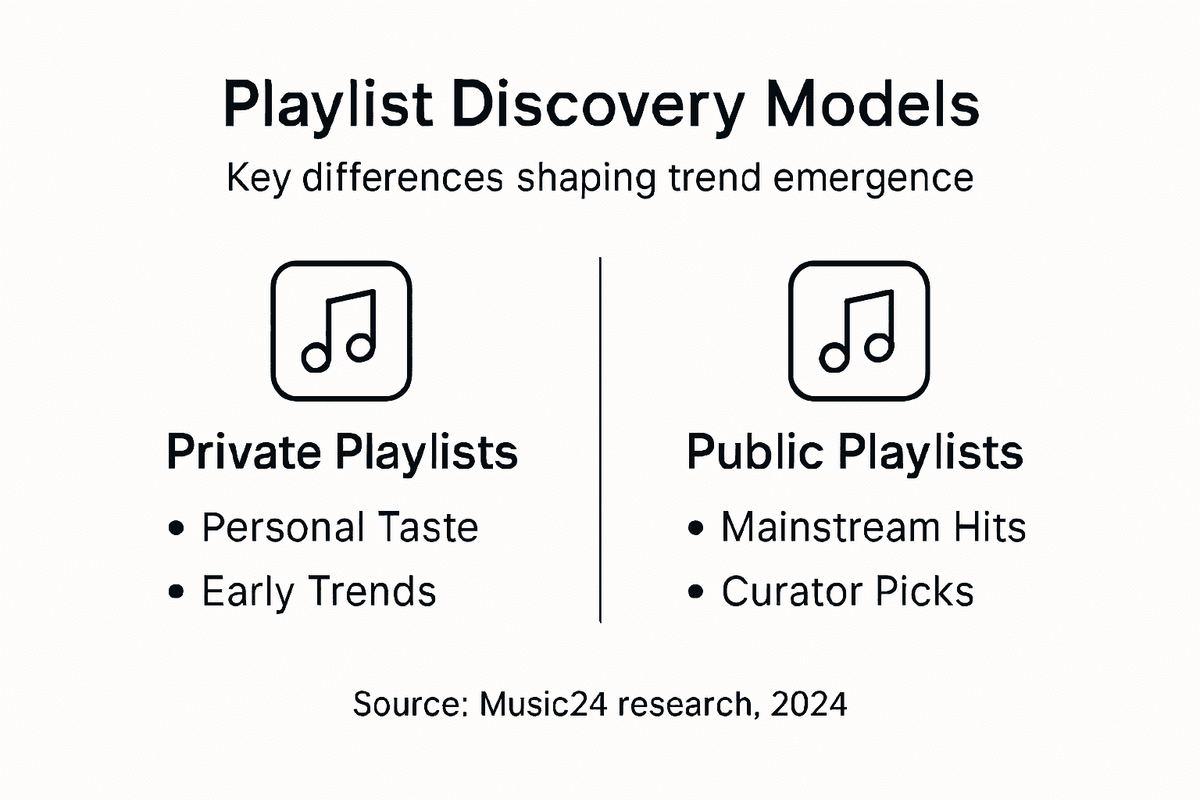
The landscape of music discovery has fundamentally transformed, with private and public playlists emerging as critical battlegrounds for artist exposure and trend identification. While public playlists represent algorithmically curated and widely accessible collections, private playlists offer a more nuanced window into authentic listener preferences and emerging musical movements.
Public playlists, often managed by streaming platforms and music editors, tend to amplify mainstream music trends through carefully constructed selections designed to appeal to broad audiences. These playlists leverage sophisticated algorithms that prioritize popularity, engagement metrics, and existing listener patterns. In contrast, private playlists function as intimate musical ecosystems, where individual users craft highly personalized collections that reflect more genuine and spontaneous musical discoveries.

The critical distinction lies in the organic nature of private playlist curation. Unlike public playlists driven by commercial interests, these personal collections capture unfiltered musical journeys, revealing nascent genre crossovers, underground artist potential, and listener-driven trend formations. Music industry professionals increasingly recognize private playlists as predictive indicators of future musical landscapes, offering insights that traditional metrics cannot capture. These collections represent living, breathing musical networks where emerging artists can gain authentic traction before breaking into mainstream consciousness.
Pro tip: Develop advanced tracking mechanisms that analyze private playlist dynamics, focusing on song retention rates, cross-genre transitions, and contextual playlist placement to uncover genuine musical trend signals.
Here's a comparison of private versus public playlists and their roles in music discovery:
| Aspect | Private Playlists | Public Playlists |
|---|---|---|
| Curation Style | Highly personalized | Algorithm/editor-driven |
| Trend Detection Value | Early indicator of trends | Amplifies mainstream hits |
| Listener Influence | High, reflects genuine taste | Moderate, shaped by platform goals |
| Impact on Emerging Artists | Fosters niche discovery | Favors established artists |
| Data Accessibility | Limited to user actions | Broadly tracked by platforms |
Analyzing User Behavior and Trend Emergence
Music discovery has evolved into a complex ecosystem where user interactions create intricate pathways for trend emergence. The modern streaming landscape transforms listener behavior into a dynamic feedback mechanism that continuously reshapes musical landscapes, with each skip, replay, and playlist addition serving as a micro-signal in a broader trend detection system.
Streaming platforms now leverage sophisticated algorithms that analyze user engagement patterns to understand deeper listener preferences. These systems go beyond simple play counts, examining nuanced interactions like partial song plays, immediate skips, repeat listens, and cross-playlist migrations. By tracking these granular behavioral signals, music platforms can map the subtle underground currents that eventually transform into mainstream trends, identifying emerging artists and genre shifts before they become widely recognized.
The most critical aspect of trend emergence lies in understanding the interaction feedback loop. Each user action generates data points that collectively create a complex network of musical preferences. These interactions are not linear but interconnected, with individual listener choices influencing recommendation algorithms, which in turn shape future listening experiences. This creates a self-reinforcing ecosystem where user behavior and algorithmic curation are constantly co-evolving, making trend prediction an increasingly sophisticated science that requires deep analytical understanding.
Pro tip: Develop multi-dimensional tracking metrics that capture not just quantitative listening data, but qualitative engagement signals like emotional resonance, contextual playlist placement, and cross-genre exploration.
Key types of user interactions that drive trend prediction algorithms:
| Interaction Type | Platform Response | Trend Impact |
|---|---|---|
| Repeat Listening | Boosts recommendation score | Elevates artist visibility |
| Playlist Addition | Marks engagement intent | Signals organic momentum |
| Song Skipping | Lowers future recommendations | Filters out unpopular tracks |
| Cross-Genre Exploration | Triggers new suggestions | Sparks genre crossover trends |
Identifying Influencers in Private Playlist Networks
The music discovery landscape is increasingly shaped by hidden tastemakers operating within private playlist networks - individuals whose curatorial choices can transform emerging artists from obscurity to recognition. These influencers represent far more than casual listeners, functioning as sophisticated musical curators who bridge underground creativity with potential mainstream success.
Private playlist networks contain intricate social dynamics where niche music curators drive trend propagation. Unlike public platforms, these networks operate through nuanced, community-driven selections that prioritize authentic musical exploration over algorithmic recommendations. Each influencer represents a unique microcosm of musical taste, creating specialized playlists that reflect specific moods, subcultures, or genre intersections, thereby providing emerging artists unprecedented pathways to targeted audience engagement.
Identifying these influential playlist creators requires sophisticated analytical approaches that go beyond traditional metrics. Music professionals must develop advanced mapping techniques to understand complex network relationships, tracking how playlist additions spread, how certain curators generate disproportionate listener impact, and how musical recommendations cascade through interconnected communities. The most successful influencers are not necessarily those with the largest followings, but those who demonstrate consistent taste-making ability and the capacity to introduce genuinely novel musical experiences.
Pro tip: Develop network mapping algorithms that analyze playlist cross-pollination, tracking how musical recommendations migrate between different curator communities and measuring the actual propagation velocity of emerging artist discoveries.
Risks, Limitations, and Data Privacy Considerations
Playlist-driven music discovery, while revolutionary, introduces complex ethical and technical challenges that demand rigorous scrutiny. The extensive data collection mechanisms underlying these systems create significant potential for both transformative insights and profound privacy vulnerabilities, requiring sophisticated governance frameworks to protect user interests.
The most critical concern emerges from algorithmic bias and privacy risks inherent in recommendation systems. These platforms collect granular user interaction data, potentially marginalizing independent artists while creating opaque decision-making processes that can systematically disadvantage certain musical genres or cultural expressions. The algorithms' tendency to reinforce existing popularity metrics threatens genuine musical diversity, creating echo chambers that limit true artistic discovery.
Moreover, the technical limitations of current playlist recommendation models reveal significant structural challenges. Recommendation systems often struggle with representational accuracy, frequently overfitting to narrow user behavior patterns and failing to capture the nuanced, contextual nature of musical preferences. This limitation not only restricts musical exploration but also raises profound questions about the ethical boundaries of data collection and algorithmic curation, demanding transparent mechanisms that prioritize user agency and musical diversity.
Pro tip: Implement robust anonymization protocols and develop algorithmic diversity metrics that actively measure and counteract potential bias in music recommendation systems.
Unlock the Power of Playlist-Driven Discovery with Music24
The article reveals the challenges of identifying emerging artists and authentic music trends hidden within private playlists rather than relying solely on public charts. If your goal is to break through noise created by algorithm-driven public playlists or to track genuine listener engagement and influencer impact in private playlist networks, Music24 offers the precise solution you need. By tapping into millions of anonymized private playlists, Music24 uncovers early genre blending, micro-trends, and influential tastemakers shaping the future of music discovery.
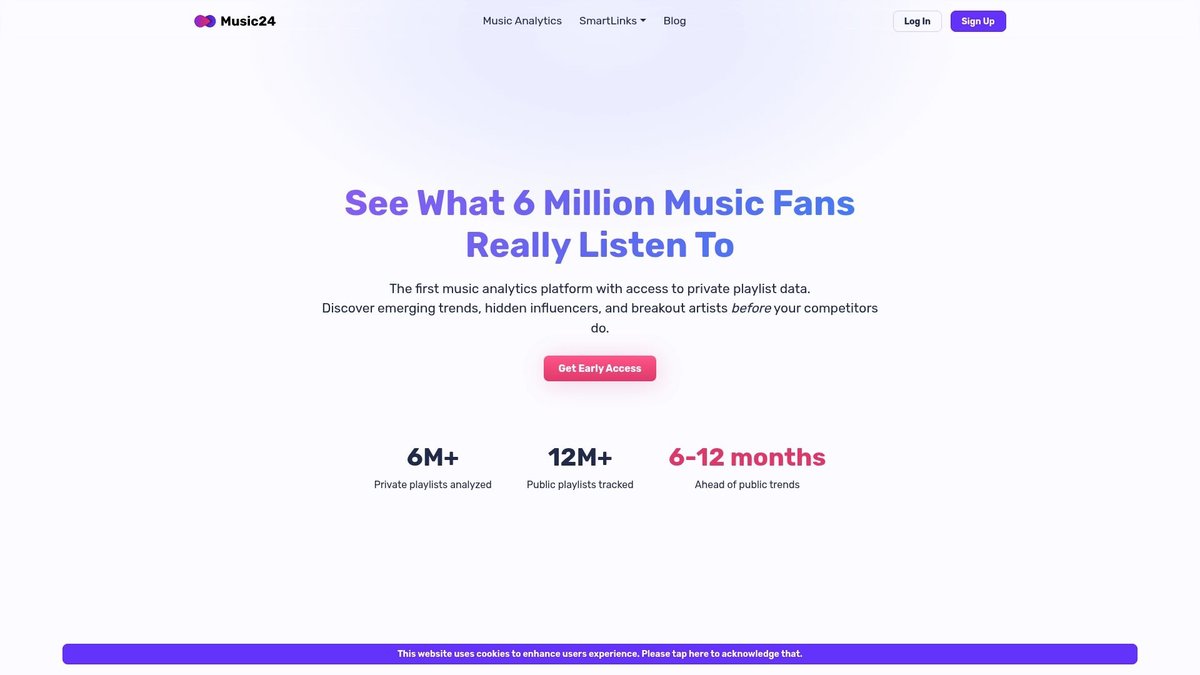
Take control of trend prediction and artist breakouts today. Visit Music24.com to explore how our platform’s proprietary insights transform raw private playlist data into actionable intelligence. Discover how you can stay ahead of streaming platforms and identify your next breakout artist before anyone else does. Start leveraging true playlist-driven discovery now by visiting Music24.com.
Frequently Asked Questions
What is playlist-driven discovery in music?
Playlist-driven discovery refers to the method of music consumption where algorithmic systems and user-curated playlists help shape artist exposure and listener experiences. It focuses on understanding how music selections propagate through playlists to identify emerging artists and trends.
How do private playlists differentiate from public playlists in trend detection?
Private playlists are highly personalized collections that capture unfiltered musical journeys, making them effective early indicators of emerging trends. In contrast, public playlists are algorithmically curated and often amplify mainstream music trends, favoring established artists.
What role do user interactions play in music trend emergence?
User interactions like replays, skips, and playlist additions create feedback mechanisms that reshape musical preferences. Streaming platforms analyze these behaviors to map underground currents that can evolve into mainstream trends.
Why are hidden tastemakers in private playlist networks important?
Hidden tastemakers within private playlist networks act as curators who introduce emerging artists to niche audiences. Their selections can significantly influence trend propagation and help lesser-known artists gain recognition before reaching mainstream platforms.

