
Every Senior A&R executive knows that the path to discovering fresh talent often lies in the listening habits fans keep private. Balancing privacy with deep insight, anonymized data now opens new doors for record labels determined to get ahead of emerging trends. By leveraging the statistical richness of private playlists without exposing individual identities, you gain a more authentic view of genuine grassroots momentum and regional taste shifts that pure streaming numbers alone often overlook.
Table of Contents
- Defining Anonymized Data in Music Analytics
- How Private Playlists Shape Industry Insights
- Key Methods for Data Anonymization
- Early Artist Discovery Through Playlist Analytics
- Addressing Privacy Risks and Legal Compliance
Key Takeaways
| Point | Details |
|---|---|
| Importance of Anonymization | Anonymized data is crucial for protecting user privacy while allowing for insightful music analytics. |
| Private Playlists as Insights | Analyzing private playlists provides deeper insights into genuine listener preferences and emerging trends. |
| Legal Compliance Necessities | Data privacy laws require robust strategies that ensure user consent and transparent data practices. |
| Advanced Data Techniques | Utilizing sophisticated anonymization methods enhances data protection while preserving analytical value. |
Defining Anonymized Data in Music Analytics
In music analytics, anonymized data represents a critical strategy for protecting individual user privacy while enabling powerful insights for industry professionals. Anonymization techniques provide a sophisticated method of stripping away personally identifiable information from massive datasets, allowing researchers and A&R executives to analyze music consumption patterns without compromising user identities.
The core principle of anonymization involves systematically removing direct identifiers and obscuring quasi-identifiers that could potentially reveal an individual's identity. These quasi-identifiers might include demographic details, precise listening histories, or unique interaction patterns. By implementing advanced data masking techniques, music analytics platforms can transform raw user data into statistically meaningful insights without risking personal information exposure.
Key characteristics of effective anonymized music data include:
- Complete removal of username and account-specific identifiers
- Statistical aggregation of listening behaviors
- Preservation of genre, mood, and trend analysis capabilities
- Robust protection against potential re-identification attempts
- Compliance with global data privacy regulations
Complex de-identification approaches have emerged to address the nuanced challenges of protecting user privacy. These methods go beyond simple name removal, employing sophisticated algorithms that mathematically transform data while maintaining its fundamental analytical value. Modern techniques like differential privacy and synthetic data generation offer increasingly sophisticated ways to protect individual users while delivering actionable insights.
Pro tip: Always validate your anonymization protocols with independent privacy experts to ensure comprehensive data protection strategies.
How Private Playlists Shape Industry Insights
Private playlists represent a goldmine of authentic musical discovery that goes far beyond traditional streaming metrics. Music consumption patterns reveal that these personal collections offer unprecedented insights into listener preferences, cultural trends, and emerging artist potential. Unlike algorithmic recommendations, private playlists capture genuine user taste, unfiltered by platform suggestions or commercial manipulation.
The strategic value of private playlists for A&R professionals lies in their ability to uncover organic music trends before they become mainstream. These curated collections reflect nuanced listener behaviors, revealing subtle genre crossovers, niche artist potential, and regional musical preferences that traditional analytics might overlook. By analyzing aggregated private playlist data, industry experts can identify:
- Emerging artists with grassroots listener momentum
- Underground genre fusion trends
- Geographic music preference variations
- Early indicators of potential breakout musicians
- Authentic listener-driven music discovery patterns
Private playlist analysis goes beyond surface-level metrics by providing a deeper understanding of music consumption. These personal collections represent a raw, unfiltered snapshot of musical taste, allowing A&R teams to track genuine listener preferences without the bias introduced by algorithmic recommendations or promotional campaigns. The granular insights derived from these playlists can help record labels, streaming platforms, and artist management teams make more informed decisions about talent development and marketing strategies.

Pro tip: Develop advanced anonymization techniques that preserve the statistical richness of private playlist data while protecting individual user privacy.
Key Methods for Data Anonymization
Data anonymization is a sophisticated process of transforming sensitive information to protect individual privacy while maintaining analytical value. Privacy-preserving techniques have evolved dramatically, addressing the complex challenges of preventing re-identification in massive music industry datasets. The goal is to strip away personally identifiable details while preserving the statistical integrity necessary for meaningful insights.
Modern anonymization approaches employ multiple sophisticated strategies to protect user data. These methods go beyond simple name removal, implementing advanced algorithmic techniques that mathematically obfuscate individual identifiers while retaining the dataset's core informational value. Each technique aims to balance privacy protection with data utility, ensuring that aggregate insights remain meaningful for A&R professionals and music industry researchers.
Key anonymization methods include:
- Data Masking: Replacing sensitive identifiers with fictional but statistically representative values
- Perturbation: Introducing controlled noise to individual data points
- Aggregation: Combining individual records into statistical summaries
- Synthetic Data Generation: Creating artificial datasets that mirror original data characteristics
- Differential Privacy: Adding mathematical guarantees against individual re-identification
The complexity of modern anonymization requires a multilayered approach. Anonymization strategies must anticipate potential linkage and inference attacks, using advanced encryption and access controls to protect individual privacy. By combining multiple techniques, music analytics platforms can create robust protection mechanisms that preserve the rich insights derived from private playlist data.
Here's a comparison of advanced anonymization techniques and their business impacts in music analytics:
| Technique | Data Protection Strength | Business Impact | Implementation Challenge |
|---|---|---|---|
| Differential Privacy | Very high; statistical guarantees | Preserves trends, supports compliance | Complex mathematical design |
| Synthetic Data | Removes real user risk | Enables new model testing | Requires realistic data modeling |
| Aggregation | Moderate; summary-level privacy | Useful for broad market insights | May sacrifice granular patterns |
| Data Masking | Obscures identifiable details | Allows secure sharing and collaboration | Needs careful value selection |
Pro tip: Implement a continuous validation process that regularly tests anonymization protocols against emerging re-identification techniques.
Early Artist Discovery Through Playlist Analytics
Playlist analytics transform the traditional artist discovery landscape, enabling A&R professionals to identify emerging talent with unprecedented precision. Music curator platforms now leverage complex data aggregation techniques to track artist momentum across multiple digital channels, revealing nuanced indicators of potential breakout success long before mainstream recognition.
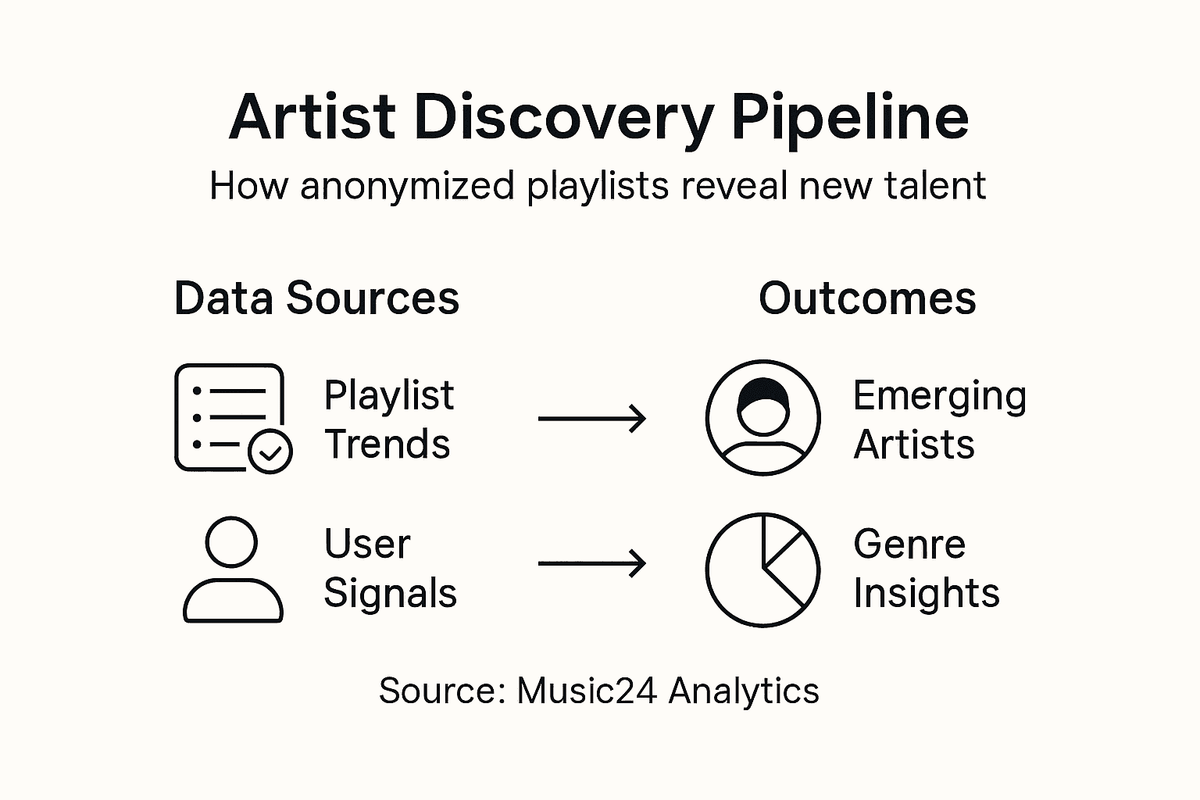
The strategic approach to early artist discovery involves analyzing multiple dynamic signals that traditional metrics often overlook. These signals extend far beyond simple streaming numbers, encompassing subtle indicators of authentic listener engagement, geographical concentration of fan interest, and organic playlist inclusion patterns. By examining these granular data points, music industry professionals can detect artists with genuine potential who are building meaningful connections with listeners.
Key indicators for early artist discovery include:
- Consistent growth in playlist inclusions
- Geographic clustering of listener engagement
- Cross-platform momentum across streaming services
- Organic fan-driven playlist additions
- Emerging genre fusion and niche audience development
- Sustained listener retention rates
- Grassroots social media and community interactions
Successful early artist discovery requires a holistic, data-driven approach that balances quantitative analysis with qualitative understanding. Modern A&R teams must develop sophisticated analytical frameworks that can distinguish between temporary viral moments and sustained artistic potential. By combining anonymized playlist data with nuanced contextual insights, music professionals can identify artists who represent genuine, long-term creative potential.
Below is a summary of how private playlist analytics contribute to early artist discovery:
| Analytical Focus | Industry Value | Typical Data Sources |
|---|---|---|
| Geographic Trends | Identifies local fan bases | Regional playlist metadata |
| Genre Crossovers | Reveals new market segments | Aggregated playlist curation |
| Listener Retention | Gauges true audience engagement | Long-term playlist activity |
| Organic Momentum | Predicts breakout artist potential | Natural playlist additions |
Pro tip: Develop a multi-dimensional scoring system that weights playlist analytics alongside additional contextual discovery metrics.
Addressing Privacy Risks and Legal Compliance
Privacy and legal compliance have become critical challenges for music analytics platforms processing sensitive user data. Global data protection regulations mandate rigorous standards for collecting, processing, and storing personal information, requiring music industry professionals to develop sophisticated approaches to data management that protect individual privacy while enabling meaningful insights.
The complex landscape of data privacy demands a multifaceted approach that goes beyond simple anonymization techniques. Music analytics platforms must implement comprehensive strategies that address consent, data minimization, purpose limitation, and transparent data usage. These approaches require constant vigilance, regular audits, and a proactive stance toward emerging privacy challenges across different jurisdictions.
Key legal compliance requirements include:
- Obtaining explicit user consent for data collection
- Implementing robust data minimization strategies
- Establishing clear purpose limitations for data usage
- Ensuring transparent data processing practices
- Developing comprehensive data protection policies
- Creating secure data storage and transmission protocols
- Maintaining detailed documentation of data handling processes
Data anonymization techniques provide critical protection mechanisms, but they are not foolproof. Advanced approaches like data masking, randomization, and synthetic data generation help reduce privacy risks while preserving the analytical value of music consumption data. However, music industry professionals must continuously evaluate and update their anonymization strategies to address evolving re-identification risks.
Pro tip: Develop a cross-functional privacy compliance team that includes legal experts, data scientists, and technology specialists to create comprehensive data protection strategies.
Unlock Early Artist Discoveries with Anonymized Playlist Analytics
The challenge of balancing user privacy with meaningful music insights is at the heart of transforming A&R discovery today. This article highlights the importance of anonymized data and private playlist analytics in uncovering authentic listener patterns and emerging artist momentum. If your goal is to access deep, unfiltered music trends while ensuring robust privacy protections, you need a reliable platform that specializes in advanced anonymization and predictive analytics.
Music24.com delivers a cutting-edge solution by leveraging millions of anonymized private playlists to reveal nuanced signals like genre crossovers, geographic micro-trends, and grassroots listener engagement. Built on proprietary access to private playlist data, Music24 empowers music professionals to identify breakout artists, anticipate industry shifts, and make data-driven decisions long before public charts catch on.
Experience the next level of music analytics that respects privacy without sacrificing insight.
Discover how Music24.com can transform your A&R strategies.
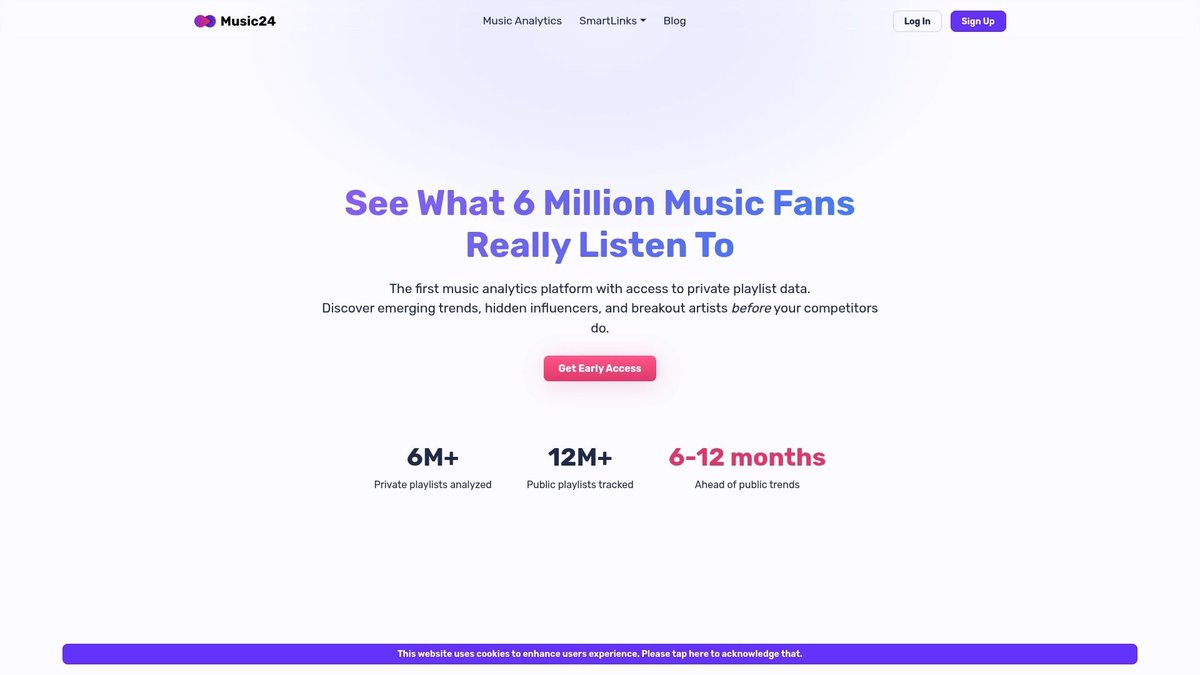
Take control of your artist discovery process now by exploring Music24's powerful analytics platform. Gain unmatched early access to authentic music trends through advanced anonymization techniques and private playlist data analysis. Visit Music24.com today and stay ahead in the evolving music industry landscape.
Frequently Asked Questions
What is anonymized data in music analytics?
Anonymized data in music analytics refers to information that has had personally identifiable details removed, allowing industry professionals to analyze music consumption patterns without compromising user privacy.
How do private playlists impact music trend analysis?
Private playlists provide unfiltered insights into listener preferences, helping A&R professionals identify emerging artists and trends without the influence of algorithmic recommendations.
What are some methods used for data anonymization in music?
Key methods for data anonymization in music include data masking, perturbation, aggregation, synthetic data generation, and differential privacy, each aimed at protecting individual privacy while retaining analytical value.
Why is legal compliance important in music analytics?
Legal compliance is crucial in music analytics as it ensures adherence to global data protection regulations, protecting individual user privacy and maintaining trust while allowing for meaningful insights.

