Top Playlist Tracking Tools 2025 – Expert Comparison
Discover the top playlist tracking tools 2025. Compare 7 essential tools to elevate your music tracking strategy and maximize your reach.
Finding the right music analytics tool can feel like chasing trends that change overnight. Some platforms promise early insight and others focus on detailed audience tracking or wide coverage across channels. Each brings its own style of data and unexpected benefits for labels, managers, marketers and artists who want to stay ahead. The real challenge is knowing which features will actually give you a head start before new sounds break through. With so many ways to measure success and spot rising talent, the differences between these tools might surprise you.
Table of Contents
Music24
At a Glance
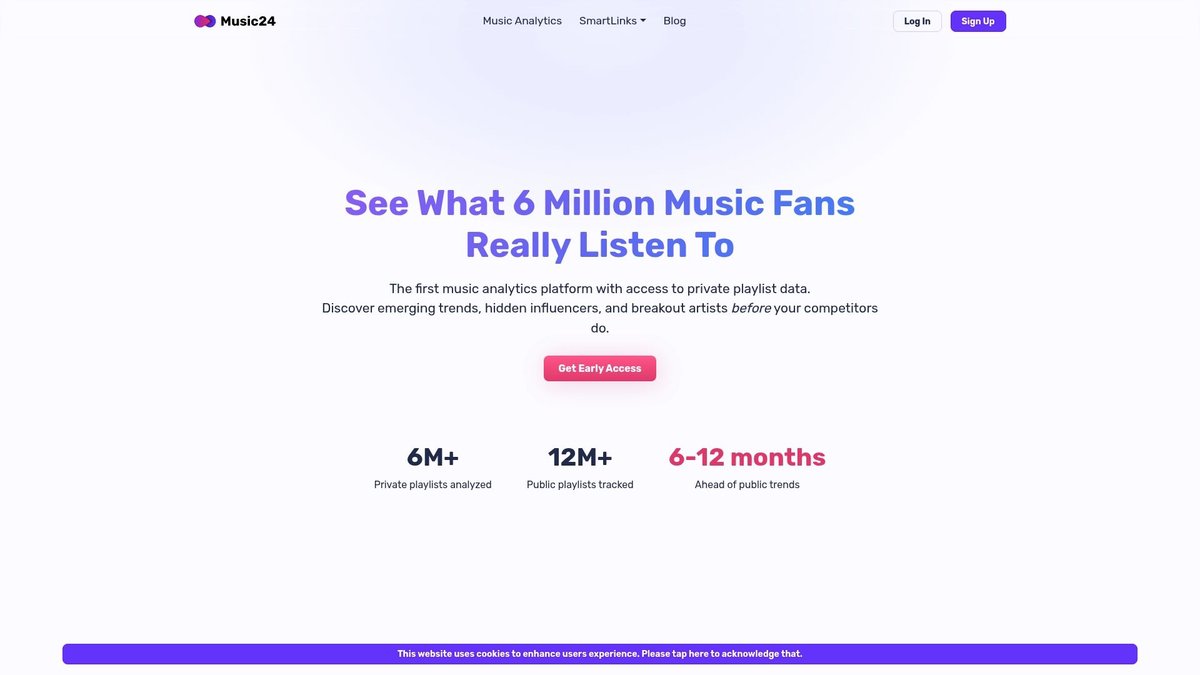
Music24 reads millions of public playlists and charts every day and shows which playlists add songs like yours, which tracks and artists are gaining playlists fastest in a genre, and the countries where that genre grows.
Core Features
Add a song and Music24 makes the posts and the videos, plans the rollout and publishes to TikTok, Instagram, YouTube, Facebook and Threads. Its analytics show your streams, your followers and every post you made in one place.
Pros
- Early artist discovery: The platform shows the tracks and artists that gain playlists fastest in a genre and a country, so labels and managers can spot what is rising before it peaks.
- Micro-trend and genre blending detection: Music24 supports identification of nuanced shifts in taste and hybrid genres, which informs smarter A&R and marketing choices.
- Practical for industry teams: Labels, managers, and marketers can identify real influencers and fanbases rather than relying on vanity social metrics.
- Risk-reduced trial options: Music24 includes a short free trial and a money-back guarantee to validate its value in your workflow.
Who It's For
Music24 is built for independent artists and for music industry professionals—A&R teams, artist managers, record labels, music marketers, PR teams, and data analysts—who want the release work done (the posts, the videos, the release plan and the posting) and public and private playlist data in the same account. If your role depends on spotting micro-trends, targeting genuine tastemakers, or measuring what a campaign did, Music24 was designed for you.
Unique Value Proposition
Music24 puts SmartLinks, pre-saves, reels and scheduled posts next to your playlist and artist data.
Pricing
Music24 has a Free plan, paid plans from $19 a month, a 7-day trial of the Pro plan with no card and a 30-day money-back guarantee on web purchases; API access is on the Label plan.
Website: https://music24.com
Chartmetric
At a Glance
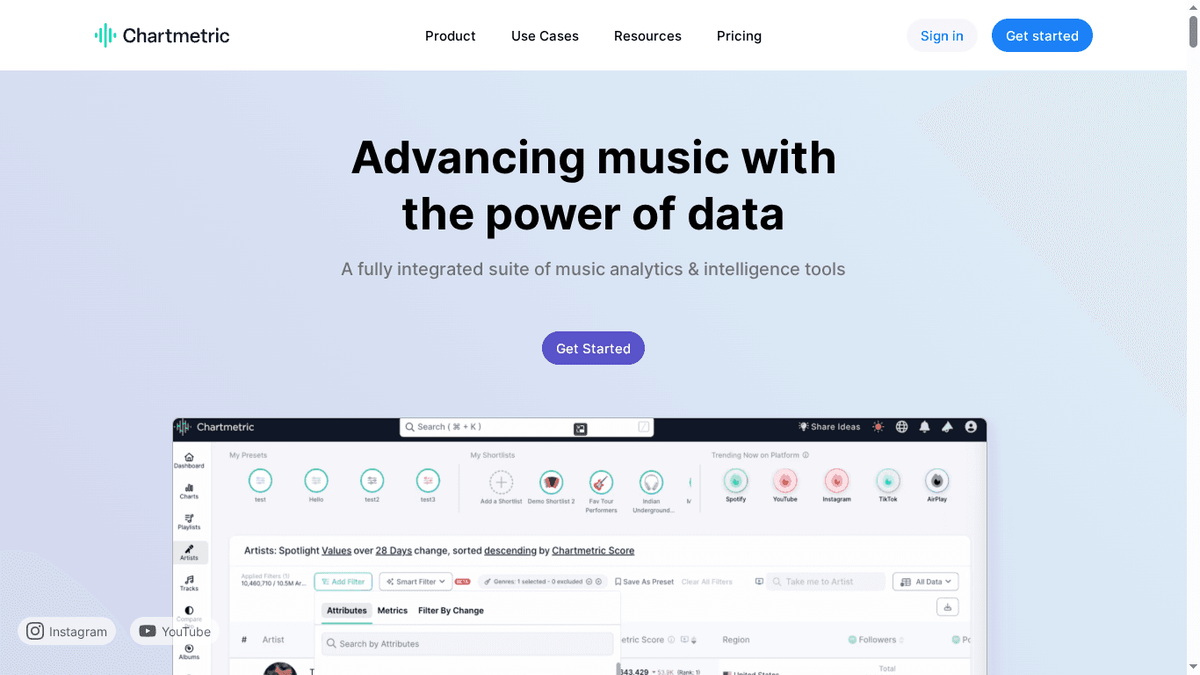
Chartmetric is a robust music analytics and intelligence platform built for industry professionals who need actionable data across streaming and social ecosystems. It processes millions of daily data points to support artist development, trend tracking, campaign optimization, and market research. If you manage artists or run A&R and marketing strategies, Chartmetric gives a comprehensive, centralized view of performance and audiences—though its depth comes with a learning curve and a price tag that may not suit every independent artist.
Core Features
Chartmetric aggregates cross-platform data to deliver artist development analytics, trend tracking, new release campaign optimization, market research, and audience demographic insights pulled from major streaming and social platforms. The platform includes advanced filters, custom dashboards, benchmarking tools, and the ability to export customized reports for stakeholders. It’s designed to convert large, disparate data sets into interpretable signals you can act on when planning releases, tours, or promotional pivots.
Pros
- Comprehensive cross-platform coverage: Chartmetric collects data from streaming and social channels, giving you a full-funnel view of performance rather than isolated metrics. This helps you spot early momentum across systems.
- Advanced filtering and custom dashboards: The platform’s filters and dashboards let you tailor views to an artist’s lifecycle stage or a campaign’s objectives, enabling focused analysis without sifting through noise.
- Early trend and artist discovery: With tools built to surface rising artists and emergent patterns, Chartmetric helps teams identify opportunities before they become mainstream.
- Detailed audience and demographic analytics: Audience insights enable targeted marketing and smarter touring decisions by showing who listens, where they live, and how they engage across platforms.
- Custom reports and benchmarking: You can generate tailored reports and benchmark performance against peer sets, which is useful for label decks, manager briefings, and A&R screening.
Cons
- Pricing may be expensive for individual artists or small teams: The listed tiers indicate a higher cost relative to many solo artist budgets, which may limit access for emerging independents.
- Data complexity requires time to learn and use effectively: The breadth of metrics and filters demands onboarding and regular use before you get reliable signal-to-noise results.
- Limited clarity on free trial specifics: The available data does not specify trial lengths or precise feature differences between tiers, making purchase decisions harder without direct vendor conversations.
Who It's For
Chartmetric is best suited for music industry professionals—artist managers, label teams, A&R, and music marketers—who prioritize data-driven decisions. If you need early trend signals, comparative benchmarking, and audience profiling to shape campaigns, releases, or signings, Chartmetric fits into your toolkit.
Unique Value Proposition
Chartmetric’s strength is its breadth: it unifies streaming and social indicators into a single analytics layer that supports discovery, campaign optimization, and competitive analysis. That consolidated perspective helps teams act faster on nascent trends and make measurable artist development choices.
Real World Use Case
A manager uses Chartmetric to monitor an artist’s streaming trajectory and social growth, compares those signals with similar acts, and times collaborations and release windows based on where momentum is generating meaningful audience conversion.
Pricing
Artist plan: $60/year or $10/month; Manager plan: $480/year or $60/month; Premium plan: $1400/year or $150/month.
Songstats
At a Glance
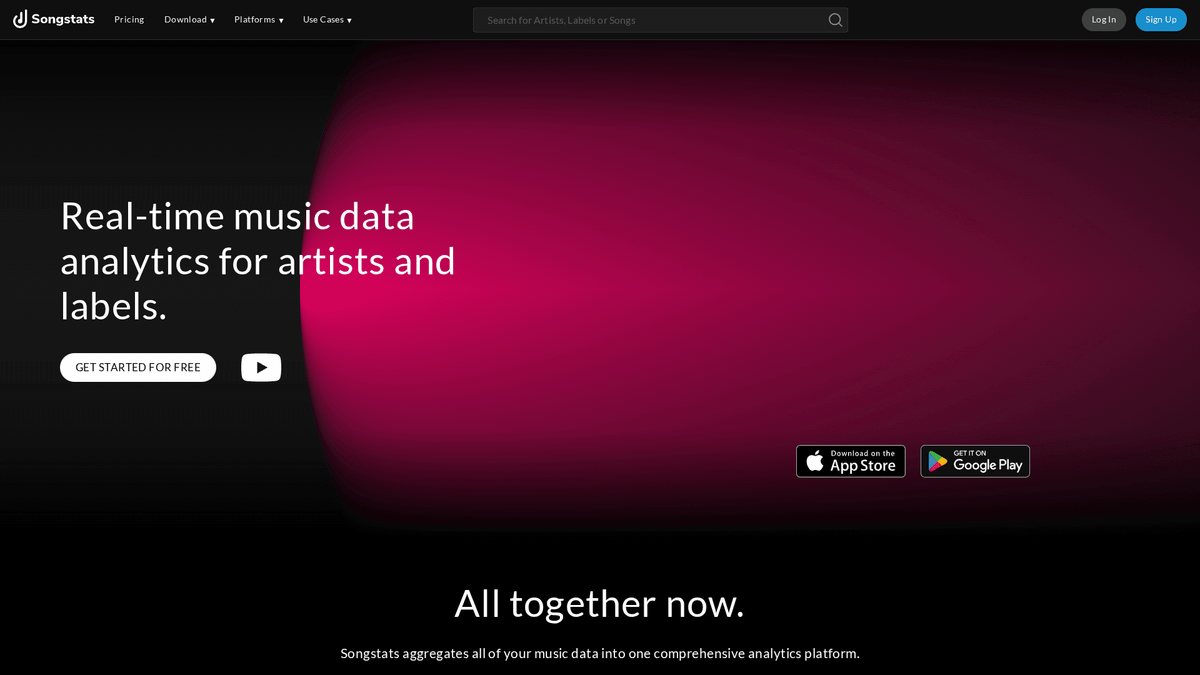
Songstats consolidates your music data into a single analytics dashboard that updates in real time, making it straightforward for artists and labels to monitor streams, playlist reach, and engagement across Spotify, Apple Music, YouTube, TikTok, and more. It’s strong on notifications and social sharing, so you’ll know about playlist adds and chart movements as they happen. That immediacy helps teams react fast, but cost and occasional technical setup needs can be a barrier for smaller operations.
Core Features
Songstats aggregates multi-platform streaming and social data into one place and delivers a live activity feed with push notifications for playlist positions, chart entries, and feature placements. It tracks streams, playlist reach, and engagement metrics, offers detailed track analytics and PDF reporting, and supports social sharing so teams can celebrate and promote milestones. Multiple-user access enables collaboration across teams managing artists or catalogs.
Pros
- Comprehensive aggregation: Songstats pulls data from multiple streaming and social platforms into one dashboard, saving you from toggling between services.
- Real-time notifications: Push alerts for playlist adds, chart changes, and placements let you respond to momentum the moment it happens.
- Team collaboration support: Multiple-user access makes it easy for labels, managers, and promoters to work from the same dataset.
- Detailed reports: PDF-ready analytics and track-level breakdowns help you create professional reports for stakeholders.
- Social integration: Built-in sharing tools let you amplify wins on social platforms without extra tooling.
Cons
- Higher pricing for smaller players: Pricing tiers may be costly for independent artists or very small labels when budget is tight.
- Free trial limitations for returning users: Although plans include free trials, users who have previously subscribed may be ineligible for a new trial.
- Technical setup required: Some integrations or advanced features may require technical setup or onboarding time before you get full value.
Who It's For
Songstats is designed for musicians, record labels, managers, publishers, and industry professionals who need consolidated, near-instant visibility across streaming platforms and social channels. If you manage multiple artists or run campaigns where timing matters, Songstats gives the situational awareness your team needs.
Unique Value Proposition
Songstats’ unique value is its real-time, cross-platform aggregation combined with notification-driven workflows. Instead of relying on delayed public charts, you get a live view of playlist placements and engagement so you can double down on promotions, coordinate PR pushes, or adjust ad spend while a track is still gaining steam.
Real World Use Case
An artist team watches a new single climb on Spotify and sees immediate playlist adds and TikTok engagement via Songstats alerts. They use those alerts to schedule targeted social posts, push a radio outreach, and compile a PDF report for the label—actions that capitalize on the window of interest before mainstream charts reflect the momentum.
Pricing
Plans listed: Artist €11.99/month, Artist + RadioStats €19.99/month, Professional €99.99/month; discounts apply for yearly subscriptions and plans include free trials (with trial restrictions for returning subscribers).
Soundcharts

At a Glance
Soundcharts is a real-time music analytics platform built for professionals who need timely, wide-ranging signals about artist performance, playlists, airplay, charts, and social activity. Its strength is comprehensive coverage — monitoring over 25,000 charts and millions of playlists — packaged into customizable dashboards that support scouting, campaign measurement, and competitive benchmarking. If you need fast, actionable insight across multiple channels, Soundcharts delivers; if you’re an emerging artist on a tight budget, the pricing and feature depth may feel heavy.
Core Features
Soundcharts consolidates airplay, playlists, chart positions, and social monitoring into a single interface with in-depth country- and song-level views. Expect global radio airplay tracking across 25,000+ charts, playlist detection across millions of collections, real-time alerts, and the ability to build custom reports and notifications. The platform also includes artist and competition tracking with dashboards designed for benchmarking and talent discovery. Those capabilities are presented as configurable widgets and reports so teams can focus on the metrics that matter to them.
Pros
- Extensive global coverage: The platform monitors over 25,000 charts and millions of playlists, giving you broad visibility into international radio and playlist trends.
- Real-time updates for fast decisions: Real-time monitoring ensures you see airplay and playlist placements as they happen, which is essential during campaign windows.
- Customizable dashboards and reports: You can tailor notifications and reporting to specific artists, territories, or songs, reducing noise and surfacing relevant signals quickly.
- Supports talent scouting and benchmarking: Built-in competition tracking and artist performance views make it practical to identify breakout acts and benchmark marketing efforts.
- Tiered plans for different needs: The product offers multiple pricing tiers that can fit individual artists up to data-heavy teams, enabling scaling as requirements grow.
Cons
- Pricing may be prohibitive for smaller acts: Entry-level plans exist, but the overall cost structure may feel steep for independent artists or very small labels.
- Feature complexity requires onboarding: The depth of functionality introduces a learning curve for new users who want to exploit advanced reporting and benchmarking.
- Limited public detail on integrations and API: The provided information does not clarify the scope of integrations or API access, which makes technical planning harder for teams that rely on automation.
Who It's For
Soundcharts is built for music industry professionals: label managers, A&R teams, artist managers, music marketers, and analytics-focused publicists who need comprehensive, real-time data across radio, playlists, charts, and social channels. It’s particularly useful for teams that monitor multiple artists and territories simultaneously and require reliable benchmarking to inform strategy.
Unique Value Proposition
Soundcharts combines broad data coverage with real-time monitoring and customizable reporting so teams can detect trends and measure campaigns before signals appear in conventional charts. That early visibility is valuable when timing promotional pushes or identifying rising talent across markets.
Real World Use Case
A record label uses Soundcharts to track global airplay and playlist placements for signed artists, compare performance versus competitors, and measure the impact of a PR campaign within days rather than weeks, enabling faster budget and playlisting decisions.
Pricing
Plans start at $10/month for individual artists, $49/month for monitoring up to 10 artists, and $129/month for unlimited data including discovery and market features.
Chartmetric
At a Glance
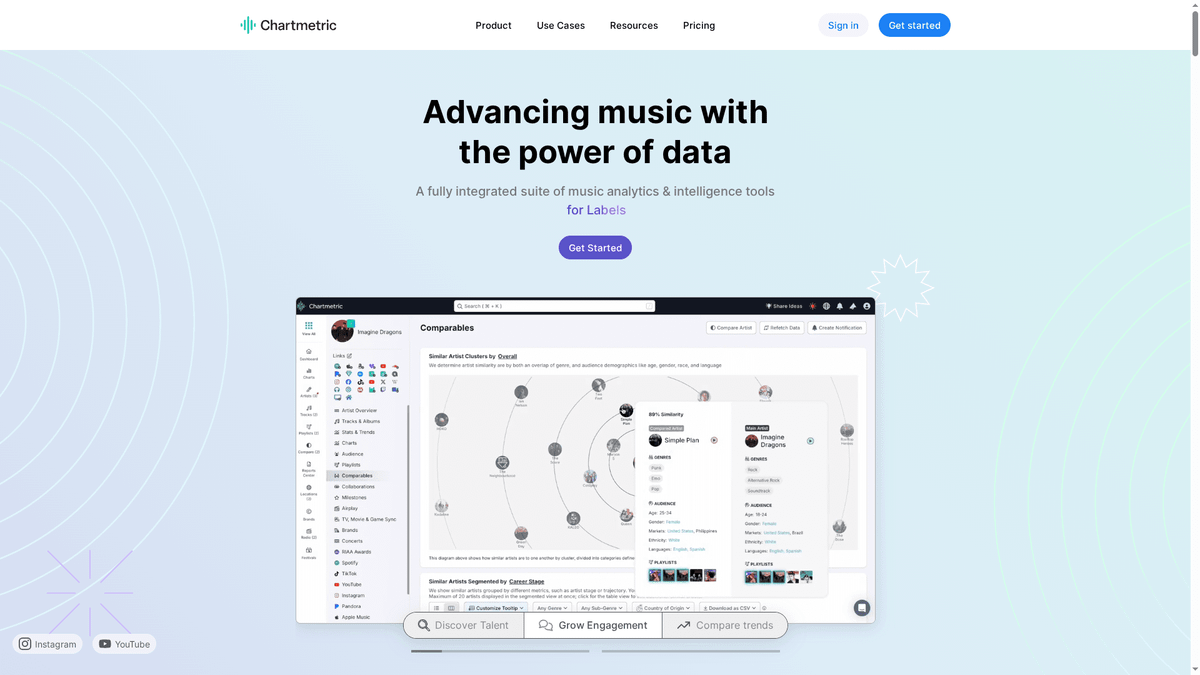
Chartmetric is a comprehensive music analytics and intelligence platform that surfaces real-time performance signals across Spotify, Apple Music, YouTube, TikTok, and more. For artist development teams and A&R professionals who need early, cross-platform insights, Chartmetric delivers broad coverage and customizable dashboards that make trend spotting and competitive analysis efficient. It can feel dense to newcomers, but the depth of data rewards investment in learning the tool.
Core Features
Chartmetric combines artist development analytics, trend identification, talent discovery and comparison, release campaign optimization, and market research into a single interface. The platform aggregates demographics and engagement metrics across major streaming and social services, enabling you to monitor growth trajectories, compare artists side-by-side, and refine release strategies. Dashboards are customizable and support advanced filters so you can slice data by platform, geography, and timeframe for targeted analysis.
Pros
- Extensive data coverage and real-time insights: Chartmetric pulls from a wide range of streaming and social platforms, giving you a near-complete picture of an artist's performance across the ecosystem.
- User-friendly interface with customizable dashboards: The visual layout makes dense datasets approachable, and dashboards can be tailored to highlight the KPIs that matter most to your team.
- Advanced filters for refined analysis: You can segment by platform, date range, and demographic signals to test hypotheses or isolate emergent trends.
- Useful for artist development and market research: The tool supports both micro-level artist growth tracking and macro-level trend analysis for playlist curation and strategy.
- Flexible plans for different roles: Subscription tiers accommodate individual artists, managers, and larger industry teams, which helps match cost to use case.
Cons
- Pricing may be high for individual artists or small teams: The paid plans are positioned for professionals, and the entry-level and manager tiers may stretch early-career budgets.
- Complexity of data might require a learning curve: New users will need time to master filters and interpret cross-platform signals effectively.
- Limited free features for full access: Trial or free access appears restricted, so full evaluation may require committing to a paid plan.
Who It's For
Chartmetric is ideal for music industry professionals—A&R teams, artist managers, label strategists, and music marketers—who rely on data to make signing, promotion, and playlisting decisions. If you need cross-platform visibility and robust segmentation to justify marketing spend or prioritize artists, Chartmetric fits the bill.
Unique Value Proposition
Chartmetric’s strength lies in unifying broad streaming and social datasets into one actionable interface. The combination of real-time signals, customizable dashboards, and advanced filtering helps you spot micro-trends, benchmark talent, and optimize release campaigns before indicators become mainstream.
Real World Use Case
A record label uses Chartmetric to monitor catalogue and new releases across platforms, identify regional pockets of growth for targeted playlist pitching, and discover emerging artists whose trajectories justify outreach or development investment.
Pricing
Artist plan: $60/year for full access to 1 artist profile. Manager plan: $480/year for up to 10 artist profiles. Premium plan: $1,400/year for full access to all features and data for over 12 million artists.
Soundcharts

At a Glance
Soundcharts is a real-time music analytics platform that consolidates airplay, playlists, charts, and social media monitoring into a single dashboard for industry professionals. It’s built for teams that need live visibility across markets and platforms to scout talent, benchmark artists, and optimize campaigns. The platform’s strength is breadth: global radio and playlist coverage plus customizable reporting provide fast, actionable intelligence. Be aware: the depth and pricing may be more than what an independent artist or tiny team needs.
Core Features
Soundcharts delivers continuous airplay monitoring across more than 25,000 charts and millions of playlists, paired with global radio airplay data and country- and song-specific analysis. The product supports notifications and automated reports for talent monitoring and offers campaign tracking in real time with customizable dashboards and report templates. In one place you can track charts, playlists, radio spins, and social signals—then slice the data by territory, song, or campaign to inform A&R and marketing decisions.
Pros
- Comprehensive, real-time industry data: The platform aggregates airplay, playlists, charts, and social monitoring so you can act on live signals instead of waiting for weekly reports.
- Customizable dashboards and reports: You can tailor views and alerts to the KPIs that matter for an artist or campaign, which speeds decision making during active rollouts.
- Global coverage across channels: With radio, playlists, and social metrics included, you get a cross-platform view that supports market-level and song-level analysis.
- Team collaboration and access controls: Multiple users and different access levels make it practical for labels, managers, and marketing teams to work from the same dataset.
- Data-driven talent and campaign insight: The platform is positioned to assist scouting, benchmarking, and campaign optimization with measurable signals.
Cons
- Pricing may be prohibitive for very small teams: The subscription tiers and feature depth can make Soundcharts expensive for lone independent artists or very small operations.
- Feature complexity can require training: The breadth of tools and custom reporting options means new users will likely need onboarding to unlock full value.
- Limited published detail on UI and support quality: The product data lists strong capabilities but offers less explicit information about user interface ease of use or the responsiveness of customer support.
Who It's For
Soundcharts is aimed at music industry professionals who require live, granular analytics: record labels, radio teams, artist managers, A&R, and marketing departments that manage multiple artists or campaigns across territories. If you need to benchmark competitors, scout by playlist and airplay signals, or monitor campaigns in real time, Soundcharts fits your workflow.
Unique Value Proposition
Soundcharts’ core selling point is real-time, cross-channel visibility—combining airplay, playlists, charts, and social data into a single, customizable workspace trusted by industry users to inform talent development and campaign strategy.
Real World Use Case
A record label uses Soundcharts to monitor radio spins and social engagement for its roster, benchmark those metrics against competitors, discover promising artists via playlist signals, and adjust promotion tactics mid-campaign based on live data.
Pricing
Plans start at $10/month for one artist, $49/month for ten artists, and $129/month for unlimited access with discovery and market features; annual billing discounts are available and include two free months.
Viberate
At a Glance
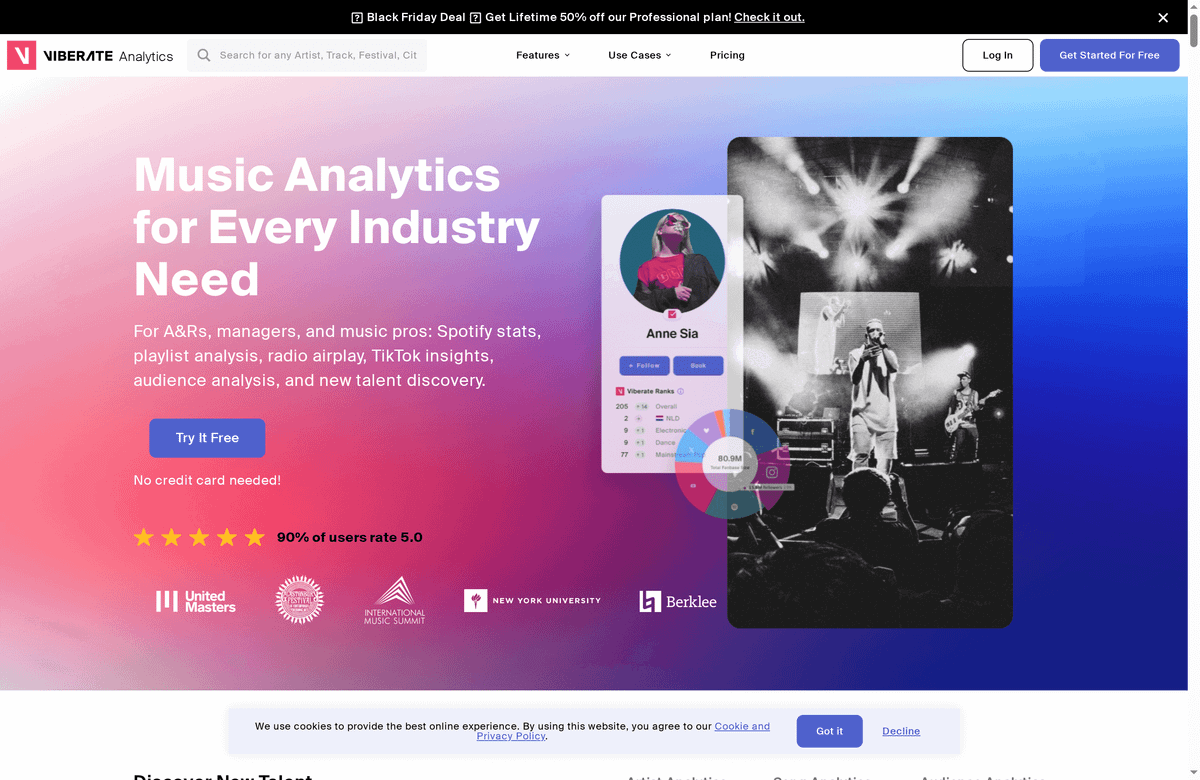
Viberate is a robust analytics suite built for music industry pros who need a single source of truth across streaming, social, playlists, and radio. It consolidates artist and song performance into visual dashboards with real-time updates, making trend spotting and benchmarking fast. The platform leans toward A&R teams, managers, labels, and promoters who want actionable, cross-channel intelligence without stitching together multiple reports.
Core Features
Viberate tracks artist performance across major channels including Spotify, TikTok, YouTube, and Instagram, and pairs that with song-level metrics such as streams, playlist activity, views, and radio spins. You get audience breakdowns by geography and demographics, A&R charts filtered by genre, market, or engagement, and playlist analytics showing reach, curator behavior, and placement details for Spotify and Apple Music. Real-time alerts surface significant performance shifts so you can act quickly.
Straight to the point.
Pros
- Broad multi-channel coverage accelerates discovery: Viberate aggregates streaming, social, and radio data so you can compare performance across channels in one view.
- Visual dashboards reduce analysis time: The interface presents complex datasets as charts and tables that managers and A&R can interpret quickly.
- Cost-effective entry point: With a starting price aimed at individual professionals, Viberate offers many features that larger teams would otherwise pay more for.
- Real-time alerts keep teams responsive: Notifications for sudden spikes or drops help you prioritize outreach, promotion, or rapid strategy shifts.
- Strong talent discovery and benchmarking tools: A&R charts and curated metrics make it easier to flag rising artists and measure them against market norms.
Cons
- Feature complexity demands onboarding: The platform’s breadth means you’ll likely need training or time to learn workflows and extract maximum value.
- Advanced collaboration can be limited to higher tiers: Multi-user access and enterprise workflows may require upgraded plans or additional configuration.
- Coverage depends on partner data availability: Gaps or delays from third-party sources can affect completeness or accuracy of certain metrics at times.
Who It's For
Viberate fits music industry professionals who need consolidated, data-driven insight: A&R scouts, artist managers, label analysts, marketing teams, and festival programmers. If your role requires rapid talent discovery, cross-platform performance tracking, or market benchmarking, Viberate is built to support those workflows.
Unique Value Proposition
Viberate’s edge is its unified cross-channel perspective: instead of siloed streaming or social reports, you get synchronized analytics and A&R-focused charts designed for talent discovery and campaign optimization. That consolidated lens speeds decision cycles and reduces reliance on manual data wrangling.
Real World Use Case
A record label uses Viberate to monitor an artist’s momentum across Spotify, TikTok, and local radio, spotting regional spikes before they hit mainstream charts. The team then reallocates promotional spend and targets playlist outreach to markets showing early engagement, boosting pickup during a single release window.
Pricing
Plans start at €19.90 per month for individual professionals, with tiered options for larger teams and custom enterprise data services available on request.
Music Analytics Tools Comparison
This table provides a comprehensive comparison of five music analytics platforms, highlighting their features, target users, and pricing options.
| Product | Key Features | Pros | Cons | Pricing Options |
|---|---|---|---|---|
| Music24 | Release kits, scheduled posting, playlist and chart data, API on the Label plan | Promotion and analytics in one account | Posts to five platforms only; API limited to the Label plan | Free plan, 7-day trial with no card, paid from $19 a month |
| Chartmetric | Cross-platform analytics, audience demographics, custom dashboards | Comprehensive coverage, advanced filtering, trend and artist discovery | Higher cost for independents, complexity requires learning, vague trial features | $60/year for artists, $480/year for managers, $1,400/year premium |
| Songstats | Real-time notifications, detailed track analytics, multi-user access | Instant alerts, team collaboration support, social integration | High cost for independents, trial limitations, technical setup may be needed | €11.99/month for artists, €19.99/month including RadioStats, discounts on yearly |
| Soundcharts | Coverage across 25,000 charts, customizable dashboards, real-time notifications | Extensive global coverage, supports competitive benchmarking, talent scouting | Pricing steep for small acts, complex features require onboarding, limited details on API | $10/month for one artist, $49/month for ten artists, $129/month unlimited |
| Viberate | Multi-channel analytics, visual dashboards, real-time alerts, A&R charts | Broad data coverage, cost-effective entry, strong talent discovery | Complexity necessitates learning, limited multi-user access on lower tiers, depends on data availability | €19.90/month for individual professionals, custom options for larger teams |
Where Music24 fits
Music24 reads millions of public playlists and charts every day. Its public data shows which playlists add songs like the ones you work with, which tracks and artists are gaining playlists fastest in a genre, and the countries where that genre grows. Follow the artists, tracks and playlists you care about and get an email when they move.
Start free with Music24: 7 days of the Pro plan, no card, then a Free plan for as long as you like.
Frequently Asked Questions
What are playlist tracking tools and why are they important?
Playlist tracking tools are software platforms that monitor the performance and reach of songs across various playlists on streaming services. They are important because they provide insights into how tracks are performing, helping artists and labels identify trends, engage audiences, and optimize marketing strategies.
How do I choose the right playlist tracking tool for my needs?
To choose the right playlist tracking tool, assess your specific needs such as data coverage, ease of use, and reporting capabilities. Compare features like real-time updates and historical data access, then select a tool that aligns with your goals, whether for A&R decisions or campaign tracking.
Can playlist tracking tools help identify emerging artists?
Yes, playlist tracking tools can help identify emerging artists by analyzing data on playlist placements and listener engagement. Leverage these tools to spot trends and flag rising talents before they hit mainstream success, enabling timely outreach or marketing efforts.
What metrics should I look for in a playlist tracking tool?
When evaluating a playlist tracking tool, look for metrics such as playlist add counts, listener demographics, track reach, and engagement rates. Prioritize tools that offer real-time updates and customizable dashboards to monitor performance effectively.
How quickly can I see results from using a playlist tracking tool?
With effective use of a playlist tracking tool, you can start seeing results within a few weeks as you monitor updates and trends. Regularly analyze the data to adjust your promotional strategies and optimize engagement based on real-time insights.
Is there a learning curve when using playlist tracking tools?
Yes, there is often a learning curve when using playlist tracking tools due to their comprehensive features and data sets. Invest time in familiarizing yourself with the interface and functionalities to maximize their value in your music strategy.
Recommended
Get your music heard. Grow the fans who stay.
Add a song. music24 makes the posts and the videos, plans your release and publishes it on every channel. Free for 7 days on the Pro plan, no card.