How to Build a Music Marketing Plan in 2026: Step-by-Step Template for Independent Artists
A music marketing plan maps out exactly how you will promote your music, grow your audience, and hit measurable goals. This step-by-step guide walks independent artists through building a complete music marketing strategy in 2026, with a free template to get started today.
A music marketing plan is a written strategy that maps out exactly how you will promote your music, grow your audience, and hit measurable goals over a set timeframe. Without one, you are guessing. With one, every dollar and hour you spend on promotion moves you closer to a specific outcome. This guide walks you through building your own music marketing plan in 2026, step by step, with a free template you can start using today.
Why Every Artist Needs a Music Marketing Plan
A music marketing plan turns scattered promotion efforts into a focused system that builds real momentum. Artists who plan their marketing consistently outperform those who post randomly and hope for the best. A plan tells you where to spend your time, how to measure what works, and when to change direction.
Most independent artists skip the planning step entirely. They release a track, share it on Instagram, maybe pitch a playlist or two, and wonder why streams stay flat. The problem is not effort. The problem is that effort without direction does not compound. A marketing plan forces you to define success before you chase it.
Here is what a solid music marketing plan gives you:
- Clarity on goals. You know exactly what you are working toward (10,000 monthly listeners, 500 email subscribers, a sold-out show) instead of a vague desire for "more fans."
- Budget control. You allocate money to channels that actually convert instead of spreading $200 across five platforms and seeing nothing from any of them.
- Consistency. A plan with deadlines keeps you posting, pitching, and engaging even when motivation dips.
- Measurable progress. You track specific numbers week over week, so you know if your strategy works or needs adjusting.
Think of your marketing plan as the GPS for your music career. You already have the fuel (your music). The plan tells you which roads to take.
Step 1: Define Your Goals and Target Audience
Your marketing plan starts with two questions: what do you want to achieve, and who are you trying to reach? Get specific on both. Vague goals like "get more fans" give you nothing to measure and no way to know if your strategy works.
Set SMART Goals
Every goal in your plan should be Specific, Measurable, Achievable, Relevant, and Time-bound. Here are examples:
| Vague Goal | SMART Goal |
|---|---|
| Get more streams | Reach 25,000 monthly Spotify listeners by September 2026 |
| Grow social media | Gain 2,000 new Instagram followers in 90 days |
| Make money from music | Generate $1,500 in merchandise sales by Q4 2026 |
| Get on playlists | Land 5 independent playlist placements within 60 days of release |
| Build an email list | Collect 1,000 email subscribers by December 2026 |
Pick two to three primary goals for the next 90 days. More than three splits your focus too thin.
Define Your Target Audience
Your music does not appeal to "everyone." The sooner you accept that, the faster you grow. Define your ideal listener by answering these questions:
- Age range: Are your fans 16 to 24, 25 to 34, or older?
- Location: Are they concentrated in specific cities, countries, or regions?
- Listening habits: Do they discover music through playlists, TikTok, radio, or live shows?
- Lifestyle and interests: What do they care about beyond music? Fashion, gaming, fitness, social justice?
- Spending behavior: Do they buy merch, attend concerts, or primarily stream?
Write a one-paragraph description of your ideal listener. Example: "My ideal listener is 20 to 28, lives in a mid-sized US city, discovers music through Spotify playlists and TikTok, cares about mental health and authenticity, and attends 3 to 5 live shows per year."
This listener profile shapes every decision in your plan, from which platforms you prioritize to the language you use in your captions.
Step 2: Audit Your Current Online Presence
Before building new strategies, take stock of what you already have. A quick audit shows you where you stand, what is working, and where the gaps are. Spend 30 minutes reviewing every platform where you have a presence.
Run through this checklist:
- Spotify/Apple Music profile: Is your bio updated? Do you have a current artist pick? Are your profile images high quality and consistent with your brand?
- Instagram: What is your posting frequency? What content gets the most engagement (reels, carousels, stories)?
- TikTok: Are you posting consistently? Which sounds or formats drive the most views?
- YouTube: Do you have a channel? Are your video descriptions optimized with keywords?
- Website: Do you have one? Does it collect email addresses? Is your music easy to find?
- Email list: How many subscribers? What is your open rate? When did you last send a message?
Score Each Platform
Rate each platform from 1 to 5:
- Not active (no profile or abandoned)
- Minimal presence (profile exists but rarely updated)
- Active but inconsistent (post sometimes, no strategy)
- Consistent and growing (regular posts, steady growth)
- Optimized and thriving (strong engagement, clear strategy, growing fast)
Platforms scoring 1 or 2 are either opportunities to claim or channels to skip entirely. Platforms at 3 are your biggest growth opportunities since the foundation exists but the strategy does not. Platforms at 4 or 5 are working and deserve continued investment.
Document your findings in a simple spreadsheet. You will reference this audit when choosing your marketing channels in the next step.
Step 3: Choose Your Marketing Channels
You cannot be everywhere at once, and you should not try. Pick two to three primary channels based on where your target audience spends time and where your audit showed the most potential. Here are the four main categories to consider.
Social Media
Social media is where most independent artists spend their marketing energy, and for good reason. It is free, it is direct, and the algorithms reward consistency. But not every platform deserves your time.
Choose based on your audience and content strengths:
- TikTok: Best for artists who can create short, engaging video content. Strong for music discovery among listeners under 30. Tracks that trend on TikTok regularly see streaming spikes within days.
- Instagram: Best for visual storytelling, behind-the-scenes content, and building a loyal community through Stories and Reels. Strong for artists with a defined aesthetic.
- YouTube: Best for long-form content like music videos, lyric videos, vlogs, and tutorials. YouTube is also a search engine, so optimized videos surface for years. See our guide to music hashtags for artists to improve your discoverability across platforms.
- Twitter/X: Best for real-time engagement, industry networking, and personality-driven content.
Pick one primary social platform and one secondary. Post on your primary platform 4 to 5 times per week. Post on your secondary 2 to 3 times per week.
Playlist Pitching
Getting your music onto playlists (both editorial and independent) remains one of the most effective ways to reach new listeners in 2026. Playlist placement puts your track in front of people who are actively looking for new music in your genre.
Two types of playlist pitching:
-
Spotify Editorial Pitching. Submit through Spotify for Artists at least 7 days before release (ideally 2 to 4 weeks). You get one submission per release. Make your pitch specific: describe the song's mood, instruments, story, and what inspired it.
-
Independent Playlist Pitching. Reach out directly to independent playlist curators who cover your genre. Find them by searching Spotify for genre-specific playlists with 1,000 to 50,000 followers. Curators in this range are more likely to respond than those running massive playlists.
Music24 reads millions of public playlists and charts every day, so you can see which playlists add songs like yours, who curates them and how fast they grow. See which curators matter most for your genre and focus your pitching where it counts.
Email Marketing
Email is the only channel you fully own. Social platforms can change their algorithms overnight. Your email list stays with you no matter what. Even a small list of 500 engaged subscribers can outperform 10,000 passive social followers when you need to sell tickets, merch, or pre-saves.
Getting started with email:
- Use a free email platform (Mailchimp, MailerLite, or ConvertKit all offer free tiers for small lists)
- Add a signup form to your website and link-in-bio
- Offer something valuable in exchange for signups: an unreleased demo, early ticket access, or a behind-the-scenes video
- Send at least one email per month. Two to four per month during release campaigns.
Paid Advertising
Paid ads accelerate your reach when organic growth is not enough. They work best when you have a clear goal, a defined audience, and content that already performs well organically.
Best platforms for music advertising:
- Meta Ads (Instagram/Facebook): Strong targeting options by age, location, interests, and behaviors. Good for driving pre-saves, streams, and merch sales. Start with $5 to $10 per day.
- TikTok Ads: Effective for reaching younger audiences. Spark Ads let you promote organic posts that are already performing well.
- YouTube Ads: Great for promoting music videos. Cost-per-view is often lower than other platforms.
- Spotify Ad Studio: Run audio ads to listeners of similar artists. Minimum budget starts at $250.
Check out our full breakdown of the best places to advertise music for platform-by-platform strategies and budget recommendations.
Start with one paid channel. Test with a small budget ($100 to $200 over two weeks), measure results, and scale what works.
Step 4: Create a Content Calendar
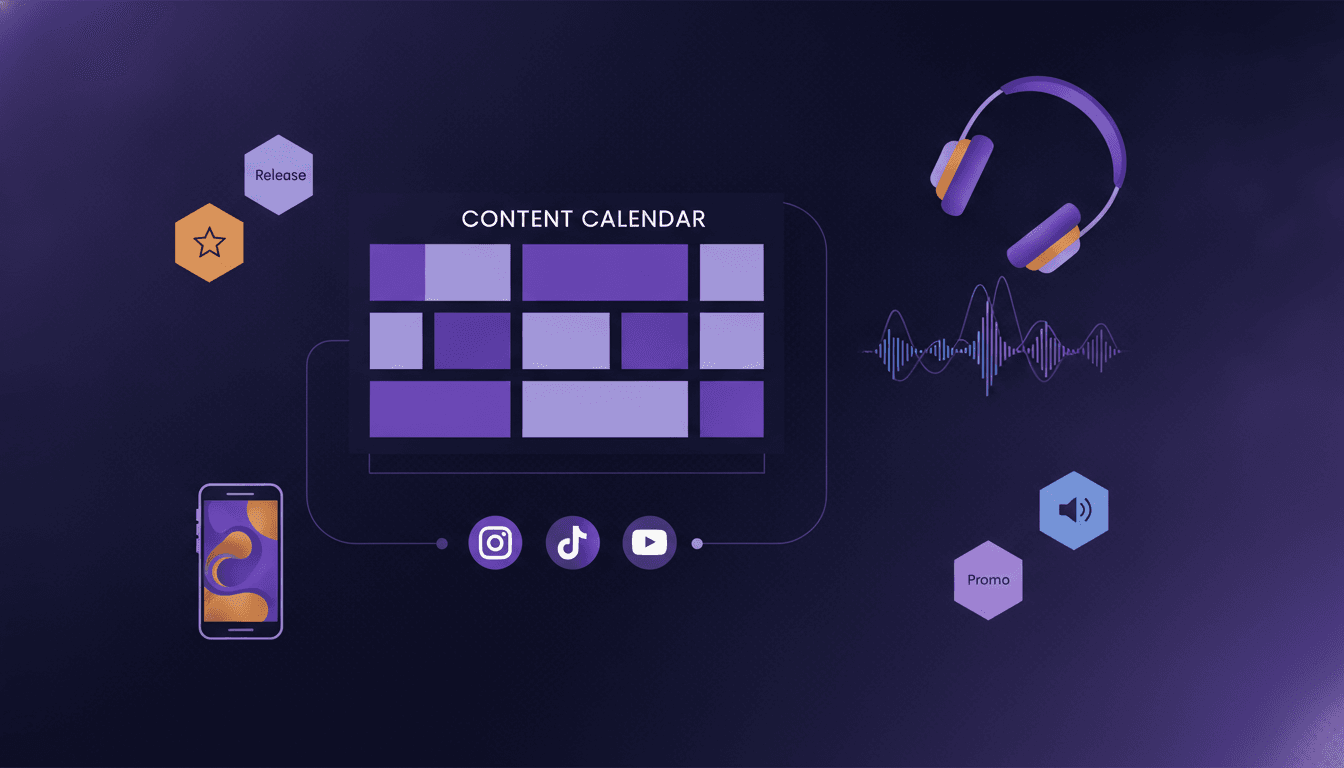
A content calendar turns your strategy into daily and weekly actions. Without one, you will default to posting only when you feel inspired, which is not often enough to build momentum. A content calendar removes the decision fatigue of "what should I post today?"
Build Your Calendar in 4 Steps
-
Map your releases and milestones. Plot your next single, EP, or album release date. Add key dates around it: announcement, pre-save link, release day, music video drop, and post-release push. Include non-music milestones like playlist pitching deadlines, show dates, and merch drops.
-
Assign content themes to each day. Example weekly structure:
- Monday: Behind-the-scenes (studio, creative process)
- Tuesday: Engage with fans (Q&A, polls, replies)
- Wednesday: Music-related content (snippet, playlist share, gear talk)
- Thursday: Personal/lifestyle (show your personality beyond music)
- Friday: New release or throwback (align with Spotify's New Music Friday cycle)
- Weekend: Repost fan content, go live, or rest
-
Batch your content creation. Set aside one day per week (or two days per month) to create content in bulk. Record 10 to 15 short videos in one session. Write captions in advance. Schedule posts using a free tool like Later, Buffer, or Meta Business Suite.
-
Leave room for spontaneity. A calendar is a guide, not a prison. Leave 20% of your posts unplanned so you can react to trends, fan moments, or unexpected opportunities.
Sample 4-Week Content Calendar
| Week | Monday | Wednesday | Friday |
|---|---|---|---|
| Week 1 | Studio teaser video | Share your current playlist | Announce upcoming single |
| Week 2 | Behind-the-scenes of cover art | Collaborate post with featured artist | Pre-save link drop |
| Week 3 | Countdown to release | Release day: music video or visualizer | Fan reaction reshares |
| Week 4 | Thank you post with stream stats | Playlist pitching results update | Live Q&A or acoustic session |
Use a spreadsheet, Google Calendar, Notion, or Trello to manage your calendar. The format matters less than actually filling it in and following through.
Step 5: Track Results and Adjust (with Music24)
A marketing plan is only useful if you measure what happens after you execute it. Tracking results tells you which channels drive real growth and which ones waste your time. Review your numbers weekly and do a deeper analysis every 30 days.
Key Metrics to Track
- Streaming numbers: Monthly listeners, streams per track, save rate, playlist adds
- Social media: Follower growth rate, engagement rate (not just likes; comments, shares, saves), video completion rate
- Email: Open rate, click-through rate, subscriber growth, unsubscribe rate
- Revenue: Merch sales, streaming royalties, show ticket sales, sync income
- Playlist performance: Number of playlist placements, listener-to-follower conversion from playlists
Where Music24 fits
Music24 is built for the work around a release. Add a song and it makes the posts and the videos, plans the rollout and publishes to TikTok, Instagram, YouTube, Facebook and Threads. Every song also gets one link page with pre-save, so fans are waiting on release day. Its analytics put your Spotify for Artists, YouTube and social numbers in one place, with each post next to the streams of the day it went out, so you can see what actually moved.
Start free with Music24: 7 days of the Pro plan, no card, then a Free plan for as long as you like.
Monthly Review Process
At the end of each month, answer these five questions:
- Which of my SMART goals am I on track to hit?
- Which marketing channel drove the most growth this month?
- Which content type got the highest engagement?
- Where did I waste time or money with little return?
- What will I do differently next month based on this data?
Adjust your plan based on the answers. Double down on what works. Cut or reduce what does not. A marketing plan is a living document, not a one-time exercise.
Music Marketing Plan Template (Comparison Table)
Use this template to organize your entire plan in one place. Fill in each section based on the steps above.
| Plan Section | What to Include | Example |
|---|---|---|
| Goals (Step 1) | 2-3 SMART goals for the next 90 days | Reach 10,000 monthly Spotify listeners by September 2026 |
| Target Audience (Step 1) | Age, location, interests, listening habits | 20-28, US cities, discovers music via playlists and TikTok |
| Current Audit (Step 2) | Platform scores (1-5) and key findings | Instagram: 3/5 (inconsistent posting). TikTok: 2/5 (barely active) |
| Primary Channels (Step 3) | 2-3 channels you will focus on | TikTok (primary), Instagram (secondary), email list |
| Content Calendar (Step 4) | Weekly posting schedule with themes | Mon: BTS, Wed: music content, Fri: release/throwback |
| Budget | Monthly spend by channel | $150/month Meta Ads, $0 TikTok (organic only), $50 email tool |
| Key Metrics (Step 5) | Numbers you track weekly | Monthly listeners, save rate, email open rate, follower growth |
| Review Schedule | When you assess and adjust | Weekly check-in (Sundays), deep review on the 1st of each month |
Copy this table into a Google Doc or Notion page and fill it in. Update it every 30 days as your strategy evolves.
Free vs Paid Marketing Channels Comparison
| Channel | Cost | Best For | Time Investment | Expected Timeline for Results |
|---|---|---|---|---|
| TikTok (organic) | Free | Discovery, viral moments | 5-7 hrs/week | 1-3 months |
| Instagram (organic) | Free | Community building, visual branding | 4-6 hrs/week | 2-4 months |
| Email marketing | Free to $30/month | Direct fan relationships, sales | 2-3 hrs/week | 1-2 months |
| Playlist pitching | Free (DIY) | Streaming growth, new listeners | 3-5 hrs/week | 1-6 months |
| Meta Ads | $150-$500/month | Targeted reach, pre-saves, merch | 2-3 hrs/week | 2-4 weeks |
| YouTube Ads | $100-$300/month | Video views, channel growth | 2-3 hrs/week | 2-4 weeks |
| Spotify Ad Studio | $250+ minimum | Reaching similar-artist listeners | 1-2 hrs/week | 2-4 weeks |
FAQ
How much does it cost to market your music independently?
You can start marketing your music for free using organic social media, DIY playlist pitching, and free email tools. Most independent artists spend $100 to $500 per month on paid promotion once they find channels that work. The key is testing small before scaling. Start with $0 and add paid channels only after you have proven organic traction on at least one platform.
How often should I update my music marketing plan?
Review your plan weekly with a quick 15-minute check on your key metrics. Do a deeper review and update every 30 days. Major updates happen around new releases or when a channel clearly stops performing. Your plan should evolve every month as you learn what works for your audience.
What is the best social media platform for music promotion in 2026?
TikTok remains the strongest platform for music discovery in 2026, especially for artists targeting listeners under 30. Instagram is best for community building and visual storytelling. YouTube is best for long-term searchable content. The "best" platform depends on your audience and content strengths. Pick one primary platform rather than spreading yourself thin across all of them.
How do I know if my music marketing plan is working?
Compare your current metrics to your baseline (the numbers from your audit in Step 2) and your SMART goals. If your monthly listeners, engagement rates, and email subscribers are trending upward and you are on track to hit your 90-day goals, your plan is working. If numbers are flat after 30 days of consistent effort, revisit your channel selection and content strategy.
Should I hire a music marketing agency or do it myself?
Start by doing it yourself. You learn faster, you spend less, and you understand your audience better through direct interaction. Consider hiring help once you have consistent revenue from music ($1,000+ per month), a proven channel that needs scaling, or specific skill gaps (like video editing or ad management) that slow you down. Agencies typically charge $500 to $3,000 per month, so make sure the ROI justifies the cost.
How far in advance should I start promoting a new release?
Start your pre-release campaign 4 to 6 weeks before the drop. This gives you time to build anticipation, pitch playlists (Spotify editorial pitching requires at least 7 days, ideally 2 to 4 weeks), run a pre-save campaign, and schedule content across your channels. The release day is not the starting line; it is the halfway point of your campaign.
Can I use the same marketing plan for every release?
Use the same framework but customize the details for each release. Your goals, target audience, and primary channels likely stay the same, but your content calendar, playlist pitch list, and ad creative should reflect the specific track or project. A high-energy dance single and an acoustic ballad need different promotional approaches even if they come from the same artist.
Releasing music soon? Start free with Music24: 7 days of the Pro plan, no card, then a Free plan for as long as you like.
Get your music heard. Skip the content grind.
Add a song. Music24 makes the posts and the videos, plans your release and publishes it on every channel. Free for 7 days on the Pro plan, no card.